Back to People & Entities





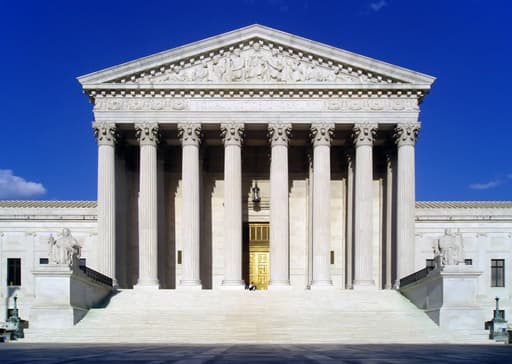

the United States Supreme Court
Organization
85
Total Mentions
81
Documents
1,273
Connected Entities
U.S. Supreme Court
The United States Supreme Court appears in the Epstein documents primarily in legal and procedural contexts, including references to Crime Victims' Rights Act litigation, David Boies' Supreme Court experience in Bush v. Gore, and legal precedents cited in Epstein-related court filings.
The Supreme Court is referenced mainly in three contexts: (1) legal arguments citing Supreme Court precedents regarding Fifth Amendment rights, search warrants, and victims' rights in Epstein case filings; (2) mentions of David Boies' credentials, specifically his representation of Al Gore in Bush v. Gore before the Supreme Court, in documents discussing Boies' involvement in Epstein litigation; and (3) discussions of the Crime Victims' Rights Act and potential Supreme Court review of whether prosecutors violated victims' rights when they secretly negotiated Epstein's 2007 non-prosecution agreement. The Court itself was not directly involved in Epstein's criminal cases during his lifetime, though victims later petitioned for Supreme Court review of CVRA violations.
Key Highlights
- •Multiple court filings cite Supreme Court precedents on Fifth Amendment privileges and search warrant standards (e.g., United States v. Nixon, Franks v. Delaware) in arguing legal points in Epstein-related cases
- •David Boies' Supreme Court experience in Bush v. Gore is referenced to establish his credentials as counsel in Epstein victim litigation
- •Discussions of Crime Victims' Rights Act violations reference potential Supreme Court jurisdiction over whether prosecutors illegally concealed Epstein's 2007 plea deal from victims
- •The Supreme Court later declined to hear Courtney Wild's appeal regarding CVRA violations (2021) and rejected Ghislaine Maxwell's appeal of her criminal conviction (2025)
Frequently Asked Questions

Document Mentions (20 of 81)
EFTA00233329.pdf
2 mentionsEFTA00233329_sub_002 - EFTA00233329_200
tatute in effect at the time of the alleged criminal conduct applies. As explained by the Landgraf court, supra at 280, and at 1505,9 9 In Landaraf the United States Supreme Court affirmed the judgment of the Court of Appeals and refused to apply new provisions of the Civil Rights Act of 1991 to conduct occurring before the e
te, Defendant's position as to the meaning of the statute would prevail. See United States'. Santos 128 S.Ct. 2020, 2025 (2008). As summarized by the United States Supreme Court in Santos supra, at 2025: 3 See argument in sections (2) and (3) that follow which represent the predicate for the rule of lenity issue discussed
EFTA00728154.pdf
2 mentionsEFTA00728154
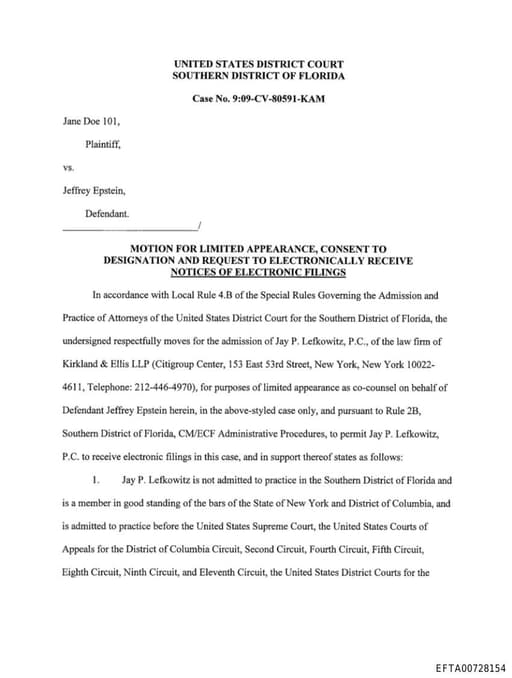
f Florida; and (2) I am a member in good standing of the bars of the State of New York and District of Columbia, and am admitted to practice before the United States Supreme Court, the United States Courts of Appeals for the District of Columbia Circuit, Second Circuit, Fourth Circuit, Fifth Circuit, Eighth Circuit, Ninth Cir
trict of Florida and is a member in good standing of the bars of the State of New York and District of Columbia, and is admitted to practice before the United States Supreme Court, the United States Courts of Appeals for the District of Columbia Circuit, Second Circuit, Fourth Circuit, Fifth Circuit, Eighth Circuit, Ninth Cir
EFTA00728148.pdf
2 mentionsEFTA00728148
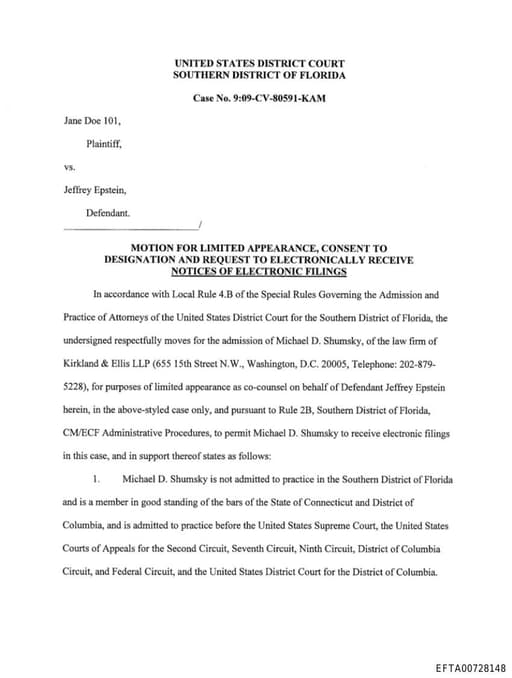
ct of Florida and is a member in good standing of the bars of the State of Connecticut and District of Columbia, and is admitted to practice before the United States Supreme Court, the United States Courts of Appeals for the Second Circuit, Seventh Circuit, Ninth Circuit, District of Columbia Circuit, and Federal Circuit, and
lorida; and (2) I am a member in good standing of the bars of the State of Connecticut and District of Columbia, and am admitted to practice before the United States Supreme Court, the United States Courts of Appeals for the Second Circuit, Seventh Circuit, Ninth Circuit, District of Columbia Circuit, and Federal Circuit, and
Sponsored
EFTA00692956.pdf
2 mentionsEFTA00692956
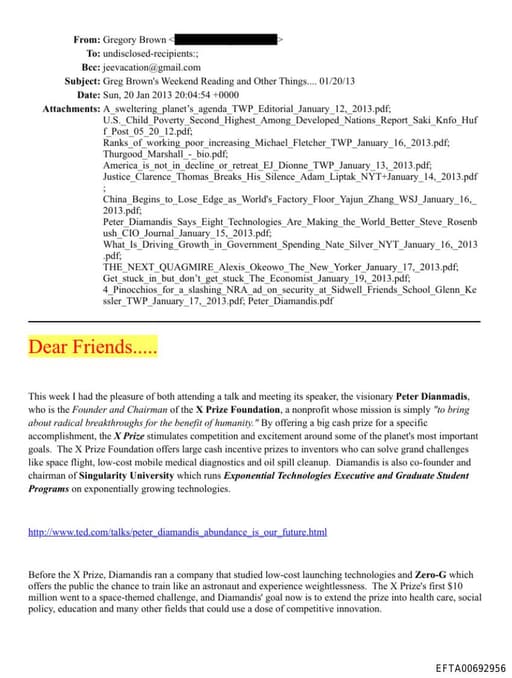
known for his high success rate in arguing before the Supreme Court and for the victory in Brown v. Board of Education. He argued more cases before the United States Supreme Court than anyone else in history. He served on the United States Court of Appeals for the Second Circuit after being appointed by President John F. Kenne
n F. Kennedy and then served aS the Solicitor General after being appointed by President Lyndon Johnson in 1965. President Johnson nominated him to the United States Supreme Court in 1967. EFTA00692958 Of the three leading black figures of the civil rights ,movement in the last century were Martin Luther King, Malcolm X and
1 mention
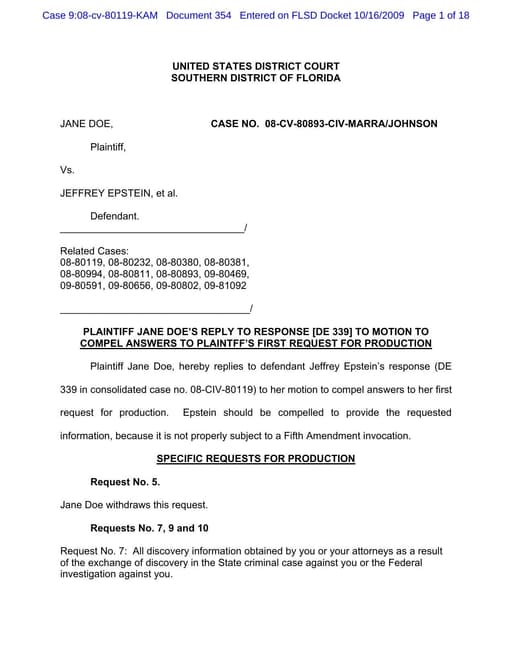
ld support a criminal conviction, but even if "the responses would merely 'provide a lead or clue' to evidence having a tendency to incriminate."). The United States Supreme Court has made clear that the scope of the Fifth Amendment Privilege also encompasses the circumstance where "the act of producing documents in response
1 mention
in the development of other incriminating evidence that can be used at trial. Id; Pillsbury Company v. Conboy, 495 U.S. 248, 103 S.Ct. 608 (1983). The United States Supreme Court has made clear that the scope of the Fifth Amendment Privilege includes the circumstances as here "the act of producing documents in response to a
Sponsored
ARTICLE: Treating Crime Victims Fairly: Integrating Victims into the Federal Rules of Criminal Procedure
1 mentionHOUSE_OVERSIGHT_017635 - HOUSE_OVERSIGHT_017713
Feb 28, 2019Source: House Oversight Committee
interests of the victim. 774 Having seen the Advisory Committee proposal and accompanying note, I am concerned that the limits on subpoenas found in the United States Supreme Court's decision in United States v. Nixon 734 might be vitiated by a broad rule. To ensure courts consistently apply Nixon's substantive and procedural stan
Page: HOUSE_OVERSIGHT_017665 →1 mention
designed to guarantee." Hoffman, 341 U.S. at 479. The United States Supreme Court has made clear that the scope of the Fifth Amend
1 mention
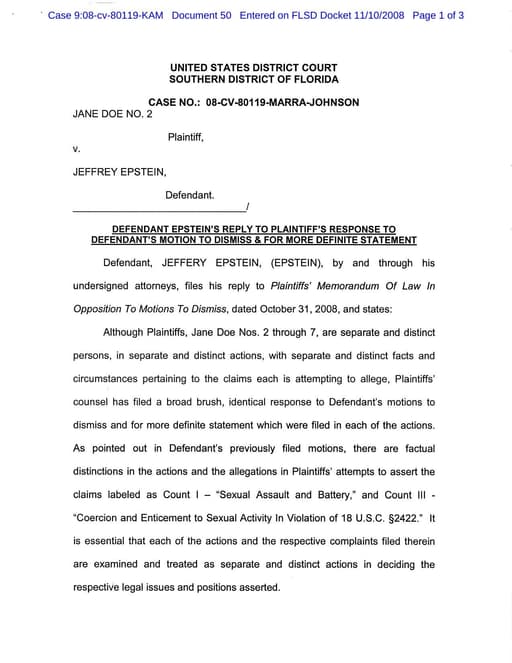
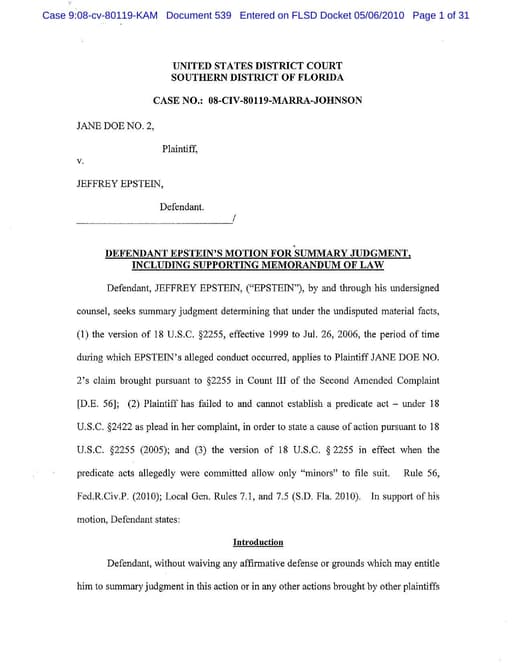
"Sexual Assault and Battery" and in Count Ill pursuant to 18 U.S.C.§2422, and Defendant has not "misconstrued" the pleading standard formulated by the United States Supreme Court in Bell Atlantic Corp. v. Twombly, 127 S.Ct. 1955 (2007). In discussing Twombly, the Eleventh Circuit in Watts v. Fla. International Univ., 495 F.3
Sponsored
1 mention
e others third-party privacy rights. As noted by the United States Supreme Court in Eisenstadt v. Baird, 405 U.S. 438, 454, 92 S.C
1 mention
significantly narrower that other requests that the United States Supreme Court and other courts have upheld. See, e.g., Fisher
1 mention
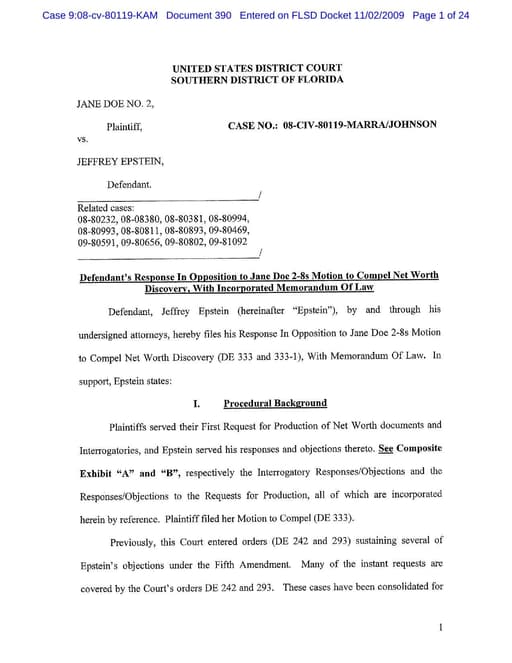
tered on FLSD Docket 11/02/2009 Page 10 of 24 4 The United States Supreme Court has expressly encompassed the innocent citizen as
Sponsored
1 mention
ein to walk a thin line with regard to "surrender[ing] the very protection which the privilege is designed to guarantee." Hoffman, 341 U.S. at 479. The United States Supreme Court has made clear that the scope of the Fifth Amendment Privilege also encompasses the 10 Case 9:08-cv-80119-KAM Document 391 Entered on FLSD D
1 mention
essional background above herein. 5 In Landgraf, the United States Supreme Court affirmed the judgment of the Court of Appeals an
1 mention
ce had been served. Additionally, any defendant had a statutory right of appeal against sentence to a federal court of appeals and, though rare, to the United States Supreme Court. He could also seek review of the sentencing by the trial judge within one year of the sentence being passed. 132. The Department of Justice's let
Page: EFTA00031774 →Sponsored
1 mention
n and freeze them so that they may be preserved to satisfy a potential judgment." Id. at 1527. The court went on to cite an oft- quoted passage from the United States Supreme Court in De Beers Consol. Mines, Ltd. v. United States, 325 U.S. 212, 221 (1945): To sustain the challenged order would create a precedent of sweeping e
1 mention
78), the search warrant affidavit in this case reveals knowing and reckless falsehoods and omitted material information. This is precisely the type the United States Supreme Court sought to guard against. The age of the alleged victims, and of Mr. Epstein's intent in that regard, is an element of the crimes that must be prove
Page: EFTA00013795 →1 mention
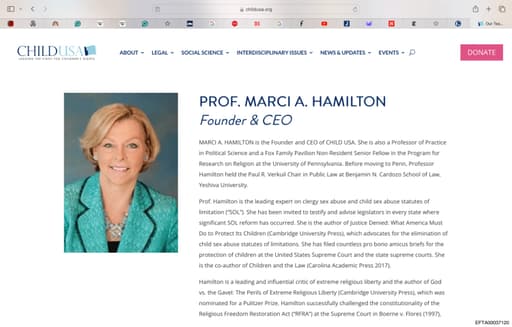
es for the elimination of child sex abuse statutes of limitations. She has filed countless pro bono amicus briefs for the protection of children at the United States Supreme Court and the state supreme courts. She is the co-author of Children and the Law (Carolina Academic Press 2017). Hamilton is a leading and influential cr
Page: EFTA00037120 →Sponsored
EFTA00090721.pdf
1 mentionEFTA00090721
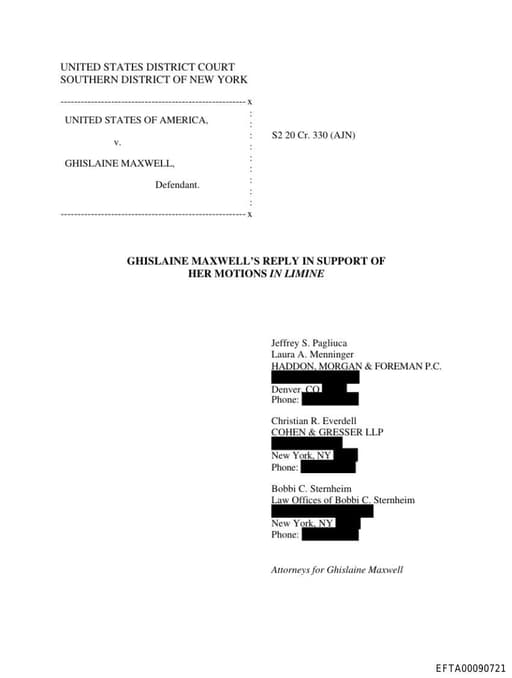
s no place in a criminal jury trial, because it will "radically simplify" an otherwise complex case, Burns, 2009 WL 3617448, at *5, and it will, as the United States Supreme Court has cautioned, prejudicially mislead the jury, Daubert v. Merrell Dow Pharnts., Inc., 509 U.S. 579, 595 (1993) ("Expert evidence can be both powerf
1 mention
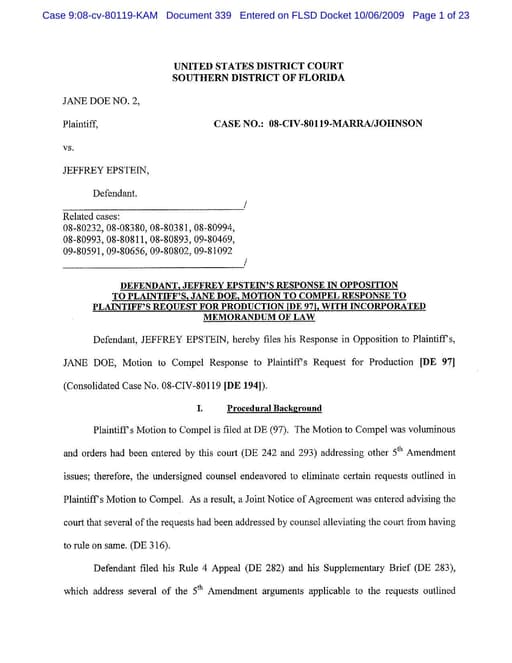
"civil" in nature, under the analysis provided by the United States Supreme Court in Landgraf v. USI Film Products, 511 U.S. 244,
Sponsored
Connected Entities(20 of 1,273)
Jeffrey Epstein
PersonAmerican sex offender and financier (1953–2019)
65 docs65 co-mentions
JD
Jane Doe
PersonPseudonym for anonymous victims/witnesses in Epstein legal proceedings
46 docs46 co-mentions
United States
LocationCountry located primarily in North America
44 docs44 co-mentions
Bradley Edwards
PersonAmerican attorney who represented Epstein victims, author of Relentless Pursuit
38 docs38 co-mentions
George W. Bush
PersonPresident of the United States from 2001 to 2009
36 docs36 co-mentions
JG
Jack Goldberger
PersonAmerican criminal defense attorney who represented Jeffrey Epstein, partner at Goldberger Weiss P.A. in West Palm Beach, Florida
35 docs35 co-mentions
Kenneth Marra
PersonAmerican judge
29 docs29 co-mentions
SR
Scott Rothstein
PersonAmerican criminal
24 docs24 co-mentions
Alan Dershowitz
PersonAmerican lawyer, author, and art collector (born 1938)
24 docs24 co-mentions
the Southern District
LocationFederal judicial district in New York City
24 docs24 co-mentions
MP
Michael J. Pike
PersonPerson referenced in Epstein-related documents
23 docs23 co-mentions
Atterbury Goldberger & Weiss
OrganizationLaw firm based in Florida
23 docs23 co-mentions
Paul Cassell
PersonUnited States federal judge
21 docs21 co-mentions
Ghislaine Maxwell
PersonBritish socialite and sex trafficker, daughter of Robert Maxwell, accomplice of Jeffrey Epstein
21 docs21 co-mentions
Julie K. Brown
PersonAmerican journalist
20 docs20 co-mentions
Prince Andrew
PersonThird child of Queen Elizabeth II and Prince Philip, Duke of Edinburgh (born 1960)
20 docs20 co-mentions
Supreme Court
OrganizationHighest court of jurisdiction in the US
19 docs19 co-mentions
JS
Jack Scarola
PersonAmerican attorney who represented Jeffrey Epstein victims, partner at Searcy Denney Scarola Barnhart & Shipley
19 docs19 co-mentions
Scarlett Johansson
PersonAmerican actress (born 1984)
19 docs19 co-mentions
LB
Leon Black
PersonAmerican billionaire businessman (born 1951)
18 docs18 co-mentions