Back to People & Entities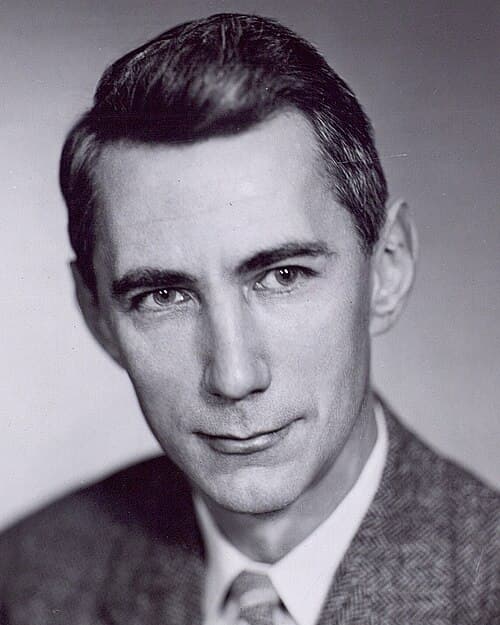





Claude Shannon
Person
14
Total Mentions
14
Documents
1,761
Connected Entities
American mathematician and information theorist (1916–2001)
Document Mentions (14)
WWW Conf Program.pdf
1 mentionHOUSE_OVERSIGHT_017526 - HOUSE_OVERSIGHT_017573
Sep 5, 2012Source: House Oversight Committee
this design. In 1988, continuing this research, Hillis received a PhD in EECS from MIT under doctoral advisers Gerald Jay Sussman, Marvin Minsky and Claude Shannon. Hillis co-founded Thinking Machines Corporation in 1983 while doing his doctoral work at MIT. The company was to develop Hillis’ Connection Machine
Page: HOUSE_OVERSIGHT_017542 →EFTA00315128.pdf
1 mentionEFTA00315128
his design. In 1988, continuing this research, Hillis received a PhD in EECS from MIT under doctoral advisers Gerald Jay Sussman, Marvin Minsky and Claude Shannon. Hillis co-founded Thinking Machines Corporation in 1983 while doing his doctoral work at MIT. The company was to develop Hillis' Connection Machi
EFTA01735494.pdf
1 mentionEFTA01735494
's 1936 paper, "On computable numbers, with an application to the Entcheidungproblem." This paper was a key inspira- tion towards the future work of Claude Shannon creating modern cryptographt via his collaboration with Alan Turing at Bletchlcy Park during WWII. (see: http://en.wikipedia.org/wiki/Claude_Shann
Sponsored
EFTA02417369.pdf
1 mentionEFTA02417369
's 1936 paper, "On computable numbers, with an application to the Entcheidungproblem." This paper was a key inspira- tion towards the future work of Claude Shannon creating modern cryptographt via his collaboration with Alan Turing at Bletchlcy Park during WWII. (see: http://en.wikipedia.org/wiki/Claude_Shann
AreTheAndroids_James Tagg_small_p2.pdf
1 mentionHOUSE_OVERSIGHT_015675_sub_001 - HOUSE_OVERSIGHT_015774
Source: House Oversight Committee
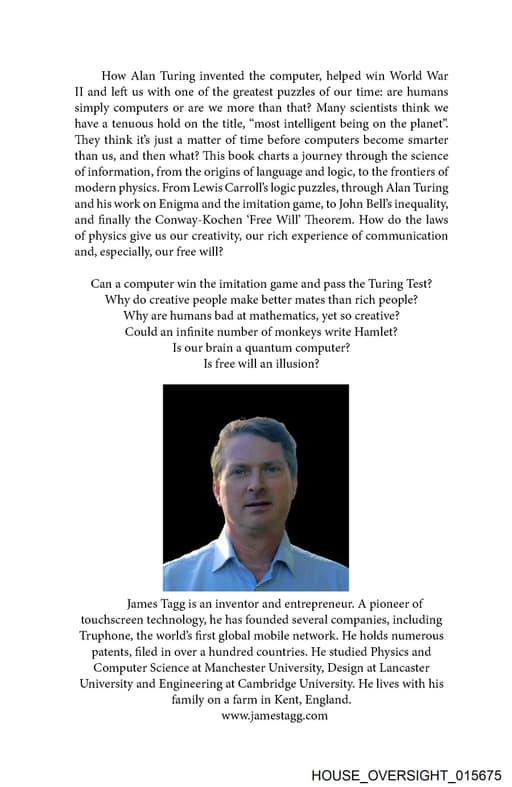
MIND OVER COMPUTER Computer versus Human “I visualize a time when we will be to robots what dogs are to humans, and I'm rooting for the machines.” Claude Shannon “The question of whether computers can think is just like the question of whether submarines can swim.” Edgar Dijkstra HOUSE_OVERSIGHT_015693 Kas
AreTheAndroids_James Tagg_small_p2.pdf
1 mentionHOUSE_OVERSIGHT_015675_sub_003 - HOUSE_OVERSIGHT_015974
Source: House Oversight Committee
t. Because each key is only used once you can't use any sort of statistical method to work out the message, making the one-time pad perfectly secure. Claude Shannon proved this in 1945 while working for Bell Corporation but, due to wartime secrecy, his proof was not published until 1948. HOUSE_OVERSIGHT_015906
Sponsored
AreTheAndroids_James Tagg_small_p2.pdf
1 mentionHOUSE_OVERSIGHT_015675_sub_004 - HOUSE_OVERSIGHT_016074
Source: House Oversight Committee
tted is useless as it is, in effect, encrypted using a one-time pad. The only person in possession of a copy of this one-time pad is me: the sender. Claude Shannon proved a one-time pad is unbreakable during the Second World War. Yet the British succeeded in breaking it. How was this possible? The fatal weaknes
EFTA00625129.pdf
1 mentionEFTA00625129_sub_002 - EFTA00625129_200
rapidly diminishing explanatory returns from increasingly explicit microfoundations. [Wright 2009] And a shorter one from Von Neumann, reported by Claude Shannon: "My greatest concern was what to call it. I thought of calling it 'information', but the word was overly used, so I decided to call it 'uncertaint
Nearness.pdf
1 mentionHOUSE_OVERSIGHT_013501_sub_002 - HOUSE_OVERSIGHT_013700
Source: House Oversight Committee
atrices are numerous and frequently appear in matrix algebra texts under the rubric of the Frobenius-Perron theorems. Using the entropy formalism of Claude Shannon as developed previously, Hy is computed as the sum across either of the identical rows of each probability times its logarithm, px /og(p.p2x/og(p2))
Sponsored
1 mention
But at the center it is dense, still, even quiet with the silently cranking algorithms of massively concentrated power. The computer science pioneer Claude Shannon saw information in 1949 as wild, uncertain, and pulsing with the instability of an entropic system. Yang. The machine architect Norbert Weiner, writi
Brockman_DeepThinking.MS.pdf
1 mentionHOUSE_OVERSIGHT_016804_sub_001 - HOUSE_OVERSIGHT_016903
Source: House Oversight Committee
series of dinners—an ongoing seminar about media, communications, art, music, and philosophy that focused on Cage’s interest in the ideas of Wiener, Claude Shannon, and Marshall McLuhan, all of whom had currency in the New York art circles in which I was then moving. In particular, Cage had picked up on McLuhan’
Brockman_DeepThinking.MS.pdf
1 mentionHOUSE_OVERSIGHT_016804_sub_002 - HOUSE_OVERSIGHT_016995
Source: House Oversight Committee
arguments in Zhe Human Use of Human Beings seem closer to the 19th century than the 21st. In particular, although Wiener made reference throughout to Claude Shannon’s then-new work on information theory, he seems not to have fully embraced Shannon’s notion of information as consisting of irreducible, meaning-free
Sponsored
Brockman_DeepThinking.MS.pdf
1 mentionHOUSE_OVERSIGHT_016221_sub_001 - HOUSE_OVERSIGHT_016320
Source: House Oversight Committee
series of dinners—an ongoing seminar about media, communications, art, music, and philosophy that focused on Cage’s interest in the ideas of Wiener, Claude Shannon, and Marshall McLuhan, all of whom had currency in the New York art circles in which I was then moving. In particular, Cage had picked up on McLuhan’
Brockman_DeepThinking.MS.pdf
1 mentionHOUSE_OVERSIGHT_016221_sub_002 - HOUSE_OVERSIGHT_016412
Source: House Oversight Committee
arguments in Zhe Human Use of Human Beings seem closer to the 19th century than the 21st. In particular, although Wiener made reference throughout to Claude Shannon’s then-new work on information theory, he seems not to have fully embraced Shannon’s notion of information as consisting of irreducible, meaning-free
Sponsored
Connected Entities(20 of 1,761)
Stephen Hawking
PersonBritish theoretical physicist, cosmologist and author (1942–2018)
13 docs13 co-mentions
LB
Leon Black
PersonAmerican billionaire businessman (born 1951)
12 docs12 co-mentions
George W. Bush
PersonPresident of the United States from 2001 to 2009
11 docs11 co-mentions
Marc Rich
PersonAmerican commodities trader (1934–2013)
11 docs11 co-mentions
Samantha Power
PersonIrish-American academic, author and diplomat
11 docs11 co-mentions
Turing
PersonEnglish computer scientist (1912–1954)
11 docs11 co-mentions
DB
Doug Band
PersonAmerican presidential advisor
10 docs10 co-mentions
Prince Andrew
PersonThird child of Queen Elizabeth II and Prince Philip, Duke of Edinburgh (born 1960)
10 docs10 co-mentions
William Shakespeare
PersonEnglish playwright and poet (1564–1616)
10 docs10 co-mentions
Alan Dershowitz
PersonAmerican lawyer, author, and art collector (born 1938)
10 docs10 co-mentions
Quantum
OrganizationQuantum Fund or entity referenced in documents
10 docs10 co-mentions
Harvey Weinstein
PersonAmerican film producer and sex offender (born 1952)
9 docs9 co-mentions
Eric Trump
PersonAmerican businessman and reality television personality (born 1984)
9 docs9 co-mentions
Prince Charles
PersonKing of the United Kingdom and other Commonwealth realms since 2022 (born 1948)
9 docs9 co-mentions
David Hume
PersonScottish philosopher, economist, and historian (1711-1776)
8 docs8 co-mentions
Feynman
PersonSurname reference in Epstein-related documents
8 docs8 co-mentions
Alan Turing
PersonEnglish computer scientist (1912–1954)
8 docs8 co-mentions
Bill Gates
PersonAmerican businessman, investor, and philanthropist (born 1955)
8 docs8 co-mentions
Earth
LocationThird planet from the Sun in the Solar System
8 docs8 co-mentions
Vietnam
LocationCountry in Southeast Asia
7 docs7 co-mentions