Back to People & Entities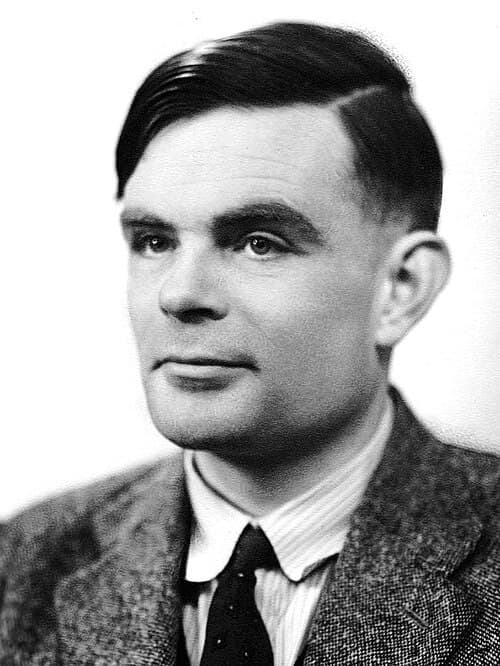









Alan Turing
Person
34
Total Mentions
34
Documents
1,535
Connected Entities
English computer scientist (1912–1954)
Alan Turing is referenced in multiple government oversight documents related to computing, cryptography, and artificial intelligence history. The mentions are contextual and academic, highlighting his foundational work rather than any direct personal involvement in the Epstein case.
The 10 mentions of Alan Turing appear across 7 government oversight documents, primarily in discussions of his pioneering contributions to computer science and cryptography. These references describe Turing's development of the Halting Problem proof, his 1950 paper 'Computing Machinery and Intelligence' that foresaw AI development, his work building rudimentary computers to decipher Enigma-encoded German messages during World War II, and his concept of a 'universal device.' All citations are academic in nature, with no evidence of personal correspondence, flight logs, or direct involvement in Epstein-related activities.
Key Highlights
- •Turing's work on the Halting Problem and non-computable proofs is cited as an example of advanced mathematical concepts
- •His 1950 paper in the journal Mind is recognized as pioneering work that anticipated artificial intelligence development
- •Mentions reference his critical role in building computers to break German Enigma codes during WWII
- •His concept of a 'universal device' is noted as an early vision of modern computing technology
Frequently Asked Questions
Related Links
Books for Further Reading
Document Mentions (20 of 34)
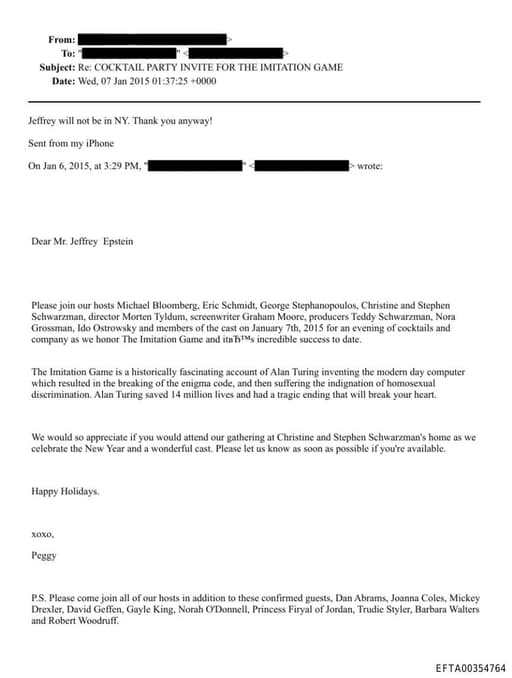
EFTA00354764.pdf
1 mentionEFTA00354764
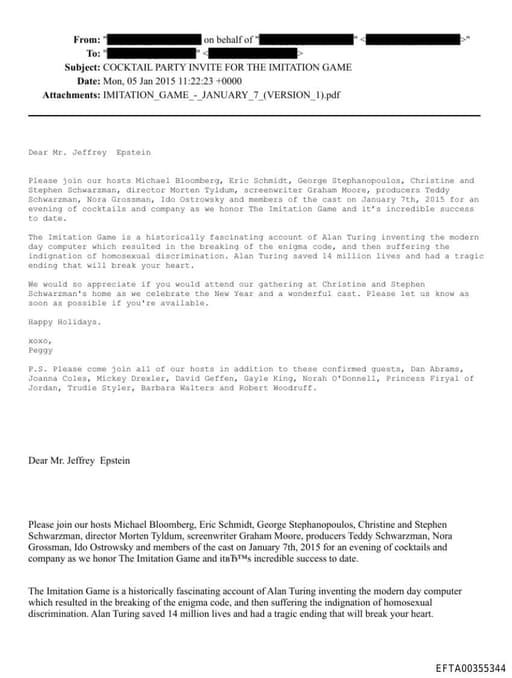
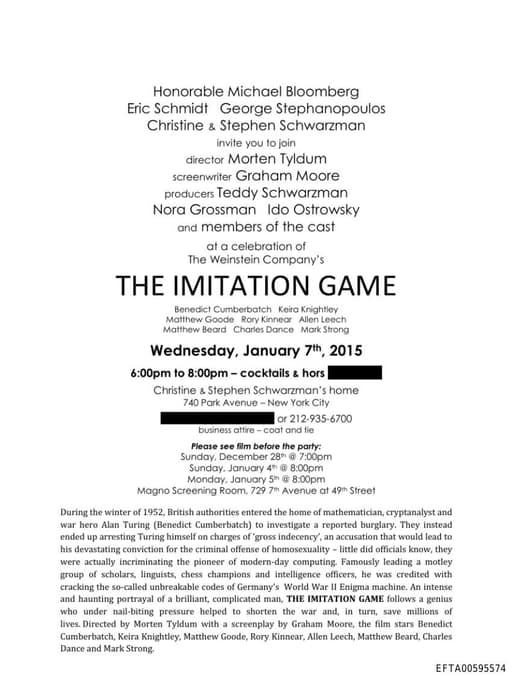
tails and company as we honor The Imitation Game and itiams incredible success to date. The Imitation Game is a historically fascinating account of Alan Turing inventing the modem day computer which resulted in the breaking of the enigma code, and then suffering the indignation of homosexual discrimination
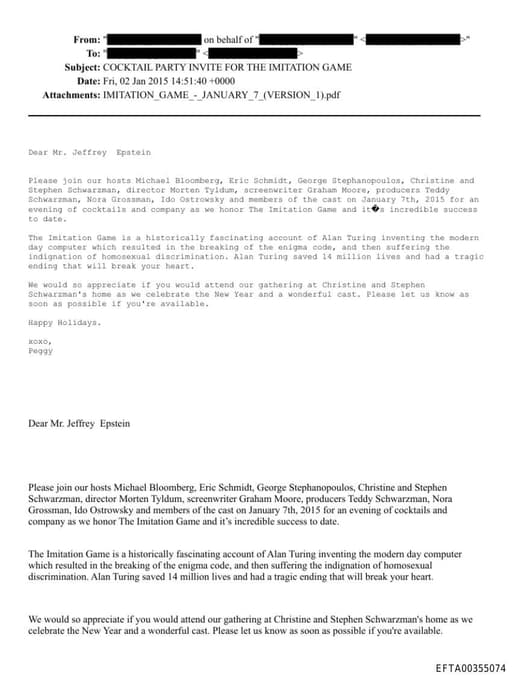
EFTA00355074.pdf
1 mentionEFTA00355074
cktails and company as we honor The Imitation Game and itOs incredible success to date. The Imitation Game is a historically fascinating account of Alan Turing inventing the modern day computer which resulted in the breaking of the enigma code, and then suffering the indignation of homosexual discriminatio
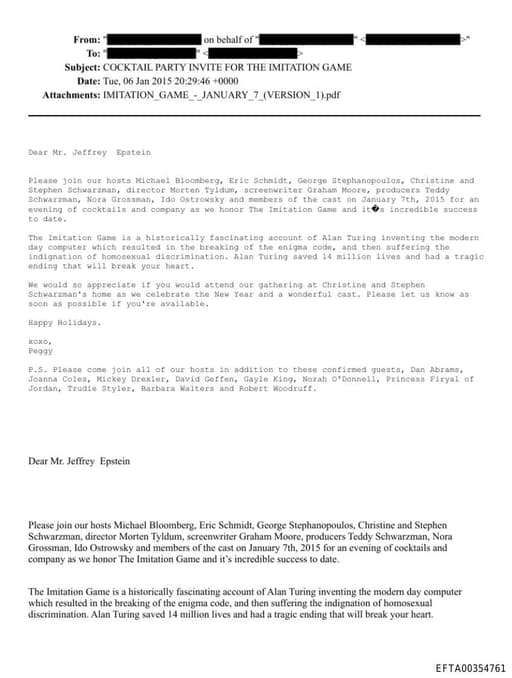
EFTA00354761.pdf
1 mentionEFTA00354761
cktails and company as we honor The Imitation Game and itOs incredible success to date. The Imitation Game is a historically fascinating account of Alan Turing inventing the modern day computer which resulted in the breaking of the enigma code, and then suffering the indignation of homosexual discriminatio
Sponsored
EFTA00355344.pdf
1 mentionEFTA00355344
cktails and company as we honor The Imitation Game and it's incredible success to date. The Imitation Game is a historically fascinating account of Alan Turing inventing the modern day computer which resulted in the breaking of the enigma code, and then suffering the indignation of homosexual discriminatio
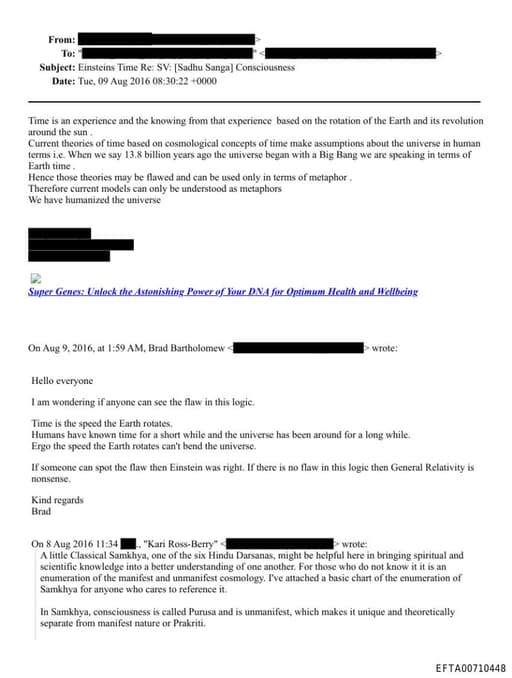
EFTA00710448.pdf
1 mentionEFTA00710448
e way Seth Lloyd explains it: "Gadd showed that the capacity for self-reference leads automatically to paradoxes in logic; the British mathematician Alan Turing showed that self- reference leads to uncomputability in computers? When a computer processes data the data contains instructions to the computer as
EFTA00740586.pdf
1 mentionEFTA00740586
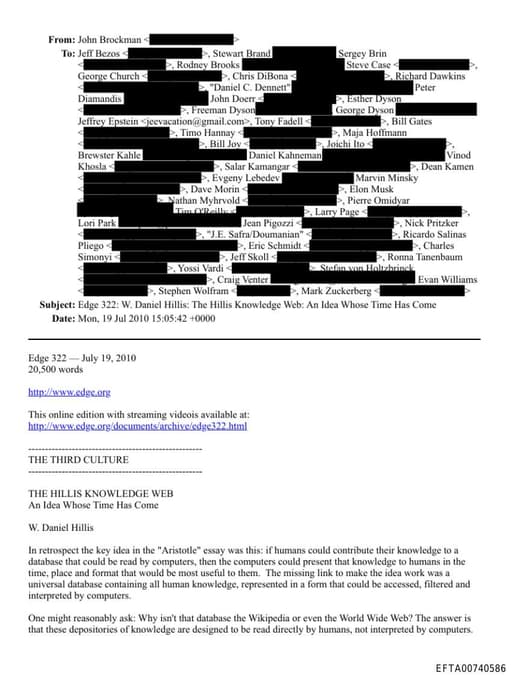
one of my hosts after my talk. "We are scanning them to be read by an AI." "When I returned to highway 101, I found myself recollecting the words of Alan Turing, in his seminal paper Computing Machinery and Intelligence, a founding document in the quest for true Al. "In attempting to construct such machines
Sponsored
EFTA00740603.pdf
1 mentionEFTA00740603
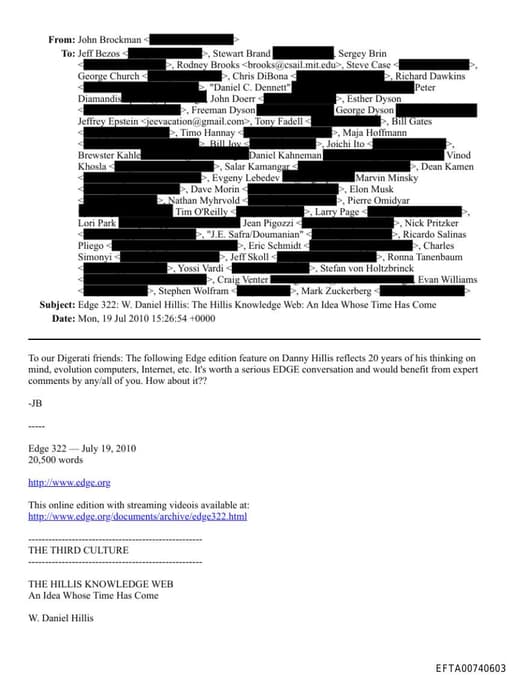
one of my hosts after my talk. "We are scanning them to be read by an AI." "When I returned to highway 101, I found myself recollecting the words of Alan Turing, in his seminal paper Computing Machinery and Intelligence, a founding document in the quest for true AI. "In attempting to construct such machines
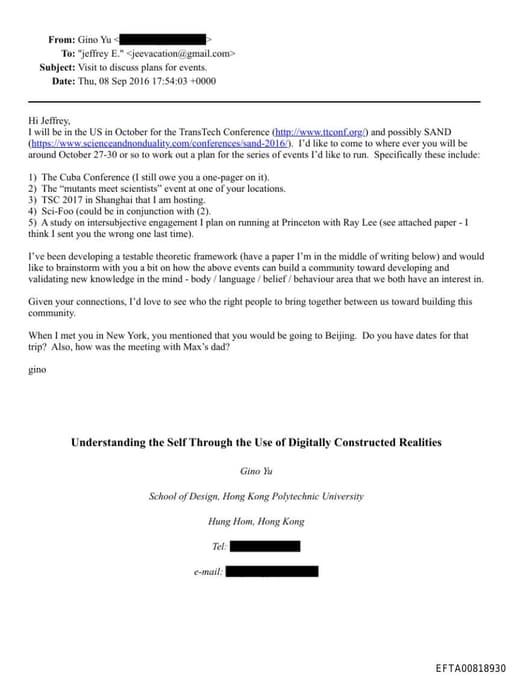
EFTA00818930.pdf
1 mentionEFTA00818930
ities of most humans (ALPHAGO, DEEPBLUE). These recent feats have rekindled discussions of computer based human-like intelligence first proposed by Alan Turing (TURING TEST), the notion of artificial consciousness (Buttazzo, 2001) and the possibility of "uploading" one's mind to a computer substrate (MIND U
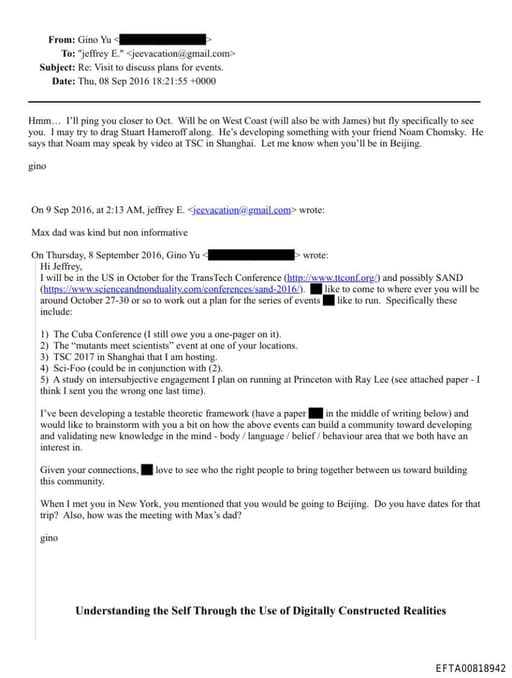
EFTA00818942.pdf
1 mentionEFTA00818942
lities of most humans (ALPHAGO, DEEPBLUE). These recent feats have rekindled discussions of computer based human-like intelligence first proposed by Alan Turing (TURING TEST), the notion of artificial consciousness (Buttazzo, 2001) and the possibility of "uploading" one's mind to a computer substrate (MIND
Sponsored
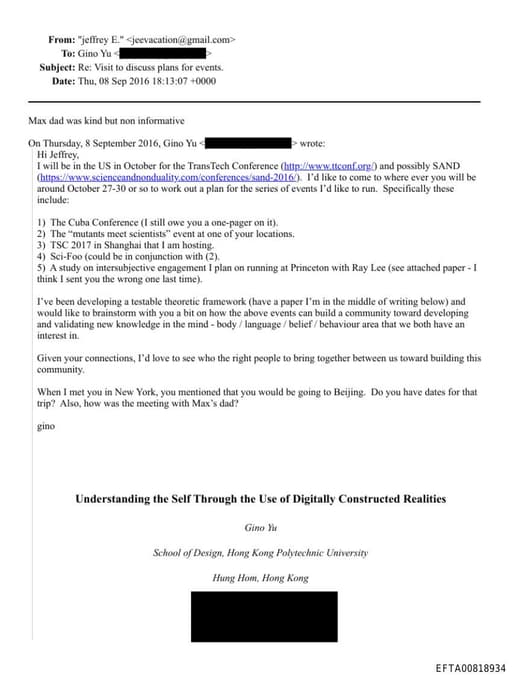
EFTA00818934.pdf
1 mentionEFTA00818934
lities of most humans (ALPHAGO, DEEPBLUE). These recent feats have rekindled discussions of computer based human-like intelligence first proposed by Alan Turing (TURING TEST), the notion of artificial consciousness (Buttazzo, 2001) and the possibility of "uploading" one's mind to a computer substrate (MIND
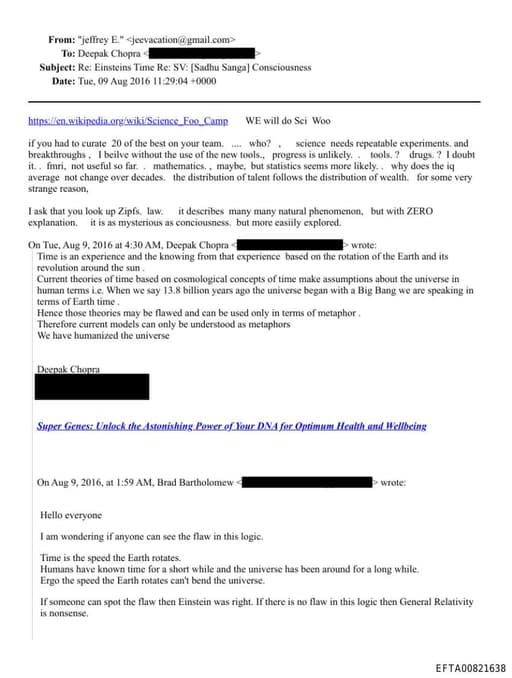
EFTA00821638.pdf
1 mentionEFTA00821638
way Seth Lloyd explains it: "Cedel showed that the capacity for self-reference leads automatically to paradoxes in logic; the British mathematician Alan Turing showed that self-reference leads to uncomputability in computers." When a computer processes data the data contains instructions to the computer a
EFTA00821616.pdf
1 mentionEFTA00821616
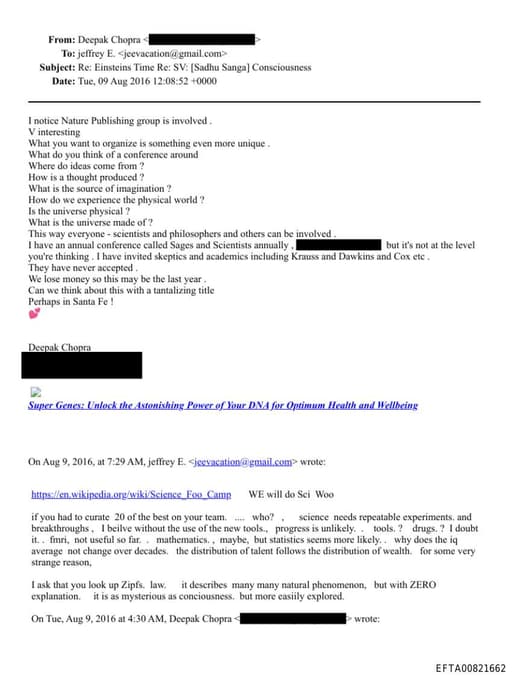
way Seth Lloyd explains it: "Cadet showed that the capacity for self-reference leads automatically to paradoxes in logic; the British mathematician Alan Turing showed that self-reference leads to uncomputability in computers." When a computer processes data the data contains instructions to the computer a
Sponsored
EFTA00821662.pdf
1 mentionEFTA00821662
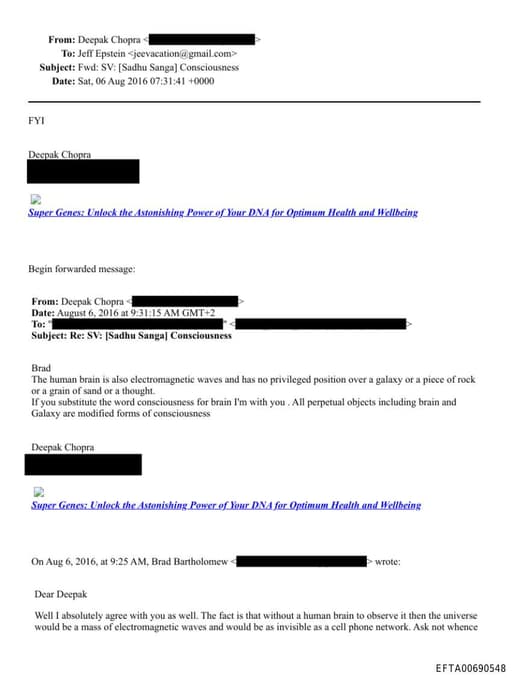
way Seth Lloyd explains it: 'Code' showed that the capacity for self-reference leads automatically to paradoxes in logic; the British mathematician Alan Turing showed that self-reference leads to uncomputability in computers." When a computer processes data the data contains instructions to the computer a
EFTA00822671.pdf
1 mentionEFTA00822671
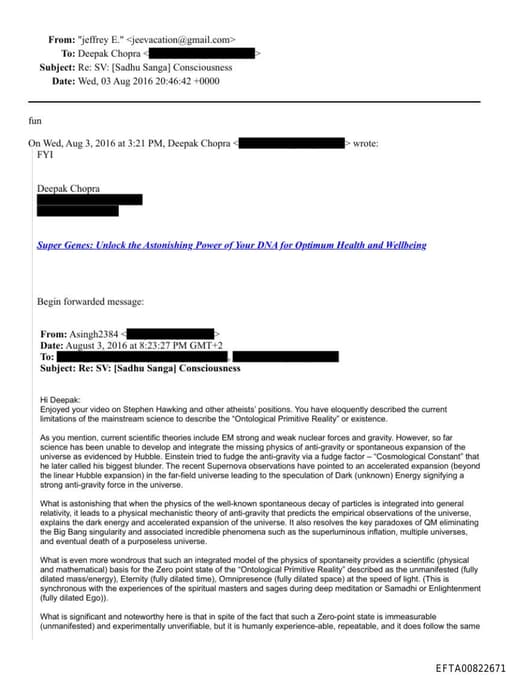
way Seth Lloyd explains it: "Code' showed that the capacity for self-reference leads automatically to paradoxes in logic; the British mathematician Alan Turing showed that self-reference leads to uncomputability in computers." When a computer processes data the data contains instructions to the computer as
EFTA00690548.pdf
1 mentionEFTA00690548
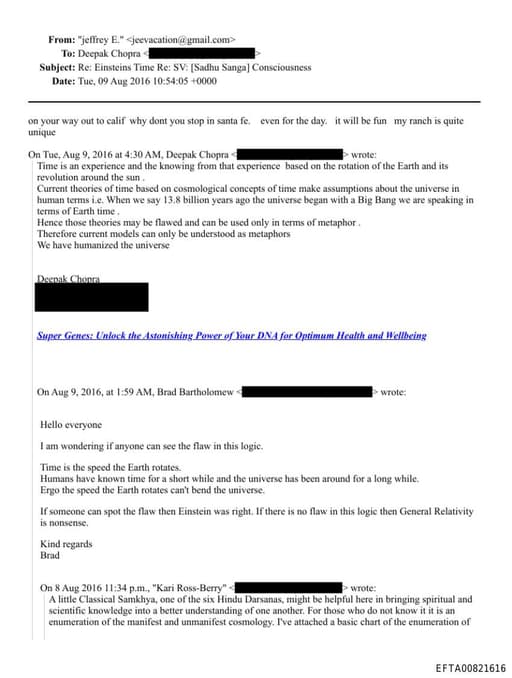
way Seth Lloyd explains it: "Godel showed that the capacity for self-reference leads automatically to paradoxes in logic; the British mathematician Alan Turing showed that self-reference leads to uncomputability in computers." When a computer processes data the data contains instructions to the computer as
Sponsored
EFTA00595574.pdf
1 mentionEFTA00595574
ing Room, 729 7th Avenue at 491" Street During the winter of 1952, British authorities entered the home of mathematician, cryptanalyst and war hero Alan Turing (Benedict Cumberbatch) to investigate a reported burglary. They instead ended up arresting Turing himself on charges of 'gross indecency', an accusa
EFTA00636243.pdf
1 mentionEFTA00636243
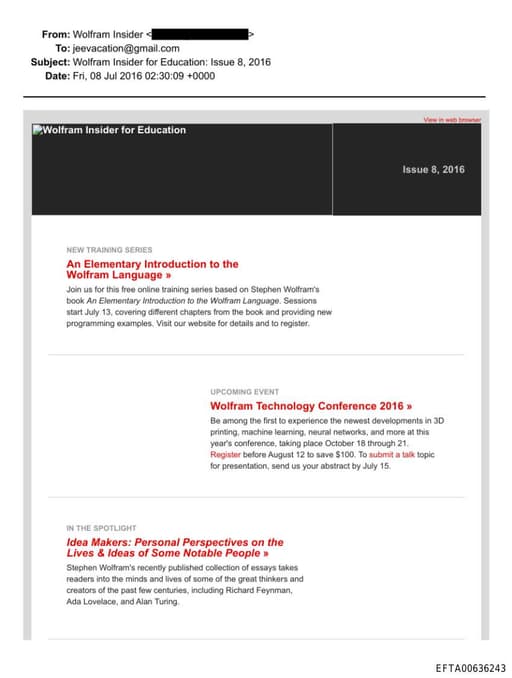
ation: Issue 8, 2016 Date: Fri, 08 Jul 2016 02:30:09 +0000 View in web browser Pro:Wolfram Insider for Education Issue 8, 2016 Ada Lovelace, and Alan Turing. start July 13, covering different chapters from the book and providing new creators of the past few centuries, including Richard Feynman, book An
EFTA00636847.pdf
1 mentionEFTA00636847
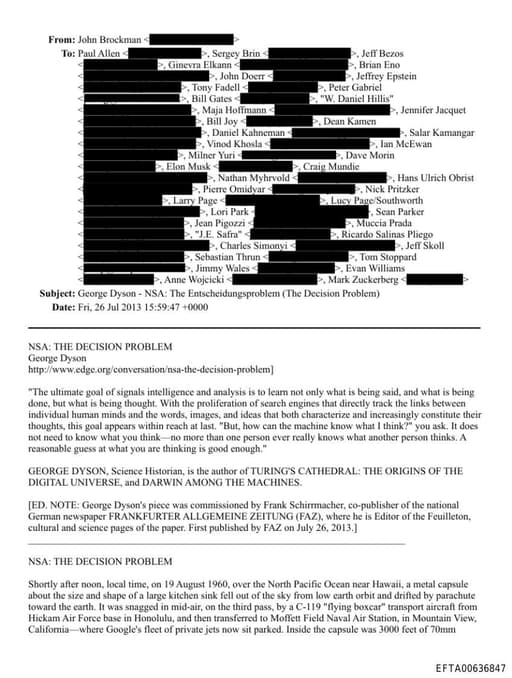
reasonable guess at what you are thinking is good enough. Data mining, on the scale now practiced by Google and the NSA, is the realization of what Alan Turing was getting at, in 1939, when he wondered "how far it is possible to eliminate intuition, and leave only ingenuity," in postulating what he termed
Sponsored
EFTA01735494.pdf
1 mentionEFTA01735494
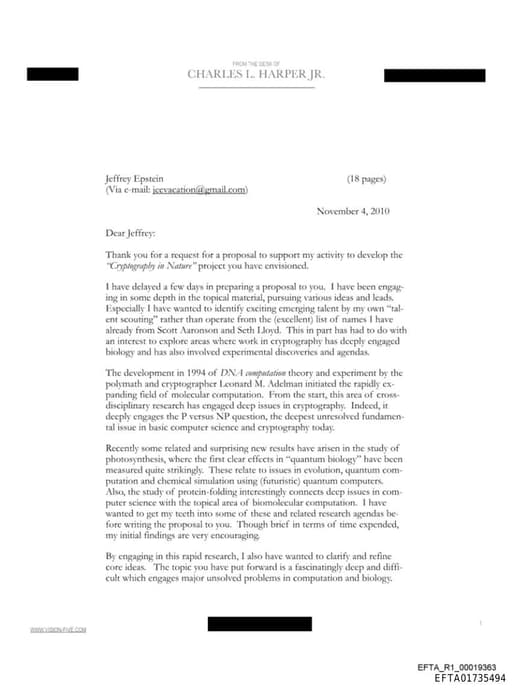
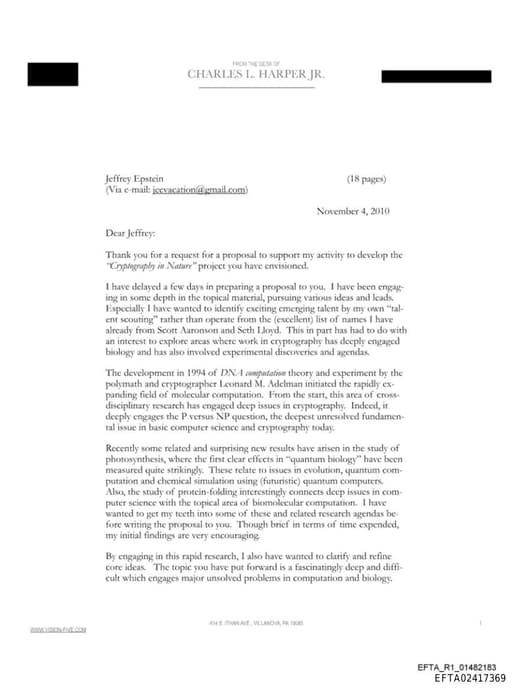
eidungproblem." This paper was a key inspira- tion towards the future work of Claude Shannon creating modern cryptographt via his collaboration with Alan Turing at Bletchlcy Park during WWII. (see: http://en.wikipedia.org/wiki/Claude_Shannon) ii) 55 years since Kurt Gadd% 1956 letter to John von Neumann
EFTA02417369.pdf
1 mentionEFTA02417369
eidungproblem." This paper was a key inspira- tion towards the future work of Claude Shannon creating modern cryptographt via his collaboration with Alan Turing at Bletchlcy Park during WWII. (see: http://en.wikipedia.org/wiki/Claude_Shannon) ii) 55 years since Kurt Gadd% 1956 letter to John von Neumann
Sponsored
Connected Entities(20 of 1,535)
Alan Dershowitz
PersonAmerican lawyer, author, and art collector (born 1938)
34 docs34 co-mentions
Stephen Hawking
PersonBritish theoretical physicist, cosmologist and author (1942–2018)
27 docs27 co-mentions
Jeffrey Epstein
PersonAmerican sex offender and financier (1953–2019)
21 docs21 co-mentions
Turing
PersonEnglish computer scientist (1912–1954)
17 docs17 co-mentions
Samantha Power
PersonIrish-American academic, author and diplomat
14 docs14 co-mentions
Prince Charles
PersonKing of the United Kingdom and other Commonwealth realms since 2022 (born 1948)
14 docs14 co-mentions
George W. Bush
PersonPresident of the United States from 2001 to 2009
13 docs13 co-mentions
Eric Schmidt
PersonSoftware engineer, businessman, former Google CEO
13 docs13 co-mentions
Eric Trump
PersonAmerican businessman and reality television personality (born 1984)
13 docs13 co-mentions
Harvey Weinstein
PersonAmerican film producer and sex offender (born 1952)
12 docs12 co-mentions
Richard Dawkins
PersonEnglish ethologist, evolutionary biologist and author (born 1941)
12 docs12 co-mentions
Prince Andrew
PersonThird child of Queen Elizabeth II and Prince Philip, Duke of Edinburgh (born 1960)
12 docs12 co-mentions
Penrose
PersonCensus-designated place in Fremont, Colorado, United States
11 docs11 co-mentions
Marc Rich
PersonAmerican commodities trader (1934–2013)
10 docs10 co-mentions
Michael Jackson
PersonAmerican singer, songwriter, record producer, and dancer (1958–2009)
10 docs10 co-mentions
Earth
LocationThird planet from the Sun in the Solar System
10 docs10 co-mentions
CH
Chalmers
PersonFirst name reference to multiple individuals in Epstein-related documents
10 docs10 co-mentions
Daniel Dennett
PersonAmerican philosopher (1942–2024)
10 docs10 co-mentions
Quantum
OrganizationQuantum Fund or entity referenced in documents
9 docs9 co-mentions
Michael Douglas
PersonAmerican retired actor, producer and activist (born 1944)
9 docs9 co-mentions