Back to Network



















9
Shared Docs
8
Same-Page
10 / 11
Mentions
Document Mentions (9 shared documents)
3 mentions1 same-page
Page ?Same page
dos of the counterfactual are having a field day. Iraq in its agony is the perfect locus for handicappers of the hypothetical. It's an old game. If Napoleon had had B-52s at Waterloo, things might have worked out differently. The left blames the disaster on President Bush and the American invasion of 200
will our Sunni friends — the Saudis, for instance — think of that? Or maybe we should just wash our hands of the whole thing and turn over a hunk of the Middle East with its oil to a terrorist organization — one that boasts of committing massacres. Oh, what dreams it must have in the desert night. William Goldm
hing approaching warmth. Nobody should bet against an independent Kurdish state within the next decade. Syria and Iraq are in a state of implosion; Middle Eastern borders are up for grabs. Qaeda affiliates have already done their grabbing. They control wide swathes of Syria and Iraq 13 years (and trillions of
3 mentions1 same-page
Page ?Same page
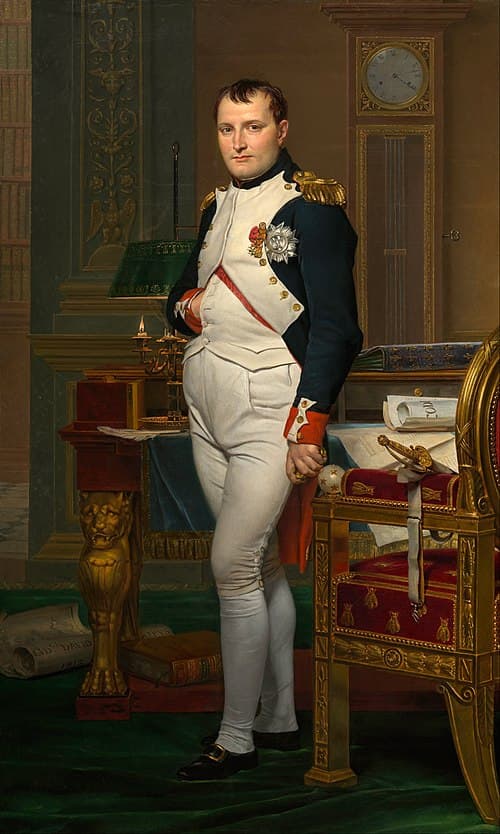
progress. In fact, dictators have sometimes acted as agents of deep economic reforms, often because international threats forced their hands. After Napoleon defeated Prussia in 1806 at the Battle of Jena, Prussia's authoritarian rulers embarked on administrative and economic reforms in an effort to str
why: "It cannot be that the secretary of defense will stand up publicly and say that an attack on Iran will plunge the world into World War III or the Middle East will go up in flames. That shows that you really don't mean to do it." Yadlin wants Israel to delay a decision and wants the United States to take
Daily Star Ethics matter, the world tells Israel Rami G. Khouri August 22, 2012 -- We may be quietly witnessing these days an important change in Middle Eastern history. The calm, rational human emphasis on ethical behavior and the quest for peace and justice could be triumphing over the attempt to spread
3 mentions1 same-page
Page ?Same page
decisive mark of leadership and success in revolutionary periods. Consider, for instance, Charles, the Duke of Brunswick-Wolfenbuttel who faced down Napoleon on the fields of Jena in what is now central Germany in October 1806. Brusnwick-Wolfenbuttel was then 71 years old. He was considered one of the most
rs to one. His men were masters of the subtle techniques of Frederick the Great, tactics that had delivered victory in far more perilous moments. But Napoleon, less than half the Duke’s age at 37, stared across the same undulating land, the same poised armies and saw in the landscape something completely 4
s have different results: Think of how an open computer system plopped into the Middle East might be used differently than one placed in the American Midwest. It was these sorts of vibrations, the ones made by power pulsing through certain forms or networks in history, that led the Orientalist scholar Kar
Sponsored
2 mentions1 same-page
Page ?Same page
an. More troubling is his lack of social or emotional intelligence. He's often called aloof and arrogant -- not for nothing do his friends call him Napoleon -- and he is infamous for acting like he's the smartest guy in the room, as though "surrounded by mental pygmies," according to Makovsky. During ou
s in Israel, he met hardly any politicians still working for a two-state solution -- the solution Germany considers the only viable path to peace in the Middle East. "It was sobering," Klose stated. What, then, should Germany do? Klose says he still believes the German government should refrain from publicly re
2 mentions1 same-page
Page ?Same page
progress. In fact, dictators have sometimes acted as agents of deep economic reforms, often because international threats forced their hands. After Napoleon defeated EFTA00712912 Prussia in 1806 at the Battle of Jena, Prussia's authoritarian rulers embarked on administrative and economic reforms in an
cs matter, the world tells Israel EFTA00712908 Rami G. Khouri August 22, 2012 -- We may be quietly witnessing these days an important change in Middle Eastern history. The calm, rational human emphasis on ethical behavior and the quest for peace and justice could be triumphing over the attempt to spread v
2 mentions1 same-page
Page ?Same page
the French Revolution. He brought it to life with insights into Montesquieu, Rousseau and John Locke, Louis XVI and Mary Antoinette, Robespierre and Napoleon. He traced the dynamics that led to the revolution, and the way its ideals descended into the bloodshed and terror that followed. He presented histor
ng the conflict with our Arab enemies would almost certainly become more difficult with time. 9 HOUSE_OVERSIGHT_011480 Iraq, perhaps Iran and other Middle Eastern states, might get nuclear weapons. A violent form of fundamentalist Islam could, over time, erode existing Arab and Muslim states, threatening Israel
Sponsored
2 mentions1 same-page
Page ?Same page
the French Revolution. He brought it to life with insights into Montesquieu, Rousseau and John Locke, Louis XVI and Mary Antoinette, Robespierre and Napoleon. He traced the dynamics that led to the revolution, and the way its ideals descended into the bloodshed and terror that followed. He presented histor
ng the conflict with our Arab enemies would almost certainly become more difficult with time. 9 HOUSE_OVERSIGHT_027857 Iraq, perhaps Iran and other Middle Eastern states, might get nuclear weapons. A violent form of fundamentalist Islam could, over time, erode existing Arab and Muslim states, threatening Israel
2 mentions1 same-page
Page ?Same page
ciples of power in a connected age. “Read over and over again the campaigns of Alexander, Hannibal, Caesar, Gustavus, Turenne, Eugene and Frederick,” Napoleon wrote once. “Make them your models. This is the 147 | was thinking: Dan Geer, “Cybersecurity as Realpolitik”, speech delivered at BlackHat, August 6
Hard Gatekeeping can - with a little imagination and some discipline — be laid on puzzles like terrorism, cyberattacks, US-China relations, order in the Middle East, the proliferation of nuclear weapons, income inequality and global warming. It provides a sharp single image of what we're after - and guidelines fo
Page HOUSE_OVERSIGHT_031573
OVERSIGHT_031572 --- PAGE BREAK --- Saudi and Iran, powerhouses of Sunni and Shiite Islam respectively, presently support opposing sides in many of the Middle East's major confrontations, and are often seen as having radically divergent and competing visions for the future of the region. Which is why, in Lebanon -
Page: HOUSE_OVERSIGHT_031573 →Page HOUSE_OVERSIGHT_031590
SIGHT_031589 --- PAGE BREAK --- is no evidence showing that the CCP is purposefully becoming more assertive in its foreign policy towards the West. Napoleon said two-hundred years ago that, when China wakes "she will shake the world." It may not be time to start shaking yet. Adrien Morin is a postgraduate
Page: HOUSE_OVERSIGHT_031590 →Sponsored
Mutual Connections (664)
Entities connected to both Napoleon and Middle East
Jeffrey Epstein
PERSON30 w/ Napoleon·240 w/ Middle
Barack Obama
PERSON17 w/ Napoleon·211 w/ Middle
United States
LOCATION14 w/ Napoleon·201 w/ Middle
George W. Bush
PERSON14 w/ Napoleon·171 w/ Middle
Bill Clinton
PERSON10 w/ Napoleon·146 w/ Middle
Marc Rich
PERSON16 w/ Napoleon·136 w/ Middle
Donald Trump
PERSON3 w/ Napoleon·138 w/ Middle
Lebanon
LOCATION11 w/ Napoleon·124 w/ Middle
Benjamin Netanyahu
PERSON12 w/ Napoleon·115 w/ Middle
Bashar al-Assad
PERSON12 w/ Napoleon·114 w/ Middle
Joe Biden
PERSON8 w/ Napoleon·118 w/ Middle
Tehran
LOCATION8 w/ Napoleon·111 w/ Middle
LB
Leon Black
PERSON6 w/ Napoleon·113 w/ Middle
Department of Justice
ORGANIZATION3 w/ Napoleon·115 w/ Middle
Prince Andrew
PERSON4 w/ Napoleon·114 w/ Middle
Julie K. Brown
PERSON3 w/ Napoleon·104 w/ Middle
Samantha Power
PERSON10 w/ Napoleon·95 w/ Middle
Virginia Giuffre
PERSON4 w/ Napoleon·101 w/ Middle
Vladimir Putin
PERSON3 w/ Napoleon·100 w/ Middle
Bloomberg L.P.
ORGANIZATION2 w/ Napoleon·100 w/ Middle