Back to People & Entities





The Eleventh Circuit's
Organization
18
Total Mentions
18
Documents
731
Connected Entities
Organization referenced in documents
Document Mentions (18)
EFTA00157655.pdf
1 mentionEFTA00157655
to engage in a criminal sex act or (b) that Owens was under the age of 18.) (emphasis added). Again, none of these factors is present in this case. The Eleventh Circuit's interpretation of the statute makes perfect sense: were § 1591 not limited in this fashion, it would threaten to criminalize a host of localized be
EFTA00161678.pdf
1 mentionEFTA00161678
cant lack of uniformity in the DOJ's current approach to privilege reviews. But a recent Eleventh Circuit decision may lead to greater consistency. The Eleventh Circuit's Recent Decision In U.S. v. ICorf,[4] the Eleventh Circuit upheld the DOJ's use of a taint team to conduct a privilege review of materials seized fro
EFTA00176507.pdf
1 mentionEFTA00176507
gainst strict liability, especially since it applies in cases where there is no sexual contact at all with any person, let alone with a real minor. The Eleventh Circuit's decision in United States Murrell, supra, reflects this same understanding of the statute. The Murrell court wrote that, under the "plain language"
Sponsored
EFTA00189749.pdf
1 mentionEFTA00189749
penalty ... if, in fact, someone ... is caught and convicted.") (emphasis added). Accordingly, Masha's Law cannot lawfully be applied in this case. The Eleventh Circuit's decision in United States v. Siegel, 153 F.3d 1256 (11th Cir. 1998), is virtually on point. hi Siegel the defendant pleaded guilty to charges under
EFTA00190116.pdf
1 mentionEFTA00190116
gainst strict liability, especially since it applies in cases where there is no sexual contact at all with any person, let alone with a real minor. The Eleventh Circuit's decision in United States, Murrell, supra, reflects this same understanding of the statute. The Murrell court wrote that, under the "plain language
EFTA00191396.pdf
1 mentionEFTA00191396
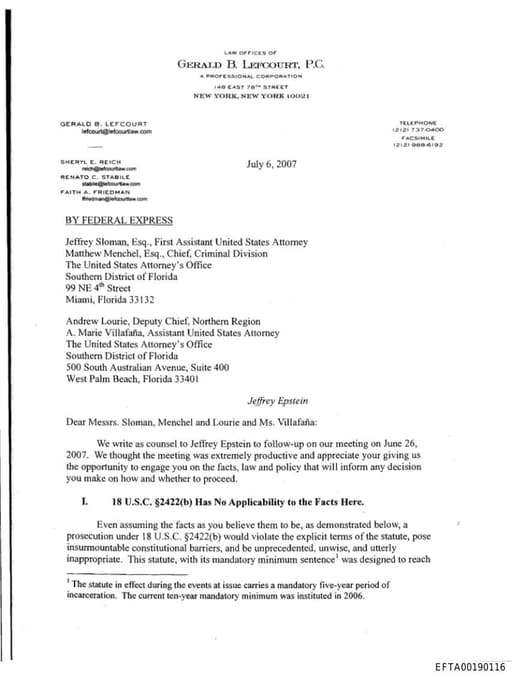
gainst strict liability, especially since it applies in cases where there is no sexual contact at all with any person, let alone with a real minor. The Eleventh Circuit's' decision in United States Murrell, supra, reflects this same understanding of the statute. The Murrell court wrote that, under the "plain language"
Sponsored
EFTA00192835.pdf
1 mentionEFTA00192835
penalty ... if, in fact, someone ... is caught and convicted.") (emphasis added). Accordingly, Masha's Law cannot lawfully be applied in this case. The Eleventh Circuit's decision in United States I, Siegel 153 F.3d 1256 (11th Cir. 1998), is virtually on point. In Siegel, the defendant pleaded guilty to charges under
EFTA00210039.pdf
1 mentionEFTA00210039
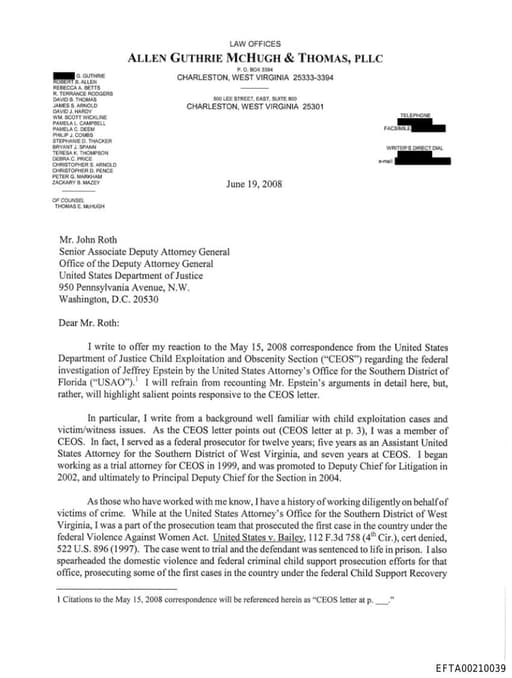
to engage in a criminal sex act or (b) that Owens was under the age of 18.) (emphasis added). Again, none of these factors is present in this case. The Eleventh Circuit's interpretation of the statute makes perfect sense: were § 1591 not limited in this fashion, it would threaten to criminalize a host of localized be
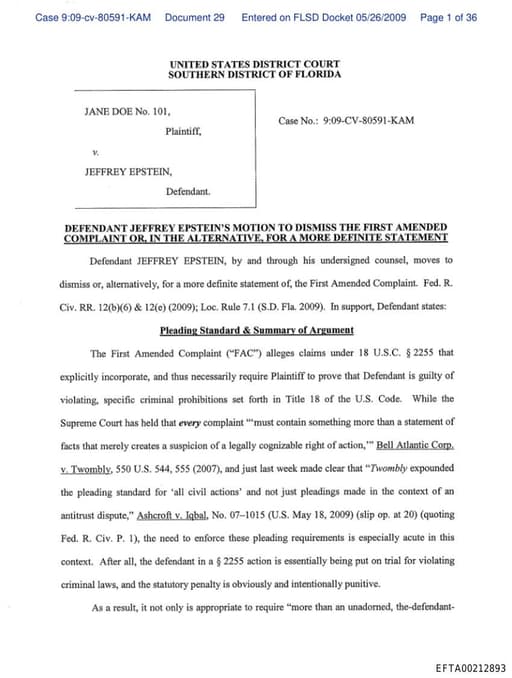
EFTA00212893.pdf
1 mentionEFTA00212893
penalty ... if, in fact, someone ... is caught and convicted.") (emphasis added). Accordingly, Masha's Law cannot lawfully be applied in this case. The Eleventh Circuit's decision in United States v. Siegel, 153 F.3d 1256 (11th Cir. 1998), is virtually on point. hi Siegel the defendant pleaded guilty to charges under
Sponsored
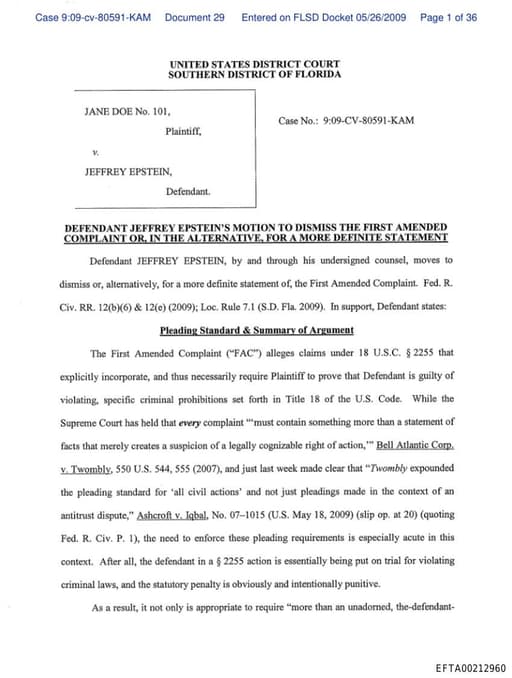
EFTA00212960.pdf
1 mentionEFTA00212960
penalty ... if, in fact, someone ... is caught and convicted.") (emphasis added). Accordingly, Masha's Law cannot lawfully be applied in this case. The Eleventh Circuit's decision in United States v. Siegel, 153 F.3d 1256 (11th Cir. 1998), is virtually on point. hi Siegel the defendant pleaded guilty to charges under
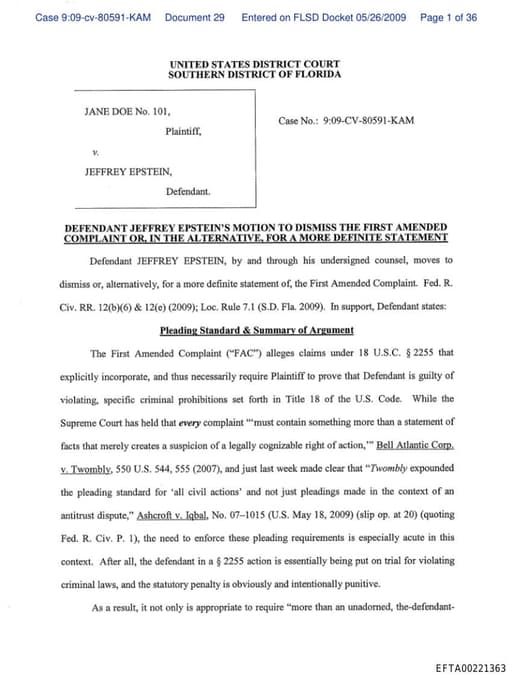
EFTA00221363.pdf
1 mentionEFTA00221363
penalty ... if, in fact, someone ... is caught and convicted.") (emphasis added). Accordingly, Masha's Law cannot lawfully be applied in this case. The Eleventh Circuit's decision in United States v. Siegel, 153 F.3d 1256 (11th Cir. 1998), is virtually on point. hi Siegel the defendant pleaded guilty to charges under
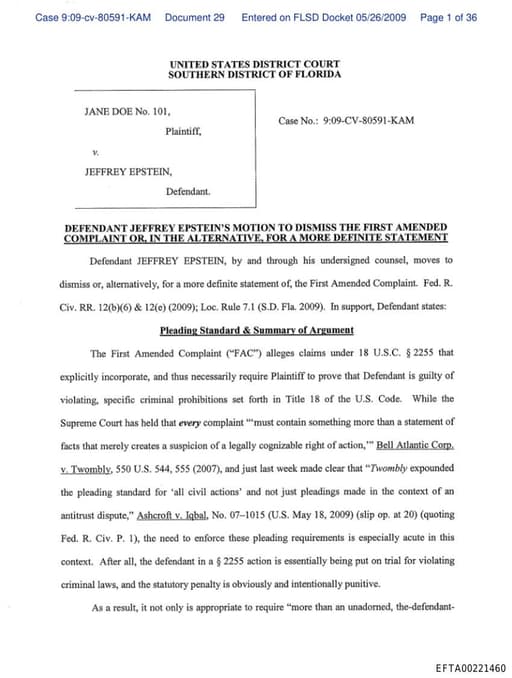
EFTA00221460.pdf
1 mentionEFTA00221460
penalty ... if, in fact, someone ... is caught and convicted.") (emphasis added). Accordingly, Masha's Law cannot lawfully be applied in this case. The Eleventh Circuit's decision in United States v. Siegel, 153 F.3d 1256 (11th Cir. 1998), is virtually on point. hi Siegel the defendant pleaded guilty to charges under
Sponsored
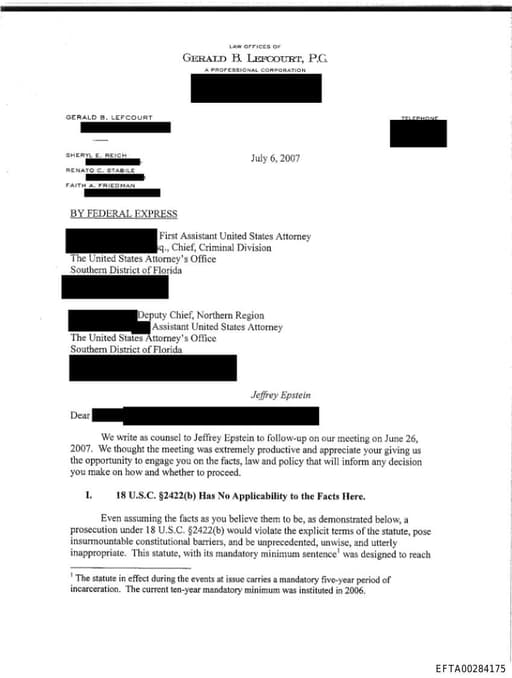
EFTA00284175.pdf
1 mentionEFTA00284175
gainst strict liability, especially since it applies in cases where there is no sexual contact at all with any person, let alone with a real minor. The Eleventh Circuit's decision in United States v. Murrell, supra, reflects this same understanding of the statute. The Mini! court wrote that, under the "plain language
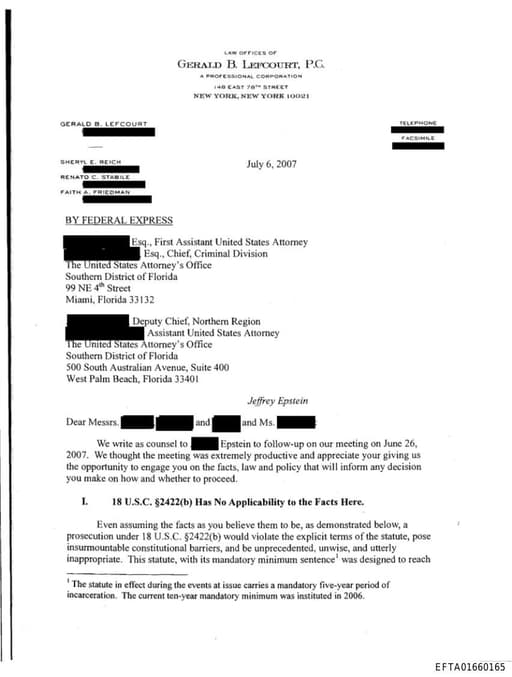
EFTA01660165.pdf
1 mentionEFTA01660165
gainst strict liability, especially since it applies in cases where there is no sexual contact at all with any person, let alone with a real minor. The Eleventh Circuit's decision in United States v. Muriel!, supra, reflects this same understanding of the statute. The Mum!! court wrote that, under the "plain language
EFTA00184224.pdf (email 14: Jeffrey Epstein)
1 mentionEFTA00184224_email_014
gainst strict liability, especially since it applies in eases whcre there is no sexual contact at all with any person, let alone with a real minor. The Eleventh Circuit's decision in United States Murrell, supra, reflects this same understanding of the statute. The Murrell court wrote that, under the "plain language"
Sponsored
EFTA00225672.pdf (email 8: RE: Epstein)
1 mentionEFTA00225672_email_008_sub_002 - EFTA00225672_209
at (a) force or coercion would be used to cause Owens to engage in a criminal sex act or (b) that Owens was under the age of 18." (emphasis added). The Eleventh Circuit's interpretation of the statute makes perfect sense: were § 1591 not limited in that fashion, it would threaten to criminalize a host of localized be
EFTA00225672.pdf (email 8: RE: Epstein)
1 mentionEFTA00225672_email_008_sub_003 - EFTA00225672_243
nduce criminal sexual activity at some point after such use, or if the defendant does not actually induce during the use, § 2422(b) does not apply. The Eleventh Circuit's Pattern Jury Instructions recognize as much. According to those Instructions, the Government must prove beyond a reasonable doubt: First: That the
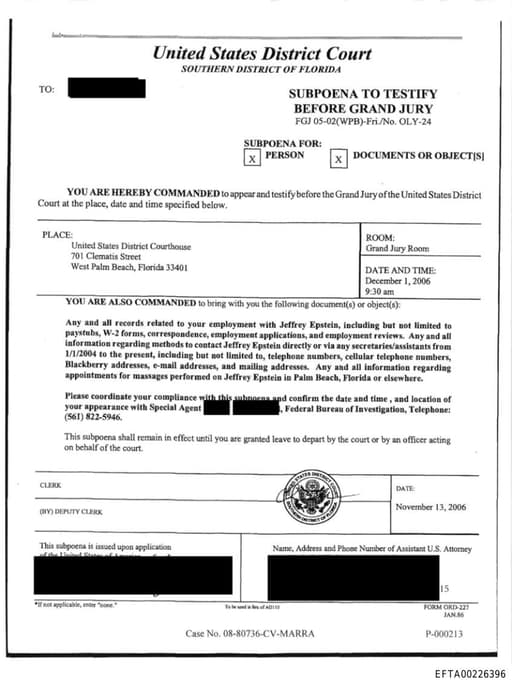
EFTA00226396.pdf (email 12, pages 340-453)
1 mentionEFTA00226396_email_012_sub_001 - EFTA00226396_439
gainst strict liability, especially since it applies in cases where there is no sexual contact at all with any person, let alone with a real minor. The Eleventh Circuit's decision in United States Murrell, supra, reflects this same understanding of the statute. The Murrell court wrote that, under the "plain language"
Sponsored
Connected Entities(20 of 731)
Jeffrey Epstein
PersonAmerican sex offender and financier (1953–2019)
18 docs18 co-mentions
United States
LocationCountry located primarily in North America
17 docs17 co-mentions
George W. Bush
PersonPresident of the United States from 2001 to 2009
17 docs17 co-mentions
EV
Evans
PersonAmbiguous surname - refers to multiple people in Epstein documents
16 docs16 co-mentions
MU
Murrell
PersonSurname reference in Epstein-related documents
16 docs16 co-mentions
JD
Jane Doe
PersonPseudonym for anonymous victims/witnesses in Epstein legal proceedings
16 docs16 co-mentions
LB
Leon Black
PersonAmerican billionaire businessman (born 1951)
15 docs15 co-mentions
Prince Andrew
PersonThird child of Queen Elizabeth II and Prince Philip, Duke of Edinburgh (born 1960)
14 docs14 co-mentions
Searcy
PersonPrimarily refers to Chris Searcy in Epstein documents
14 docs14 co-mentions
Alan Dershowitz
PersonAmerican lawyer, author, and art collector (born 1938)
13 docs13 co-mentions
the Southern District
LocationFederal judicial district in New York City
11 docs11 co-mentions
RB
Roy Black
PersonAmerican lawyer (1945–2025)
10 docs10 co-mentions
GL
Gerald Lefcourt
PersonAmerican lawyer
10 docs10 co-mentions
Alberto Gonzales
Person80th United States Attorney General
10 docs10 co-mentions
Jennifer Lopez
PersonAmerican singer and actress (born 1969)
10 docs10 co-mentions
Scarlett Johansson
PersonAmerican actress (born 1984)
9 docs9 co-mentions
Bailey
PersonName reference in Epstein documents
9 docs9 co-mentions
Jeffrey Sloman
PersonFederal prosecutor, referenced in Epstein case legal proceedings
8 docs8 co-mentions
Mortensen
PersonSurname reference in documents
8 docs8 co-mentions
Criminal Division
OrganizationDivision of the U.S. Department of Justice
8 docs8 co-mentions