Back to People & Entities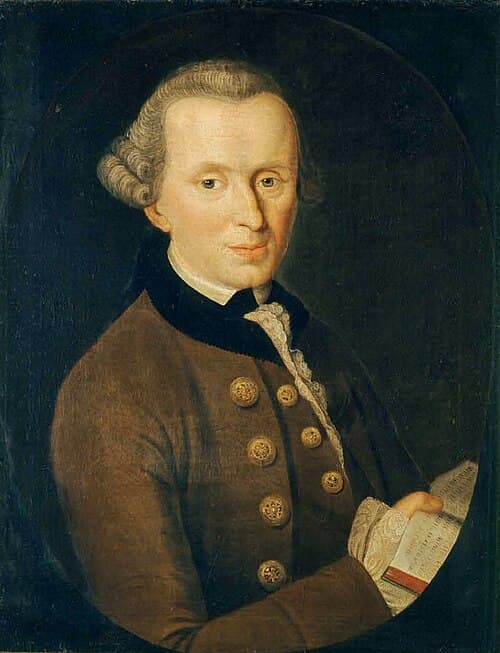





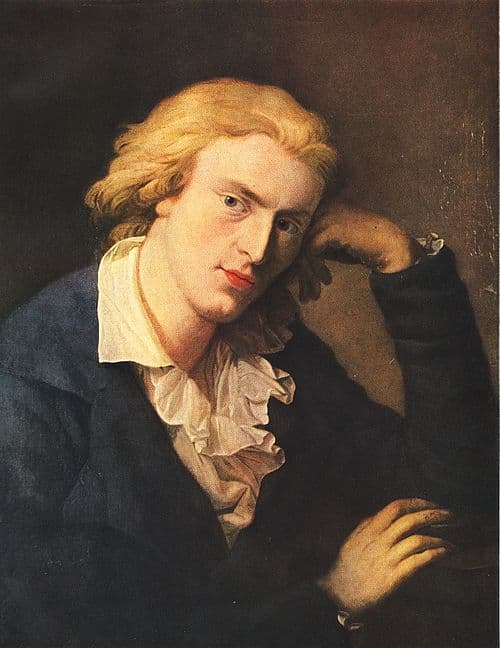
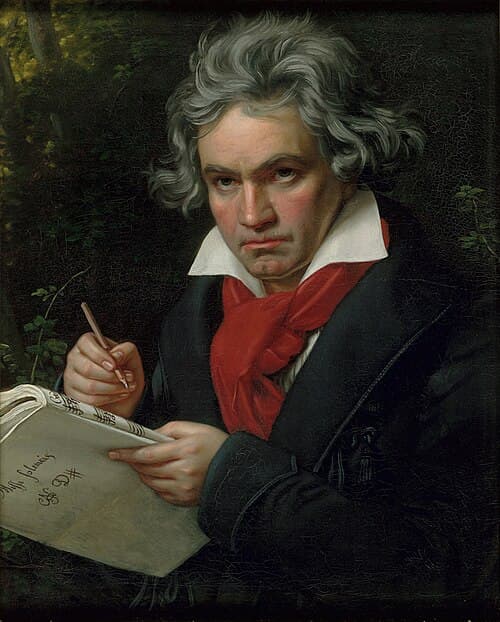
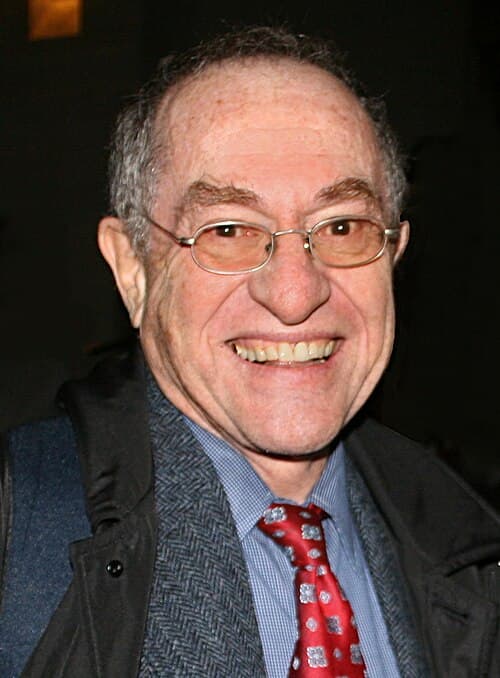

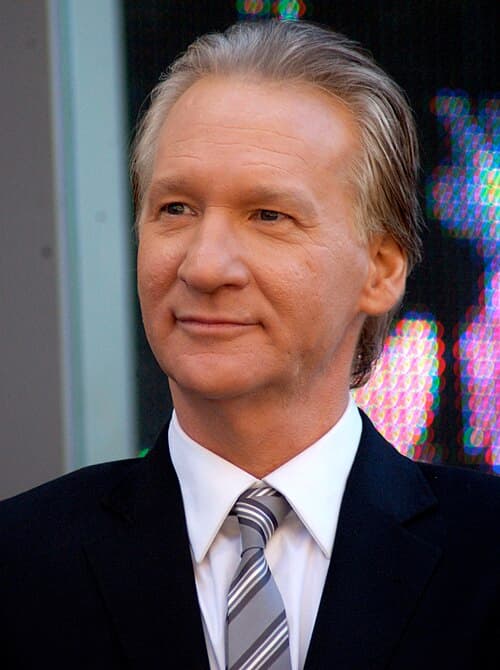

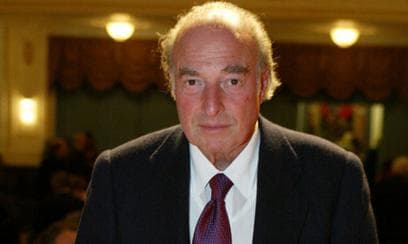
Immanuel Kant
Person
Also known as:
IMMANUEL KANT
16
Total Mentions
16
Documents
675
Connected Entities
German philosopher (1724–1804)
Immanuel Kant, the 18th-century German philosopher, appears in the Epstein documents primarily as a philosophical reference cited in government records, with 9 mentions across various contexts ranging from political analysis to ethical debates.
Kant's name appears in substantive government documents where his philosophical works are cited as intellectual references, particularly in discussions about ethics, political theory, and historical context. These are not personal communications or direct connections, but rather academic citations in policy-related materials. The mentions span multiple House Oversight documents, suggesting his ideas were referenced in various governmental discussions.
Key Highlights
- •Cited in House Oversight documents discussing ethics, morality, and political philosophy
- •References include his works 'Foundations of the Metaphysics of Morals' and 'Groundwork of the Metaphysic of Morals'
- •Appears in contexts discussing the Enlightenment, moral philosophy, and political theory
- •No evidence of personal connection to Epstein; all mentions are academic citations
Frequently Asked Questions
Related Links
Books for Further Reading
Document Mentions (16)
Untitled attachment 248655.pdf
1 mentionHOUSE_OVERSIGHT_023133 - HOUSE_OVERSIGHT_023197
Sep 17, 2014Source: House Oversight Committee
IGHT_023160 --- PAGE BREAK --- OUP CORRECTED PROOE - FINAL, 10/9/2014, SPi The Crooked Course: Step by Step on the Path to Peace INTRODUCTION As Immanuel Kant observed, “out of the crooked timber of humanity no straight thing was ever made.” And the Middle East peace process is no exception. It runs a crook
Page: HOUSE_OVERSIGHT_023161 →HOUSE_OVERSIGHT_029558 - HOUSE_OVERSIGHT_029563
1 mentionSource: House Oversight Committee
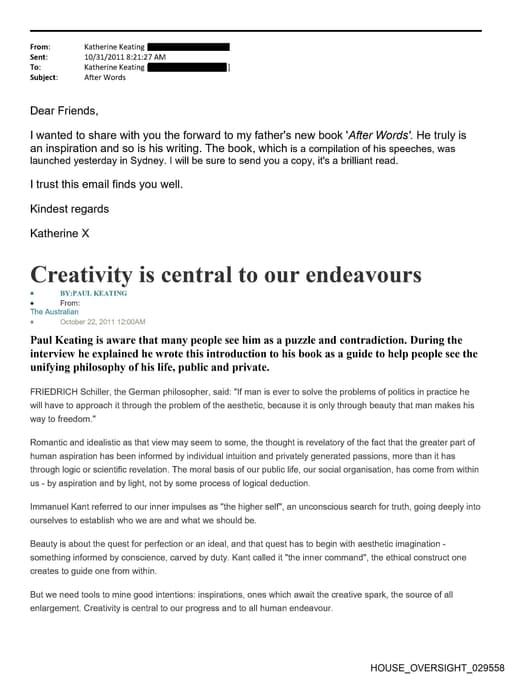
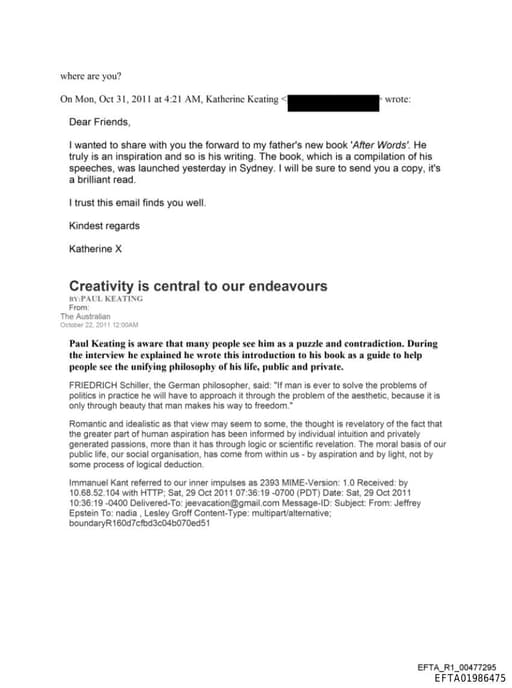
al basis of our public life, our social organisation, has come from within us - by aspiration and by light, not by some process of logical deduction. Immanuel Kant referred to our inner impulses as "the higher self", an unconscious search for truth, going deeply into ourselves to establish who we are and what we
Page: HOUSE_OVERSIGHT_029558 →HOUSE_OVERSIGHT_029663 - HOUSE_OVERSIGHT_029670
1 mentionSource: House Oversight Committee
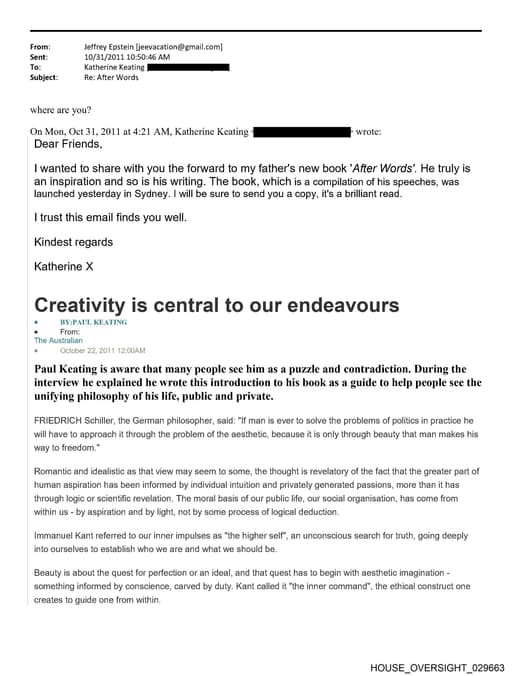
al basis of our public life, our social organisation, has come from within us - by aspiration and by light, not by some process of logical deduction. Immanuel Kant referred to our inner impulses as "the higher self", an unconscious search for truth, going deeply into ourselves to establish who we are and what we
Page: HOUSE_OVERSIGHT_029663 →Sponsored
HOUSE_OVERSIGHT_029671 - HOUSE_OVERSIGHT_029678
1 mentionSource: House Oversight Committee
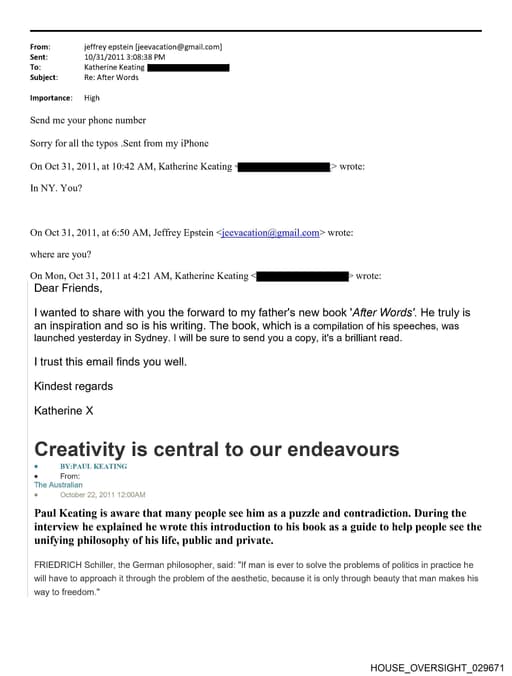
al basis of our public life, our social organisation, has come from within us - by aspiration and by light, not by some process of logical deduction. Immanuel Kant referred to our inner impulses as "the higher self", an unconscious search for truth, going deeply into ourselves to establish who we are and what we
Page: HOUSE_OVERSIGHT_029672 →14 June.doc
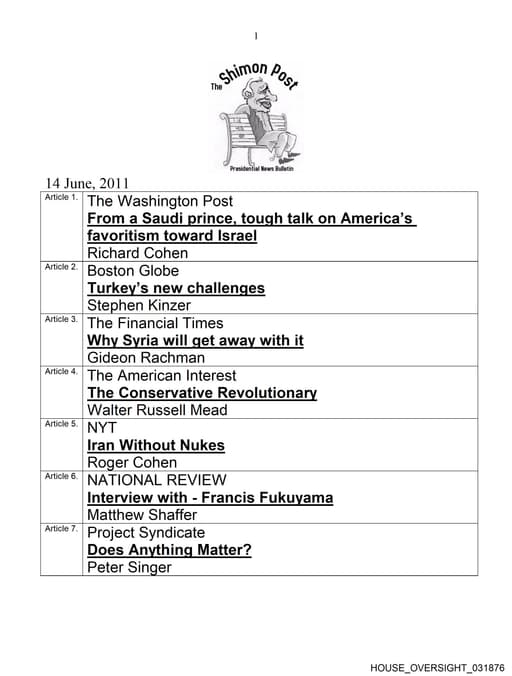
1 mentionHOUSE_OVERSIGHT_031876 - HOUSE_OVERSIGHT_031911
Jun 14, 2011Source: House Oversight Committee
eply about right and wrong, and this disagreement extends to philosophers who cannot be accused of being ignorant or confused. If great thinkers like Immanuel Kant and Jeremy Bentham disagree about what we ought to do, can there really be an objectively true answer to that question? Parfit's response to this lin
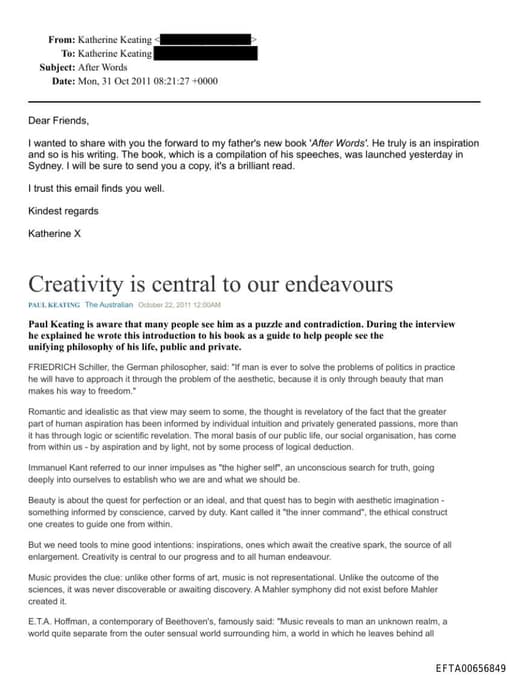
Page: HOUSE_OVERSIGHT_031911 →EFTA00656849.pdf
1 mentionEFTA00656849
basis of our public life, our social organisation, has come from within us - by aspiration and by light, not by some process of logical deduction. Immanuel Kant referred to our inner impulses as "the higher self', an unconscious search for truth, going deeply into ourselves to establish who we are and what w
Sponsored
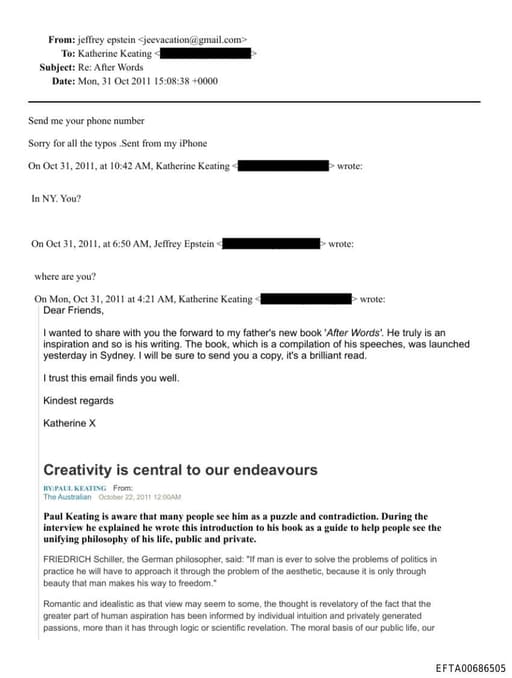
EFTA00686505.pdf
1 mentionEFTA00686505
blic life, our EFTA00686505 social organisation, has come from within us - by aspiration and by light, not by some process of logical deduction. Immanuel Kant referred to our inner impulses as "the higher self", an unconscious search for truth, going deeply into ourselves to establish who we are and what w
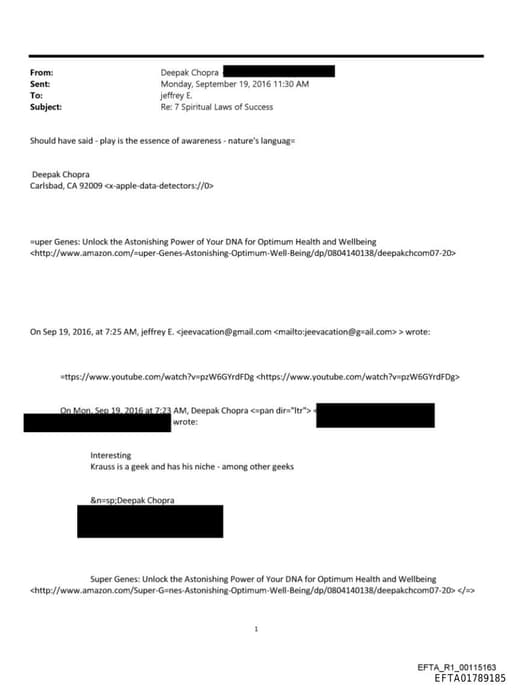
EFTA01789185.pdf
1 mentionEFTA01789185
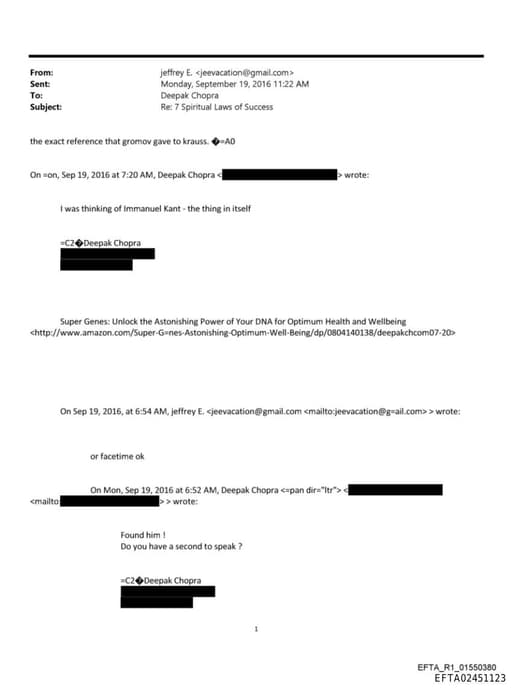
wrote: the exact reference that gromov gave to krauss. = On Mon, Se 19, 2016 at 7:20 AM, Deepak Chopra <=pan dir="ltr" wrote: I was thinking of Immanuel Kant - the thing in itself &n=sp;Deepak Chopra Super Genes: Unlock the Astonishing Power of Your DNA for Optimum Health and Wellbeing <http://www.amazo
EFTA01986475.pdf
1 mentionEFTA01986475
basis of our public life, our social organisation, has come from within us - by aspiration and by light, not by some process of logical deduction. Immanuel Kant referred to our inner impulses as 2393 MIME-Version: 1.0 Received: by 10.68.52.104 with HTTP; Sat, 29 Oct 2011 07:36:19 -0700 (PDT) Date: Sat, 29 Oc
Sponsored
EFTA02451123.pdf
1 mentionEFTA02451123
l Laws of Success the exact reference that gromov gave to krauss. 4k On =on, Sep 19, 2016 at 7:20 AM, Deepak Chopra < > wrote: I was thinking of Immanuel Kant - the thing in itself ,Deepak Chopra Super Genes: Unlock the Astonishing Power of Your DNA for Optimum Health and Wellbeing <http://www.amazon.com
EFTA02451185.pdf
1 mentionEFTA02451185
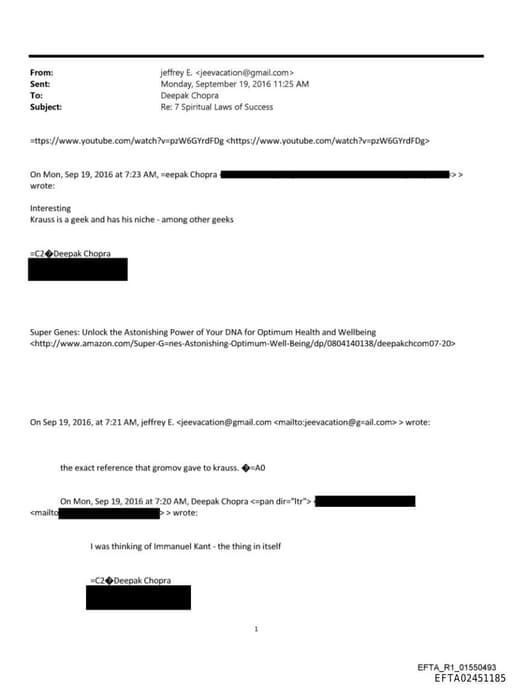
xact reference that gromov gave to krauss. 40 On Mon, Sep 19, 2016 at 7:20 AM, Deepak Chopra <=pan dir="ltr") <mailt > > wrote: I was thinking of Immanuel Kant - the thing in itself Dee ak Cho ra EFTA_R1_01550493 EFTA02451185 Super Genes: Unlock the Astonishing Power of Your DNA for Optimum Health and
EFTA00623759.pdf
1 mentionEFTA00623759_sub_004 - EFTA00623759_369
re doesn't need us, Wired. April 2000. Kant91. George Kampis. Self-Modifying Systems in Biology and Cognitive Science. Plenum Press, 1991. Kan64. Immanuel Kant. Groundwork of the Metaphysic of Morals. Harper and Row, 1964. Kap08. F. Kaplan. Neurorobotics: an experimental science of embodiment. Flontiers in
Sponsored
EngGenInt_Vol_One.pdf
1 mentionHOUSE_OVERSIGHT_012899_sub_004 - HOUSE_OVERSIGHT_013267
Source: House Oversight Committee
ture doesn’t need us, Wired. April 2000. Kam91. George Kampis. Self-Modifying Systems in Biology and Cognitive Science. Plenum Press, 1991. Kané64. Immanuel Kant. Groundwork of the Metaphysic of Morals. Harper and Row, 1964. Kap08. F. Kaplan. Neurorobotics: an experimental science of embodiment. Frontiers in
Schank 1st.pdf
1 mentionHOUSE_OVERSIGHT_023731_sub_002 - HOUSE_OVERSIGHT_023930
Source: House Oversight Committee
elligence All our knowledge begins with the senses, proceeds then to the understanding, and ends with reason. There is nothing higher than reason. —Immanuel Kant What is school for? A common answer is, to make people more knowl- edgeable. Another is, to socialize them and prepare them for living with others.
1 mention
nced confidently (and absurdly) at the Council of Trent in response to Luther’s Reformation. But there was no turning back. As the German philosopher Immanuel Kant wrote, the motto of the era could best be summarized as: Dare to know! “The Enlightenment,” he explained, “requires nothing but freedom.” This, it e
Sponsored
BeliefInUnseenPowers_Book.pdf
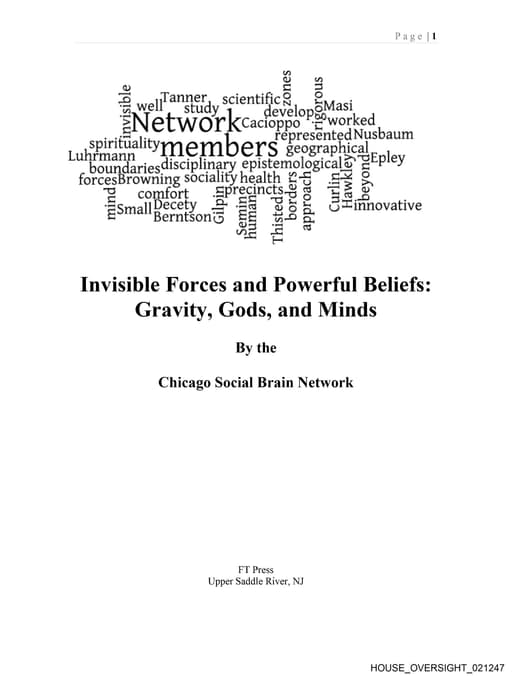
1 mentionHOUSE_OVERSIGHT_021247_sub_001 - HOUSE_OVERSIGHT_021346
Source: House Oversight Committee
k: Basic Books, 1968), Bk. 5, pp. 461- 465. ** Aristotle, Politics, Bk. 2, chpt. 3. °° Aquinas, Summa Contra Gentiles, 3, i1, p. 115. Page |39 **Tmmanuel Kant, Foundations of the Metaphysics of Morals (New York: Bobbs-Merrill Co., 1959), p. 49. *7Stephen Pope, “The Order of Love in Recent Roman Catholic Et
Sponsored
Connected Entities(20 of 675)
George W. Bush
PersonPresident of the United States from 2001 to 2009
12 docs12 co-mentions
Barack Obama
PersonPresident of the United States from 2009 to 2017
10 docs10 co-mentions
Jeffrey Epstein
PersonAmerican sex offender and financier (1953–2019)
9 docs9 co-mentions
Bill Clinton
PersonPresident of the United States from 1993 to 2001 (born 1946)
8 docs8 co-mentions
Vladimir Putin
Person2nd and 4th President of Russia (2000-2008, 2012-present), 7th and 11th Prime Minister of Russia (1999-2000, 2008-2012), Director of the Federal Security Service (1998-1999) and Deputy Mayor of Saint Petersburg (1994-1996)
7 docs7 co-mentions
Ronald Reagan
PersonPresident of the United States from 1981 to 1989 and actor (1911–2004)
7 docs7 co-mentions
Winston Churchill
PersonBritish statesman, soldier and writer (1874–1965)
7 docs7 co-mentions
Katherine X
PersonProfessor of Management - China Europe International Business School
6 docs6 co-mentions
Sydney
LocationCapital city of New South Wales, Australia
6 docs6 co-mentions
Mao Zedong
Person1st chairman of the Chinese Communist Party and founder of the People's Republic of China (1893–1976)
6 docs6 co-mentions
Mediterranean
LocationSea in southern Europe
6 docs6 co-mentions
KK
Katherine Keating
PersonAustralian socialite and businesswoman, daughter of former Australian Prime Minister Paul Keating, appeared in over 1,000 Epstein documents
6 docs6 co-mentions
Paul Keating
PersonAustralian politician, 24th Prime Minister of Australia
6 docs6 co-mentions
FRIEDRICH Schiller
PersonPerson referenced in documents
6 docs6 co-mentions
Beethoven
PersonReferences to classical composer Ludwig van Beethoven in discussions about music
6 docs6 co-mentions
Alan Dershowitz
PersonAmerican lawyer, author, and art collector (born 1938)
5 docs5 co-mentions
East Asia
LocationEastern region of Asia
5 docs5 co-mentions
Bill Maher
PersonAmerican stand-up comedian and television host
5 docs5 co-mentions
Federal Reserve
OrganizationFederal Reserve System, central banking system of the United States
5 docs5 co-mentions
Marc Rich
PersonAmerican commodities trader (1934–2013)
5 docs5 co-mentions