Back to Network

















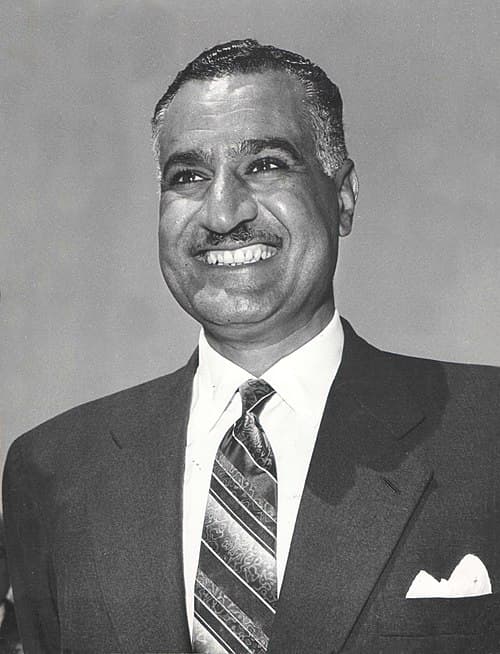

9
Shared Docs
6
Same-Page
9 / 9
Mentions
Document Mentions (9 shared documents)
2 mentions1 same-page
Page ?Same page
s sales to Israel but also in the joint attack on Egypt known as the 1956 Sinai-Suez War. The French needed Israel to help topple Egypt's President Gamal Abdul Nasser who supported their opponents in Algeria. The side payment their Socialist leaders were willing to provide Israel was a 26-megawatt nuclear researc
murderer. At the moment, there are no peace talks with Israel, the economy is in a slump and there continue to be deep divisions between Hamas and Fatah, the rival Palestinian groupings ruling the Gaza Strip and West Bank, respectively. Under these circumstances, it would be a perfect time to have n
2 mentions1 same-page
Page ?Same page
ing Foreign Policy Richard Javad Heydarian June 21, 2011 -- Egypt was once a major player in the Middle East, particularly under the leadership of Gamal Abdel Nasser in the 1950s and 1960s. Over the last decades, Egypt gradually lost its prestige and influence in the region as it became an introverted autocratic
fiant Asad Sticks to His Guns Patrick Seale Foreign Policy In Focus Egypt's Evolving Foreign Policy Richard Javad Heydarian Foreign Affairs How Fatah-Hamas Unity Threatens U.S. Funding Douglas N. Greenburg and Derek D. Smith TIME Why the Muslim Brotherhood Are Egypt's Best Democrats Bobby Ghos
2 mentions1 same-page
Page ?Same page
displays characterized all the major candidate rallies, and could reflect the old authoritarian rallies, or a desire for a galvanizing leader like Gamal Abdel Nasser, the nationalist colonel who took power in a 1952 coup, or simply the enthusiasm of voters who for the first time in their lives will likely get to
s to Assad's concerns on both the Lebanese and Palestinian fronts. When in late 1979, radical factions in Iran endeavored, in coordination with al- Fatah, to dispatch volunteer corps to Southern Lebanon, Syrians thwarted the initiative. From the perspective of President Assad, the translation of an e
Sponsored
2 mentions1 same-page
Page ?Same page
archy had been toppled in a coup organized by a group of army officers led by a stridently pan- Arabist — and anti-Israeli — lieutenant colonel named Gamal Abdel Nasser. Egypt began providing not just tacit support for the fedayeen in Gaza, but arming and training them and helping organize cross-border attacks. Then,
ancing on a Jordanian town called Karameh, across the 5 HOUSE_OVERSIGHT_011476 Jordan River from the West Bank, from which a fledgling group called Fatah, under the command of Arafat, had been staging a series of raids. In one of their most recent attacks, they’d planted land mines, one of which destro
2 mentions1 same-page
Page ?Same page
archy had been toppled in a coup organized by a group of army officers led by a stridently pan- Arabist — and anti-Israeli — lieutenant colonel named Gamal Abdel Nasser. Egypt began providing not just tacit support for the fedayeen in Gaza, but arming and training them and helping organize cross-border attacks. Then,
ancing on a Jordanian town called Karameh, across the 5 HOUSE_OVERSIGHT_027853 Jordan River from the West Bank, from which a fledgling group called Fatah, under the command of Arafat, had been staging a series of raids. In one of their most recent attacks, they’d planted land mines, one of which destro
2 mentions1 same-page
Page ?Same page
dictable regime in which everything depends on one person, the ruler. But Mubarak's sway was by no means unlimited nor was it unpredictable. Under Gamal Abdul Nasser life in Egypt was far more repressive and many more people were jailed and killed. He ruined Egypt's EFTA00586654 23 economy and suffered a crus
operation between Israel and the PA, which has led to an unprecedented calm after several years of bloody violence. Israel's reaction to the Hamas-Fatah pact has been to hunker down, hoping that the unity government will collapse under the weight of the parties' differences. Yet paralysis carries it
Sponsored
Page HOUSE_OVERSIGHT_023151
ee Officers Movement. 18 June 1953 The Revolutionary Command Council (RCC) abolishes the monarchy and proclaims the Republic of Egypt. 23 June 1956 Gamal Abdel Nasser is elected President of the Republic of Egypt. 26 July 1956 President Nasser of Egypt nationalizes the Suez Canal. 29 October 1956 Suez Crisis. Isr
Page: HOUSE_OVERSIGHT_023151 →Page HOUSE_OVERSIGHT_023152
hartoum Resolution of the three ‘Noes’. 22 November 1967 UN Security Council Resolution 242. 21 March 1968 The battle of Karameh between Israel and Fatah and Jordanian forces. First direct military confrontation between Israeli and Palestinian forces. 17 July 1968 The Palestinian National Charter. HOU
Page: HOUSE_OVERSIGHT_023152 →Page HOUSE_OVERSIGHT_023461
in the Palestinian territories; in the Saudi sphere are the Sunni Muslim-led Gulf monarchies, Egypt, Morocco and the other main Palestinian faction, Fatah. The Saudi camp is pro-Western and leans toward tolerating the state of Israel. The Iranian grouping thrives on its reputation in the region as a scr
Page: HOUSE_OVERSIGHT_023461 →Page HOUSE_OVERSIGHT_023473
wer in such circumstances because it was the only organized actor in society capable of running a government. The Egyptian Republic’s first autocrat, Gamal Abdel Nasser, came to power in precisely this manner back in July 1952, when his Free Officers movement represented the rising Egyptian middle class. The tragedy
Page: HOUSE_OVERSIGHT_023473 →Page ?
ion freed OFAC to allow all transactions with the Fatah- controlled PA in the West Bank. But should Hamas
Page HOUSE_OVERSIGHT_030171
olving Foreign Policy Richard Javad Heydarian June 21, 2011 -- Egypt was once a major player in the Middle East, particularly under the leadership of Gamal Abdel Nasser in the 1950s and 1960s. Over the last decades, Egypt gradually lost its prestige and influence in the region as it became an introverted autocratic r
Page: HOUSE_OVERSIGHT_030171 →Sponsored
Mutual Connections (616)
Entities connected to both Gamal Abdel Nasser and Fatah
Jerusalem
LOCATION14 w/ Gamal·116 w/ Fatah
Barack Obama
PERSON25 w/ Gamal·82 w/ Fatah
Lebanon
LOCATION22 w/ Gamal·83 w/ Fatah
Bashar al-Assad
PERSON24 w/ Gamal·75 w/ Fatah
Benjamin Netanyahu
PERSON14 w/ Gamal·81 w/ Fatah
Mahmoud Abbas
PERSON6 w/ Gamal·88 w/ Fatah
Cairo
LOCATION22 w/ Gamal·66 w/ Fatah
Hosni Mubarak
PERSON24 w/ Gamal·63 w/ Fatah
George W. Bush
PERSON18 w/ Gamal·64 w/ Fatah
Tehran
LOCATION18 w/ Gamal·64 w/ Fatah
United States
LOCATION17 w/ Gamal·63 w/ Fatah
Damascus
LOCATION16 w/ Gamal·63 w/ Fatah
Tunisia
LOCATION18 w/ Gamal·56 w/ Fatah
Saddam Hussein
PERSON22 w/ Gamal·44 w/ Fatah
West Bank
LOCATION9 w/ Gamal·55 w/ Fatah
the West Bank
LOCATION10 w/ Gamal·53 w/ Fatah
Middle East
LOCATION18 w/ Gamal·44 w/ Fatah
Terje Rod-Larsen
PERSON15 w/ Gamal·44 w/ Fatah
Bill Clinton
PERSON14 w/ Gamal·44 w/ Fatah
the Gaza Strip
LOCATION6 w/ Gamal·51 w/ Fatah