Back to Network
















4
Shared Docs
4
Same-Page
4 / 4
Mentions
Document Mentions (4 shared documents)
2 mentions1 same-page
Page ?Same page
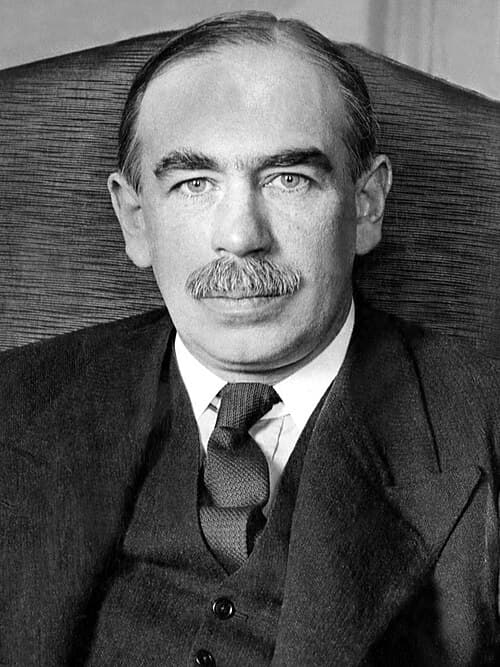
ine power. Looking back on his formative years, before Europe was ground up in the First World War, the powerfully brilliant and sensitive economist John Maynard Keynes bitterly recalled the iron certainty of his set of friends and their confident, diffident arrogance: “We were not aware that civilization was
Hillis thesis, p. 19 190 He drove: Po Bronson, “The Long Now: Time Traveling with Danny Hillis”, Wired (May, 1998) 191 Feynman: W. Daniel Hillis, “Richard Feynman and the Connection Machine” Physics Today February 1989, p. 78 192 “At times”: Michael J. Black “Book Reviews: The Connection Machine”, Al Magazine
2 mentions1 same-page
Page ?Same page
ovement of goods is largely automated, as are many services. What’s left for humans to do? In 1930—long before the advent of computers, let alone AI—John Maynard Keynes wrote, in an essay called “Economic Possibilities for our Grandchildren,” that as a result of improvements in productivity, society could prod
hine and founded what may have been the first Al company—Thinking Machines Corporation—to produce and market it. This was despite a lunch he had with Richard Feynman, at which the celebrated physicist remarked, “That is positively the dopiest idea I ever heard.” Maybe “despite” is the wrong word, since Feynman had
2 mentions1 same-page
Page ?Same page
ovement of goods is largely automated, as are many services. What’s left for humans to do? In 1930—long before the advent of computers, let alone AI—John Maynard Keynes wrote, in an essay called “Economic Possibilities for our Grandchildren,” that as a result of improvements in productivity, society could prod
hine and founded what may have been the first Al company—Thinking Machines Corporation—to produce and market it. This was despite a lunch he had with Richard Feynman, at which the celebrated physicist remarked, “That is positively the dopiest idea I ever heard.” Maybe “despite” is the wrong word, since Feynman had
Sponsored
2 mentions1 same-page
Page ?Same page
assical laws of motion and laid the basis for his theory of gravity, both of which form the foundation of much of modern physics. Never- theless, as John Maynard Keynes pointed out: Newton was not the first of the age of reason, he was the last of the magicians, the last of the Babylonians and Sumerians, the
small scales, nature behaves in a way that human intuition cannot ever fully embrace, because we cannot directly experience the behavior itself. As Richard Feynman once argued, no one understands quantum mechanics—if by under- stand one means developing a concrete physical picture that appears fully intuitive.
Sponsored
Mutual Connections (420)
Entities connected to both John Maynard and Richard Feynman
Feynman
PERSON5 w/ John·12 w/ Richard
Marc Rich
PERSON7 w/ John·10 w/ Richard
DB
Doug Band
PERSON6 w/ John·10 w/ Richard
Alan Dershowitz
PERSON6 w/ John·10 w/ Richard
George W. Bush
PERSON8 w/ John·8 w/ Richard
Earth
LOCATION5 w/ John·10 w/ Richard
Stephen Hawking
PERSON5 w/ John·10 w/ Richard
Eric Trump
PERSON6 w/ John·8 w/ Richard
Harvey Weinstein
PERSON5 w/ John·9 w/ Richard
Julie K. Brown
PERSON6 w/ John·8 w/ Richard
Keynes
PERSON9 w/ John·4 w/ Richard
LB
Leon Black
PERSON4 w/ John·9 w/ Richard
Prince Andrew
PERSON5 w/ John·7 w/ Richard
Samantha Power
PERSON5 w/ John·7 w/ Richard
Quantum
ORGANIZATION4 w/ John·8 w/ Richard
Ghislaine Maxwell
PERSON3 w/ John·8 w/ Richard
Berkeley
LOCATION2 w/ John·9 w/ Richard
Barack Obama
PERSON5 w/ John·6 w/ Richard
Turing
PERSON3 w/ John·8 w/ Richard
Marvin Minsky
PERSON3 w/ John·7 w/ Richard