Back to People & Entities







BH
Branzburg v. Hayes
Person
27
Total Mentions
22
Documents
624
Connected Entities
Person referenced in documents
Document Mentions (20 of 22)
EFTA01699638.pdf
2 mentionsEFTA01699638
ly carried out until every available clue has been run down and all witnesses examined in every proper way to find if a crime has been committed.' Branzburg v. Hayes, 408 U.S. 665, 701, 92 S.Q. 2646, 2667, 33 L.Ed.2d 626 (1972) (quoting United Sixes v. •Stone, 429 F.2d 138, 140 (24 Cir.1970)); In re Gr
ivileges. A grand jury subpoena may not be unreasonable or oppressive, and it may not violate a constitutional, common law or statutory privilege. Branzburg, 408 U.S. at 68S, 92 S.Ct. at 2660; Fed.R.Crim.P. 17(c). Grand jury subpoenas are presumed to be reasonable and the party seeking to quash the
EFTA00186748.pdf
2 mentionsEFTA00186748
y carried out until every available clue has been run down and all witnesses examined in every proper way to fmd if a crime has been committed.' " Branzburg v. Hayes, 408 U.S. 665, 701, 92 S.Ct. 2646, 2667, 33 L.Ed.2d 626 (1972) (quoting United States v. Stone, 429 P.2d 138, 140 (2d Cir.1970)); In re Grand Jury
ivileges. A grand jury subpoena may not be unreasonable or oppressive, and it may not violate a constitutional, common law or statutory privilege. Branzburg, 408 U.S. at 688, 92 S.Ct. at 2660; Fed.R.Crim.P. 17(c). Grand jury subpoenas are presumed to be reasonable and the party seeking to quash the s
EFTA00277521.pdf
2 mentionsEFTA00277521
carried out until every available clue has been run down and all witnesses examined in every proper way to find if a crime has been committed.' " Branzburg v. Hayes, 408 U.S. 665, 701, 92 2646, 2667, 33 L.Ed.2d 626 (1972) (quoting United States v. Stone, 429 F.2d 138, 140 (2d Cir.1970)); In re Grand Jury Subpo
ivileges. A grand jury subpoena may not be unreasonable or oppressive, and it may not violate a constitutional, common law or statutory privilege. Branzburg, 408 U.S. at 68S, 92 S.Ct. at 2660; Fed.R.Crim.P. 17(c). Grand jury subpoenas are presumed to be reasonable and the party seeking to quash the
Sponsored
EFTA00186707.pdf
2 mentionsEFTA00186707
ivileges. A grand jury subpoena may not be unreasonable or oppressive, and it may not violate a constitutional, common law or statutory privilege. Branzburg, 408 U.S. at 688, 92 S.Ct. at 2660; Fed.R.Crim.P. 17(c). Grand jury subpoenas are presumed to be reasonable and the party seeking to quash the
carried out until every available clue has been run down and all witnesses examined in every proper way to find if a crime has been committed.' " Branzburg v. Hayes, 408 U.S. 665, 701, 92 S.Ct. 2646, 2667, 33 L.Ed.2d 626 (1972) (quoting United States v. Stone, 429 F.2d 138, 140 (2d Cir.1970)): In re Grand Jury
EFTA00596449.pdf
2 mentionsEFTA00596449
F.3d 62 (2d Cir. 1994) 13 Baxter v. Palmigiano, 425 U.S. 308 (1976) 21 Buttner v. Berg & Dorf, 138 ad 439, 525 MI.2d 858 (2d Dep't 1988) 19 Branzburg v. Hayes, 408 U.S. 665 (1972) 23 Brown & Williamson Tobacco CS E. v. Wigand, 1996 WL 350827 (Sup. Ct. OS Co. Feb. 28, 1996), affd, 228 ..2r1187,
Merriam-Webster Online (2010), /off-the-record ("`off-the-record': given or made in confidence and not for publication <off-the-record comments>"); Branzburg v. Hayes, 408 U.S. 665, 728 (1972) (Stewart J., dissenting) (defining "confidentiality" as "the promise or understanding that names or certain aspects of co
EFTA00207332.pdf
1 mentionEFTA00207332
to non-party subpoenas in private civil disputes. Lee v. Department of Justice. 413 F.3d 53, 58 (D.C. Cir. 2005) (limiting "the applicability of the Branzburg precedent to the circumstances considered by the court in Branzburg-that is. the context of a criminal proceeding, or even more specifically, a gra
Sponsored
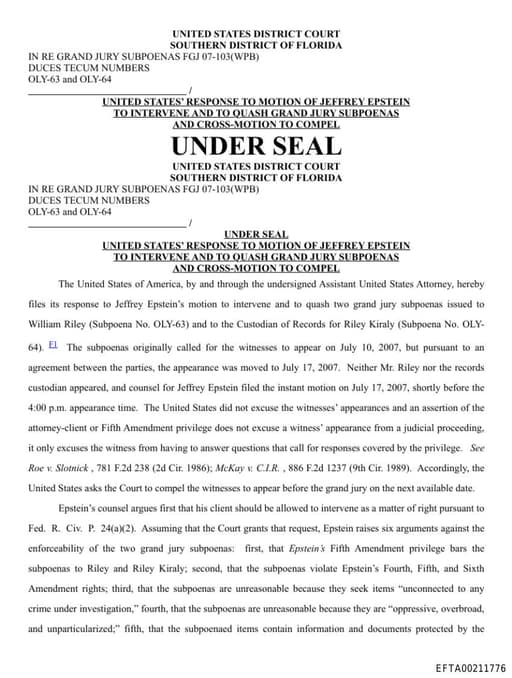
EFTA00211776.pdf
1 mentionEFTA00211776
pt for those persons protected by a constitutional, common-law or statutory privilege, . . . is particularly applicable to grand jury proceedings." Branzburg v. Hayes , 408 U.S. 665, 688 (1972) (citations omitted). In R. Enterprises , the Supreme Court held that subpoenas cannot be quashed on the basis o
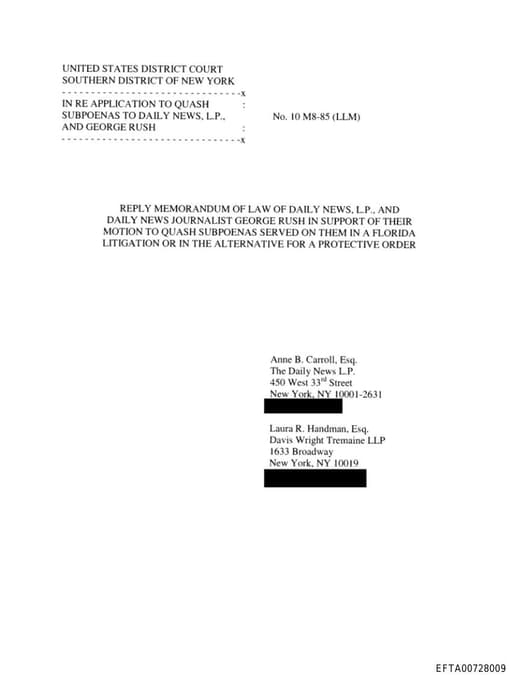
EFTA00728009.pdf
1 mentionEFTA00728009
to non-party subpoenas in private civil disputes. Lee v. Department of Justice. 413 F.3d 53, 58 (D.C. Cir. 2005) (limiting "the applicability of the Branzburg precedent to the circumstances considered by the court in Branzburg-that is. the context of a criminal proceeding, or even more specifically, a gra
EFTA00191587.pdf (email 1, pages 1-658)
1 mentionEFTA00191587_sub_003 - EFTA00191587_300
rom federalism and criminal cases; this investigation should have been enjoined if it lacked a reasonable basis or was initiated in bad faith. See Branzburg a Hayes, 408 U.S. 665, 699-701, 707-08, 92 S,Ct. 2646, 2665-2666, 2669-2670, 33 LEd.2d 626 (1972); Reporters Committee for Freedom of the Pre
Sponsored
EFTA00227381.pdf (email 1, pages 1-360)
1 mentionEFTA00227381_sub_002 - EFTA00227381_200
ivileges. A grand jury subpoena may not be unreasonable or oppressive, and it may not violate a constitutional, common law or statutory privilege. Branzburg, 408 U.S. at 688, 92 5.O. at 2660; Fed.R.Crim.R. 17(c). Grand jury subpoenas are presumed to be reasonable and the party seeking to quash the s
EFTA00178967.pdf
1 mentionEFTA00178967_sub_002 - EFTA00178967_200
pt for those persons protected by a constitutional, common-law or statutory privilege, . . . is particularly applicable to grand jury proceedings." Branzburg v. Hayes, 408 U.S. 665, 688 (1972) (citations omitted). In R. Enterprises, the Supreme Court held that subpoenas cannot be quashed on the basis of irrelevan
EFTA00102999.pdf
1 mentionEFTA00102999_sub_002 - EFTA00102999_200
s v. Calandra, 414 U.S. 338, 343 (1974)). "Wide latitude in gathering evidence is vital to the grand jury's investigative function." Id. at 422; see Branzburg v. Hayes, 408 U.S. 665, 688 (1972) ("Although the powers of the grand jury are not unlimited and are subject to the 78 EFTA00103103 supervision
Sponsored
EFTA00099941.pdf
1 mentionEFTA00099941_sub_002 - EFTA00099941_200
ates v. Calandra,414 U.S. 338, 343(1974)). "Wide latitude in gatheringevidence is vital to the grand jury's investigative function." Id. at 422; see Branzburg v. Hayes, 408 U.S. 665, 688 (1972) ("Although the powers of the grand jury are not unlimited and are subject to the 78 EFTA00100045 supervision
EFTA00077606.pdf
1 mentionEFTA00077606_sub_002 - EFTA00077606_200
s v. Calandra, 414 U.S. 338, 343 (1974)). "Wide latitude in gathering evidence is vital to the grand jury's investigative function." Id. at 422; see Branzburg v. Hayes, 408 U.S. 665, 688 (1972) ("Although the powers of the grand jury are not unlimited and are subject to the 78 EFTA00077710 supervision
EFTA00039421.pdf
1 mentionEFTA00039421_sub_002 - EFTA00039421_200
s v. Calandra, 414 U.S. 338, 343 (1974)). "Wide latitude in gathering evidence is vital to the grand jury's investigative function." Id. at 422; see Branzburg v. Hayes, 408 U.S. 665, 688 (1972) ("Although the powers of the grand jury are not unlimited and are subject to the 78 EFTA00039525 supervision
Sponsored
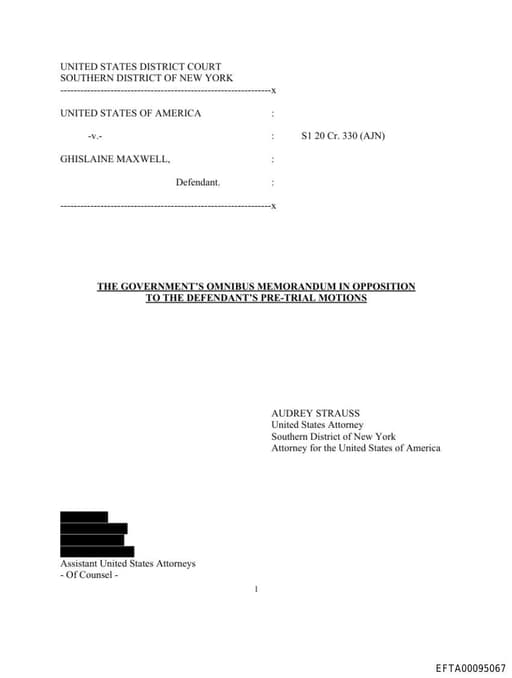
EFTA00095067.pdf
1 mentionEFTA00095067_sub_001 - EFTA00095067_100
ons, Inc., No. 97 Civ. 7587 (JGK), 1998 WL 88745 (S.D.N.Y. Feb. 27, 1998) 102 Boyd v. United States, 116 U.S. 616 (1886) 101 iv EFTA00095071 Branzburg v. Hayes, 408 U.S. 665 (1972) 78 Bridges v. United States, 346 U.S. 209 (1953) 38 Bronston v. United States, 409 U.S. 352 (1973) 121 Bryson
1 mention
such investigations it may compel the production of documentary evidence or the testimony of witnesses, as it deems necessary." Id. at 421-22; see Branzburg v. Hayes, 408 U.S. 665, 688 (1972) ("Although the powers of the grand jury are not unlimited and are subject to the supervision of a judge, the lon
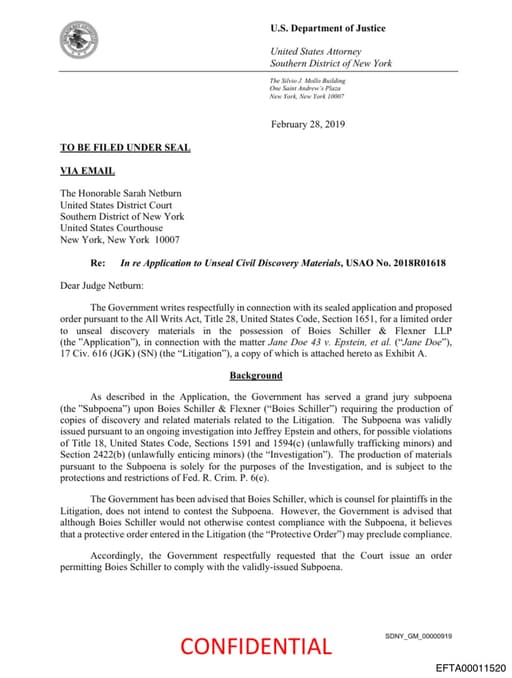
Page: EFTA00011523 →EFTA00095067.pdf
1 mentionEFTA00095067_sub_002 - EFTA00095067_200
s v. Calandra, 414 U.S. 338, 343 (1974)). "Wide latitude in gathering evidence is vital to the grand jury's investigative function." Id. at 422; see Branzburg v. Hayes, 408 U.S. 665, 688 (1972) ("Although the powers of the grand jury are not unlimited and are subject to the supervision of a judge, the lon
Sponsored
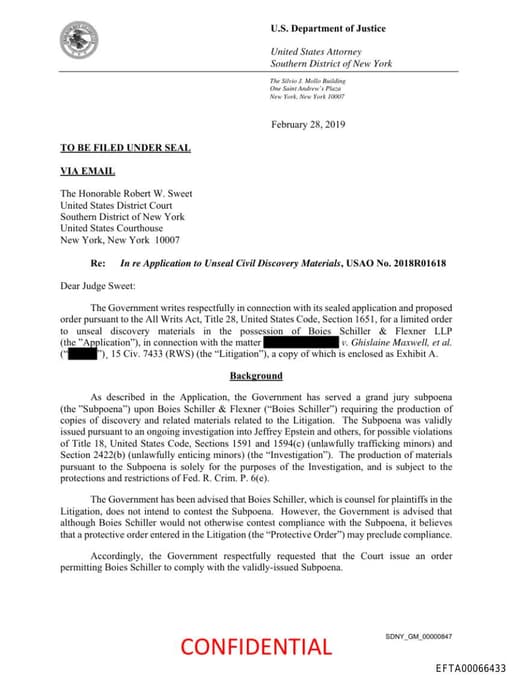
EFTA00066433.pdf
1 mentionEFTA00066433
such investigations it may compel the production of documentary evidence or the testimony of witnesses, as it deems necessary." Id. at 421-22; see Branzburg v. Hayes, 408 U.S. 665, 688 (1972) ("Although the powers of the grand jury are not unlimited and are subject to the supervision of a judge, the longstanding
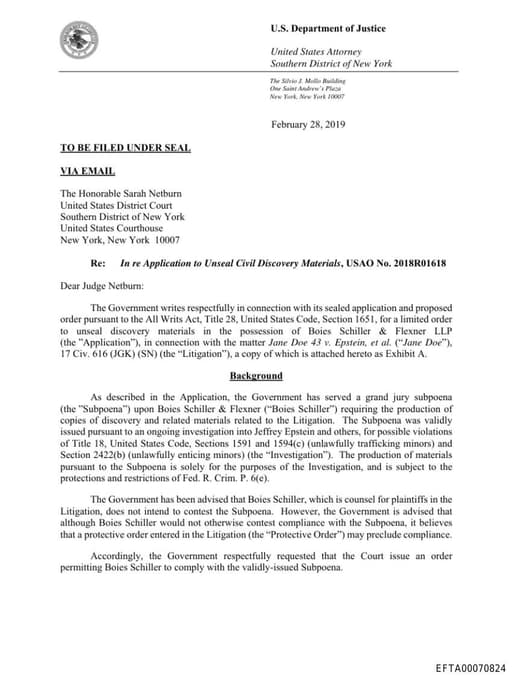
EFTA00070824.pdf
1 mentionEFTA00070824
such investigations it may compel the production of documentary evidence or the testimony of witnesses, as it deems necessary." Id. at 421-22; see Branzburg v. Hayes, 408 U.S. 665, 688 (1972) ("Although the powers of the grand jury are not unlimited and are subject to the supervision of a judge, the longstanding
Sponsored
Connected Entities(20 of 624)
Jeffrey Epstein
PersonAmerican sex offender and financier (1953–2019)
22 docs22 co-mentions
Julie K. Brown
PersonAmerican journalist
17 docs17 co-mentions
Scarlett Johansson
PersonAmerican actress (born 1984)
14 docs14 co-mentions
United States
LocationCountry located primarily in North America
14 docs14 co-mentions
David Boies
PersonAmerican lawyer and chairman
13 docs13 co-mentions
George W. Bush
PersonPresident of the United States from 2001 to 2009
13 docs13 co-mentions
Southern District of New York
OrganizationFederal judicial district covering Manhattan and surrounding areas
13 docs13 co-mentions
Department of Justice
OrganizationUnited States Department of Justice, federal executive department responsible for law enforcement
13 docs13 co-mentions
CA
Calandra
PersonSurname reference in documents
12 docs12 co-mentions
Hayes
PersonAmbiguous surname - refers to multiple people in Epstein documents
12 docs12 co-mentions
MA
Martindell
PersonSurname reference in Epstein-related documents
11 docs11 co-mentions
New York
LocationMost populous city in the United States
10 docs10 co-mentions
Bradley Edwards
PersonAmerican attorney who represented Epstein victims, author of Relentless Pursuit
10 docs10 co-mentions
Southern District
LocationFederal judicial district in New York City
10 docs10 co-mentions
Ghislaine Maxwell
PersonBritish socialite and sex trafficker, daughter of Robert Maxwell, accomplice of Jeffrey Epstein
10 docs10 co-mentions
SD
Subpoena Duces
PersonPerson referenced in documents
10 docs10 co-mentions
JD
Jane Doe
PersonPseudonym for anonymous victims/witnesses in Epstein legal proceedings
9 docs9 co-mentions
the Southern District
LocationFederal judicial district in New York City
9 docs9 co-mentions
SW
Sweet
PersonNER artifact - legal term or document reference misclassified as person
9 docs9 co-mentions
Supreme Court
OrganizationHighest court of jurisdiction in the US
8 docs8 co-mentions