Back to People & Entities




CA
Calandra
Person
25
Total Mentions
25
Documents
733
Connected Entities
Surname reference in documents
Document Mentions (20 of 25)
1 mention
jury is convened “to determine whether a crime has been committed and whether criminal proceedings should be instituted against any person.” U.S. v. Calandra, 414 U.S. 338, 344 (1974). An “action” is commenced against a person after the grand jury actually finds probable cause to make an individual answe
1 mention
ury is convened "to determine whether a crime has been committed and whether criminal proceedings should be instituted against any person." U.S. v. Calandra, 414 U.S. 338, 344 (1974). An "action" is commenced against a person after the grand jury actually finds probable cause to make an individual answe
Page: EFTA00014188 →1 mention
, 222 P.3d 925 (Cob. 2009) 10 People v. Mason, 989 P.2d 757 (Colo. 1999) 8 Smith v. Maryland, 442 U.S. 735, 740 (1979) passim United States v. Calandra, 414 U.S. 338 (1974) 6 United States v. Di Re, 332 U.S. 581 (1948) 6 United States v. Dionisio, 410 U.S. 1 (1973) 2, 15 United States v. Miller
Page: EFTA00015305 →Sponsored
EFTA00186707.pdf
1 mentionEFTA00186707
ng its investigation. See United States v. R. Enters., Inc., 498 U.S. 292, 297-98, 111 S.Ct. 722, 726, 112 L.Ed.2d 795 (1991); United States v. Calandra, 414 U.S. 338, 94 S.Ct. 613, 38 L.Ed.2d 561 (1974). "A grand jury investigation 'is not fully carried out until every available clue has been run
EFTA00186748.pdf
1 mentionEFTA00186748
ng its investigation. See United States V. R. Enters., Inc., 498 U.S. 292, 297-98, Ill S.Ct. 722, 726, 112 L.Ed.2d 795 (1991); Milted States v. Calandra, 414 U.S. 338, 94 S.Ct. 613, 38 L.Ed.2d 561 (1974). "A grand jury investigation 'is not fully carried out until every available clue has been run
EFTA00211776.pdf
1 mentionEFTA00211776
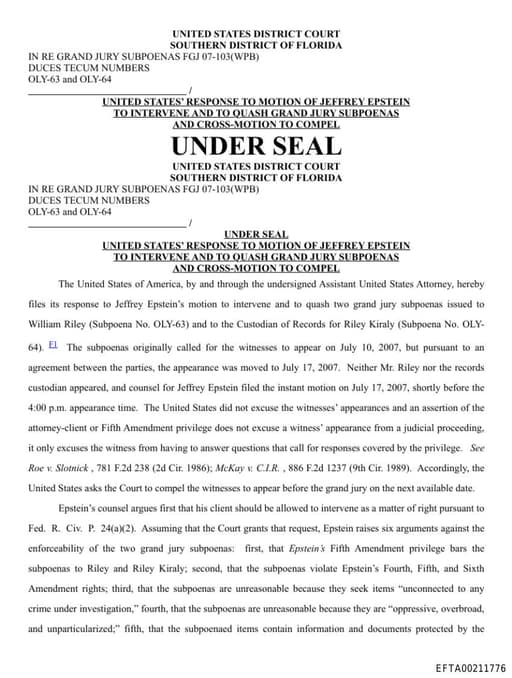
ts operation generally is unrestrained by the technical procedural and evidentiary rules governing the conduct of criminal trials." United States v. Calandra , 414 U.S. 338, 343 (1974). Courts are "mindful of the policy that `nowhere is the public's claim to each person's evidence stronger than in the con
Sponsored
EFTA00215875.pdf
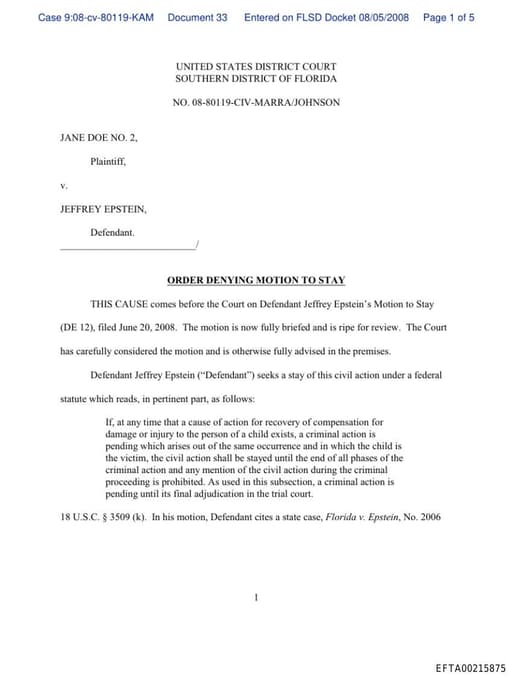
1 mentionEFTA00215875
ury is convened "to determine whether a crime has been committed and whether criminal proceedings should be instituted against any person." U.S. v. Calandra, 414 U.S. 338, 344 (1974). An "action" is commenced against a person after the grand jury actually finds probable cause to make an individual answe
EFTA00222992.pdf
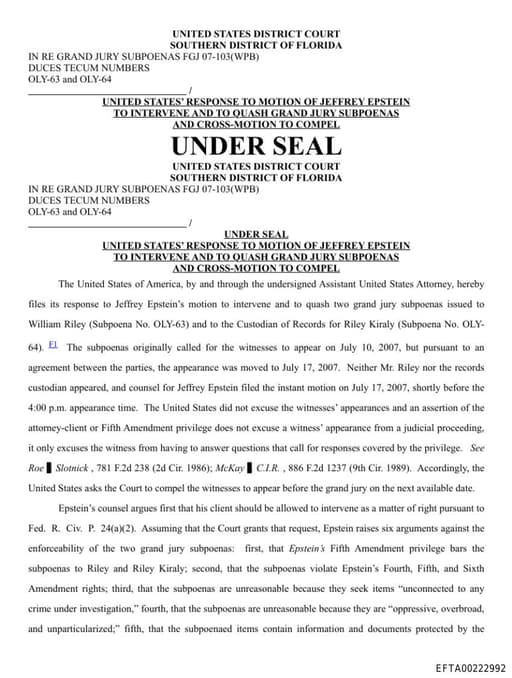
1 mentionEFTA00222992
its operation generally is unrestrained by the technical procedural and evidentiary rules governing the conduct of criminal trials." United States I Calandra , 414 U.S. 338, 343 (1974). Courts are "mindful of the policy that `nowhere is the public's claim to each person's evidence stronger than in the con
EFTA00277521.pdf
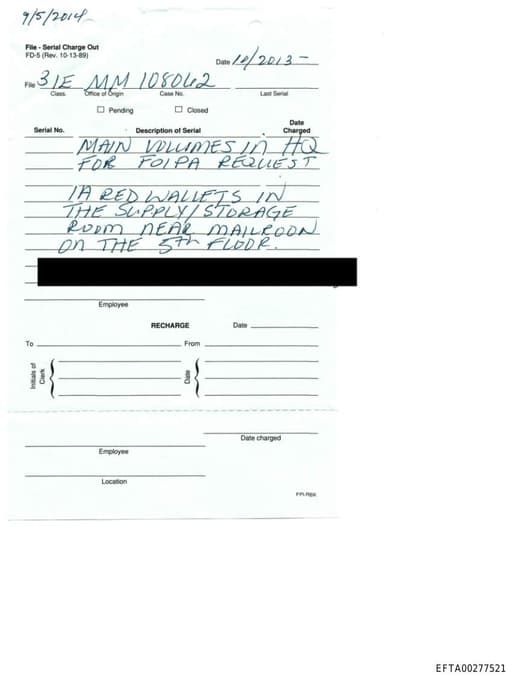
1 mentionEFTA00277521
ng its investigation. See United States v. R. Enters., Inc.. 498 U.S. 292. 297-98, Ill S.Ct. 722, 726, 112 L.Ed.2d 795 (1991); United States v. Calandra, 414 U.S. 338, 94 S.Ct. 613, 38 L.Ed.2d 561 (1974). "A grand jury investigation 'is not fully carried out until every available clue has been run
Sponsored
EFTA01579893.pdf
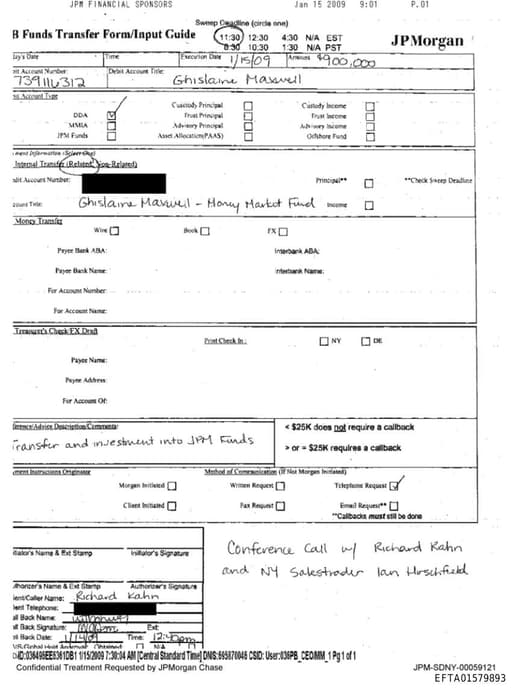
1 mentionEFTA01579893
unication (If Not Morgan Initials) Morgan Initiated 0 Wrincn Requcn 0 Tclephone Request II Client Initiated 0 Fax Request 0 Email Request" 0 ^ Calandra must sal be dome it/aloes Nang Br Ext Stamp initiators Stsnature ;Madera Name 8 Ext Sterna Authodzses Signatwe .giCkvida ientiCaller Name: len
EFTA01660018.pdf
1 mentionEFTA01660018
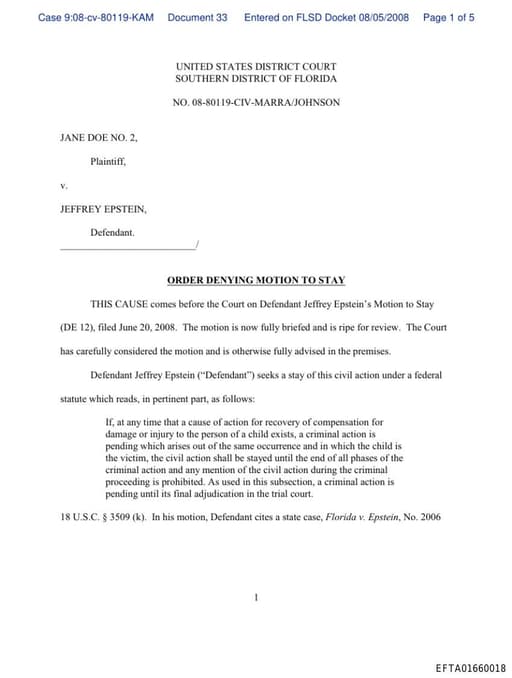
ury is convened "to determine whether a crime has been committed and whether criminal proceedings should be instituted against any person." U.S. v. Calandra, 414 U.S. 338, 344 (1974). An "action" is commenced against a person after the grand jury actually finds probable cause to make an individual answe
EFTA01699638.pdf
1 mentionEFTA01699638
ing its investigation. See United States v. R. Enters., Inc., 498 U.S. 292, 297-98, 111 S.Q. 722, 726, 112 L.Ed.2d 795 (1991); United Stares v. Calandra, 414 U.S. 338, 94 S.Ct. 613, 38 L.Ed.2d 561 (1974). PA grand jury investigation 'is not fully carried out until every available clue has been run
Sponsored
EFTA00227381.pdf (email 1, pages 1-360)
1 mentionEFTA00227381_sub_002 - EFTA00227381_200
ng its investigation. See United States v. R. Enters., Inc.. 498 U.S. 292, 297.98, Ill S.Ct. 722, 726, 112 L.Ed.2d 795 (1991); United States v. Calandra. 414 U.S. 338, 94 S.Ct. 613. 38 L.Ed.2d 561 (1974). 'A grand jury investigation 'is not fully carried out until every available clue has been run
EFTA00178967.pdf
1 mentionEFTA00178967_sub_002 - EFTA00178967_200
ts operation generally is unrestrained by the technical procedural and evidentiary rules governing the conduct of criminal trials." United States v. Calandra, 414 U.S. 338, 343 -10- EFTA00179109 (1974). Courts are "mindful of the policy that `nowhere is the public's claim to each person's evidence stro
EFTA00102999.pdf
1 mentionEFTA00102999_sub_001 - EFTA00102999_100
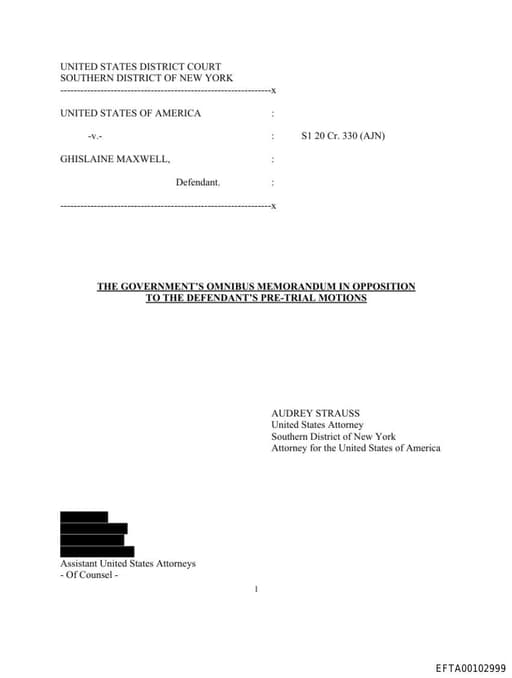
351 F. Supp. 121 (S.D.N.Y. 2004) 243 United States v. Butler, No. 04 Cr. 340, 2004 WL 2274751 (S.D.N.Y. Oct. 7, 2004) 208, 211 United States v. Calandra, 414 U.S. 338 (1974) 110 United States v. Laming, 968 F.2d 232 (2d Cir. 1992) 165 xi EFTA00103010 United States v. Campo Flores, No. 15 Cr.
Sponsored
EFTA00102999.pdf
1 mentionEFTA00102999_sub_002 - EFTA00102999_200
it may compel the production of documentary evidence or the testimony of witnesses, as it deems necessary." Id. at 421-22 (citing United States v. Calandra, 414 U.S. 338, 343 (1974)). "Wide latitude in gathering evidence is vital to the grand jury's investigative function." Id. at 422; see Branzburg v.
EFTA00099941.pdf
1 mentionEFTA00099941_sub_001 - EFTA00099941_100
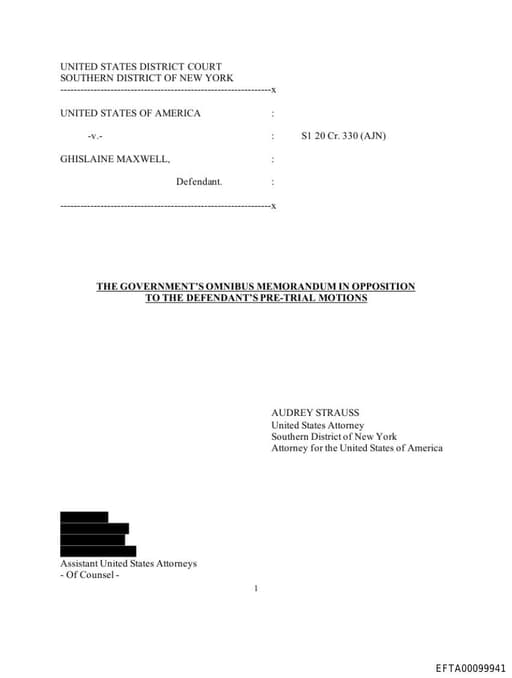
351 F. Supp. 121 (S.D.N.Y. 2004) 243 United States v. Butler, No. 04 Cr. 340, 2004 WL 2274751 (S.D.N.Y. Oct. 7, 2004) 208, 211 United States v. Calandra, 414 U.S. 338 (1974) 110 United States v. Caming, 968 F.2d 232 (2d Cir. 1992) 165 xi EFTA00099952 United States v. Campo Flores, No. 15 Cr.
EFTA00077606.pdf
1 mentionEFTA00077606_sub_001 - EFTA00077606_100
351 F. Supp. 121 (S.D.N.Y. 2004) 243 United States v. Butler, No. 04 Cr. 340, 2004 WL 2274751 (S.D.N.Y. Oct. 7, 2004) 208, 211 United States v. Calandra, 414 U.S. 338 (1974) 110 United States v. Caming, 968 F.2d 232 (2d Cir. 1992) 165 xi EFTA00077617 United States v. Campo Flores, No. 15 Cr.
Sponsored
EFTA00077606.pdf
1 mentionEFTA00077606_sub_002 - EFTA00077606_200
it may compel the production of documentary evidence or the testimony of witnesses, as it deems necessary." Id. at 421-22 (citing United States v. Calandra, 414 U.S. 338, 343 (1974)). "Wide latitude in gathering evidence is vital to the grand jury's investigative function." Id. at 422; see Branzburg v.
EFTA00039421.pdf
1 mentionEFTA00039421_sub_001 - EFTA00039421_100
351 F. Supp. 121 (S.D.N.Y. 2004) 243 United States v. Butler, No. 04 Cr. 340, 2004 WL 2274751 (S.D.N.Y. Oct. 7, 2004) 208, 211 United States v. Calandra, 414 U.S. 338 (1974) 110 United States v. Caming, 968 F.2d 232 (2d Cir. 1992) 165 xi EFTA00039432 United States v. Campo Flores, No. 15 Cr.
Sponsored
Connected Entities(20 of 733)
Jeffrey Epstein
PersonAmerican sex offender and financier (1953–2019)
24 docs24 co-mentions
Scarlett Johansson
PersonAmerican actress (born 1984)
20 docs20 co-mentions
United States
LocationCountry located primarily in North America
19 docs19 co-mentions
Julie K. Brown
PersonAmerican journalist
19 docs19 co-mentions
Southern District of New York
OrganizationFederal judicial district covering Manhattan and surrounding areas
14 docs14 co-mentions
JD
Jane Doe
PersonPseudonym for anonymous victims/witnesses in Epstein legal proceedings
14 docs14 co-mentions
Supreme Court
OrganizationHighest court of jurisdiction in the US
13 docs13 co-mentions
BH
Branzburg v. Hayes
PersonPerson referenced in documents
12 docs12 co-mentions
Alexander Acosta
PersonAmerican attorney and politician, 27th U.S. Secretary of Labor (born 1969)
12 docs12 co-mentions
FI
Fisher
PersonSurname reference in Epstein documents
12 docs12 co-mentions
Cynthia Nixon
PersonAmerican actress and politician
12 docs12 co-mentions
Hayes
PersonAmbiguous surname - refers to multiple people in Epstein documents
12 docs12 co-mentions
FBI
OrganizationFederal Bureau of Investigation, domestic intelligence and security service of the United States
12 docs12 co-mentions
MW
Martin Weinberg
PersonAmerican attorney (born 1946)
11 docs11 co-mentions
David Boies
PersonAmerican lawyer and chairman
11 docs11 co-mentions
George W. Bush
PersonPresident of the United States from 2001 to 2009
11 docs11 co-mentions
the Southern District
LocationFederal judicial district in New York City
11 docs11 co-mentions
Colorado
LocationState of the United States of America
10 docs10 co-mentions
Ghislaine Maxwell
PersonBritish socialite and sex trafficker, daughter of Robert Maxwell, accomplice of Jeffrey Epstein
10 docs10 co-mentions
Sacramento
LocationCapital city of the U.S. state of California and seat of Sacramento County
10 docs10 co-mentions