Back to Network


















4
Shared Docs
4
Same-Page
4 / 5
Mentions
Document Mentions (4 shared documents)
3 mentions1 same-page
Page ?Same page
untry was, to begin with, born out of the social and political revolutions of the 18" century. The national liberation that pulled Jefferson from his Virginia farm and into politics was the first of the great, revolutionary movements that convulsed and fractured a dozen European powers. France followed Amer
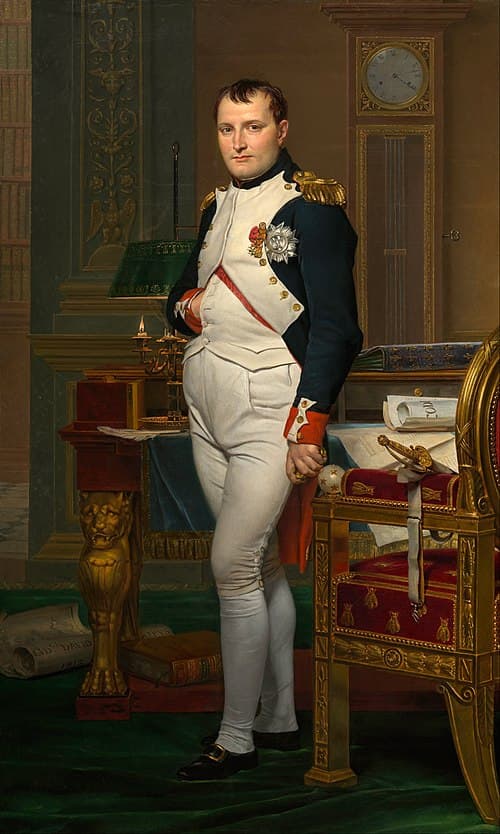
decisive mark of leadership and success in revolutionary periods. Consider, for instance, Charles, the Duke of Brunswick-Wolfenbuttel who faced down Napoleon on the fields of Jena in what is now central Germany in October 1806. Brusnwick-Wolfenbuttel was then 71 years old. He was considered one of the most
rs to one. His men were masters of the subtle techniques of Frederick the Great, tactics that had delivered victory in far more perilous moments. But Napoleon, less than half the Duke’s age at 37, stared across the same undulating land, the same poised armies and saw in the landscape something completely 4
2 mentions1 same-page
Page ?Same page
tory of how it went wrong, in Shepherdstown, West Virginia, with the Syrians and at Camp David with Yasir A
an. More troubling is his lack of social or emotional intelligence. He's often called aloof and arrogant -- not for nothing do his friends call him Napoleon -- and he is infamous for acting like he's the smartest guy in the room, as though "surrounded by mental pygmies," according to Makovsky. During ou
2 mentions1 same-page
Page ?Same page
ct of various works in cognitive science. Hirsch was made to look like a fool so often that he resorted to hir- ing a cognitive science professor at Virginia, who has written a book justifying the same nonsense with more cognitive science facts.” There is plenty of work in cognitive science that shows tha
ins with a goal. However, when we think about education and school, we often forget this. Someone, somewhere, decides that a student must learn about Napoleon, but fails to ask how such learning might conform to a goal that the student consciously holds. We don’t forget this when we try to teach a child to
Sponsored
2 mentions1 same-page
Page ?Same page
ent: Ben S. Bernanke, “Money, Gold, and the Great Depression”, H. Parker Willis Lecture in Economic Policy, Washington and Lee University, Lexington, Virginia March 2, 2004 165 HOUSE_OVERSIGHT_018397 “Computer systems are, like many other things in engineering, constructed by composition,” computer resea
ciples of power in a connected age. “Read over and over again the campaigns of Alexander, Hannibal, Caesar, Gustavus, Turenne, Eugene and Frederick,” Napoleon wrote once. “Make them your models. This is the 147 | was thinking: Dan Geer, “Cybersecurity as Realpolitik”, speech delivered at BlackHat, August 6
Sponsored
Mutual Connections (419)
Entities connected to both Virginia Giuffre and Napoleon
Jeffrey Epstein
PERSON1,539 w/ Virginia·30 w/ Napoleon
Prince Andrew
PERSON687 w/ Virginia·4 w/ Napoleon
Ghislaine Maxwell
PERSON683 w/ Virginia·3 w/ Napoleon
Donald Trump
PERSON641 w/ Virginia·3 w/ Napoleon
Department of Justice
ORGANIZATION522 w/ Virginia·3 w/ Napoleon
George W. Bush
PERSON499 w/ Virginia·14 w/ Napoleon
United States
LOCATION474 w/ Virginia·14 w/ Napoleon
Alan Dershowitz
PERSON457 w/ Virginia·5 w/ Napoleon
LB
Leon Black
PERSON439 w/ Virginia·6 w/ Napoleon
Bradley Edwards
PERSON418 w/ Virginia·2 w/ Napoleon
Bill Clinton
PERSON408 w/ Virginia·10 w/ Napoleon
Julie K. Brown
PERSON376 w/ Virginia·3 w/ Napoleon
New York
LOCATION376 w/ Virginia·2 w/ Napoleon
Joe Biden
PERSON361 w/ Virginia·8 w/ Napoleon
Marc Rich
PERSON323 w/ Virginia·16 w/ Napoleon
Prince Charles
PERSON312 w/ Virginia·4 w/ Napoleon
Barack Obama
PERSON298 w/ Virginia·17 w/ Napoleon
Stephen Hawking
PERSON309 w/ Virginia·5 w/ Napoleon
MF
Maria Farmer
PERSON306 w/ Virginia·3 w/ Napoleon
Colorado
LOCATION279 w/ Virginia·2 w/ Napoleon