Back to Network


















5
Shared Docs
5
Same-Page
5 / 5
Mentions
Document Mentions (5 shared documents)
2 mentions1 same-page
Page ?Same page
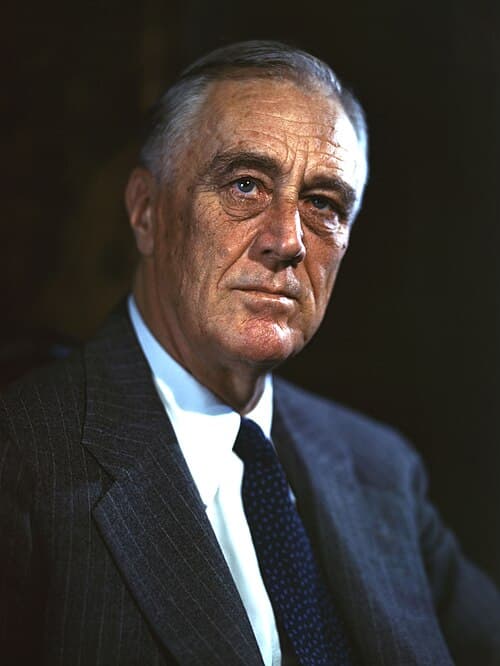
tected and promoted around the world, not only as a good in itself but as a way to safeguard U.S. national security. Consider the case of President Franklin D. Roosevelt. Several years before the Japanese attack on Pearl Harbor, Roosevelt wanted the United States to take a more proactive role in resisting Nazi Germa
U.S. interests and ideals, Roosevelt built a powerful case for an anti-Nazi policy that allowed him to extend lend-lease aid to United Kingdom and the Soviet Union and do battle with the German navy even before December 1941. Once the United States entered the war, religion was an important part of the ideolog
2 mentions1 same-page
Page ?Same page
ain, from 1938 to 1940. The senior Kennedy had predicted that Germany would defeat England and he HOUSE_OVERSIGHT_015080 therefore urged President Franklin D. Roosevelt to withhold aid. Now Johnson found himself fighting pragmatism with pragmatism. It did not work; he lost the nomination. Ironically, the vicissitude
ssible to bring about the collapse of an entire economy by shutting down one integral aspect, especially communications or transportation. Moreover, the Soviet Union was trying to cut off the United States’ supply of a metal vital to jet engine production, by their support of the Allende government in Chile and al
2 mentions1 same-page
Page ?Same page
ing in Asia and | | Epst_9780451494566_2p_all_r1.indd 198 @ 9/30/16 8:13AM | | HOUSE_OVERSIGHT_019686 The Rise of the NSA | 199 Europe, President Franklin D. Roosevelt reactivated the operation as the Signal Security Agency. It proved its value in breaking the Japanese machine-generated cipher “Purple.” In June 1942
198 | HOW AMERICA LOST ITS SECRETS of the communications of its adversaries. Even though the Cold War had been declared over after the collapse of the Soviet Union a quar- ter of a century earlier, the age-old enterprise of espionage did not end with it. Russia and China still sought to blunt the edge that the N
Sponsored
2 mentions1 same-page
Page ?Same page
amber saying famously “Gentlemen should not read each other's mail.” The moratorium did not last long. With war looming in Asia and Europe, President Franklin D. Roosevelt reactivated the operation as the Signals Security Agency. It proved its value in breaking the Japanese machine-generated cipher “purple.” In June 194
re he leaked information that exposed CIA operations. Although Agee insisted he was a whistle-blower, and he adamantly denied offering any secrets to the Soviet Union, the KGB viewed him as a conventional spy. According to Oleg Kalugin, the top Soviet counterintelligence officer in the KGB in Moscow, who defected t
2 mentions1 same-page
Page ?Same page
at the Germans had to start attacking at night. This meant they had a much smaller chance of hitting their assigned targets. In America, President Franklin D. Roosevelt declared his resolve to build 50,000 warplanes EFTA00585503 24 — a number that sounded reassuring until it was later revealed that Roosevelt had
in the 1960s, the cold war hastened the warplane's decline. As van Creveld notes, during the entire 45-year conflict between the United States and the Soviet Union, not once did combat aircraft of the two countries directly fight each other as part of their own air forces (though Soviet pilots did fight Americ
Sponsored
Mutual Connections (320)
Entities connected to both Franklin D. Roosevelt and the Soviet Union
Barack Obama
PERSON11 w/ Franklin·88 w/ the
United States
LOCATION10 w/ Franklin·86 w/ the
George W. Bush
PERSON12 w/ Franklin·80 w/ the
Bill Clinton
PERSON8 w/ Franklin·72 w/ the
LB
Leon Black
PERSON7 w/ Franklin·61 w/ the
Marc Rich
PERSON10 w/ Franklin·57 w/ the
Jeffrey Epstein
PERSON4 w/ Franklin·63 w/ the
Joe Biden
PERSON5 w/ Franklin·55 w/ the
Bashar al-Assad
PERSON6 w/ Franklin·51 w/ the
Vladimir Putin
PERSON6 w/ Franklin·51 w/ the
John F. Kennedy
PERSON8 w/ Franklin·48 w/ the
Julie K. Brown
PERSON6 w/ Franklin·47 w/ the
Department of Justice
ORGANIZATION3 w/ Franklin·50 w/ the
Prince Andrew
PERSON4 w/ Franklin·48 w/ the
Michael Cohen
PERSON2 w/ Franklin·50 w/ the
Middle East
LOCATION4 w/ Franklin·47 w/ the
Donald Trump
PERSON5 w/ Franklin·45 w/ the
Stephen Hawking
PERSON3 w/ Franklin·45 w/ the
Virginia Giuffre
PERSON5 w/ Franklin·42 w/ the
Saddam Hussein
PERSON5 w/ Franklin·41 w/ the