Back to Network













3
Shared Docs
3
Same-Page
6 / 3
Mentions
Document Mentions (3 shared documents)
3 mentions1 same-page
Page ?Same page
abbage — but he was the first to fully understand its power. When we talk about computers today we mean machines, but it is worth noting computers in Turing’s time were more often humans using pencil and paper. The mechanical computers before Turing were elementary at best. Rudimentary calculating machi
not Turing complete and his Analytical Engine has never been built. 19" Century Calculators HOUSE_OVERSIGHT_015706 Mind over Computer 17 In 1935, Turing was made a Fellow of King’s College, Cambridge, and became interested in whether mathematical proofs could be found automatically. He wanted to know
ek Island of Antikythera had cogs and gears and could accurately predict the motions of the sun and planets. Many Babbage’s Difference Engine No. 2, Computer History Museum, CA HOUSE_OVERSIGHT_015705 16 Are the Androids Dreaming Yet? of these skills were lost in the Dark Ages but, once the Renaissance was underway in
3 mentions1 same-page
Page ?Same page
a topic absent from a typical computer-science education: the physical configuration of a 118 HOUSE_OVERSIGHT_016921 computation. Von Neumann and Turing posed their questions as theoretical studies, because it was beyond the technology of their day to realize them. But with the convergence of communic
ce in terms of feedback, exploring the cultural rather than engineering uptake of this idea. She begins with primary readings by Wiener, Shannon, and Turing and then pivots from the scientists and engineers to the work and ideas of artists, feminists, postmodern theorists. Her goal: to come up with a new
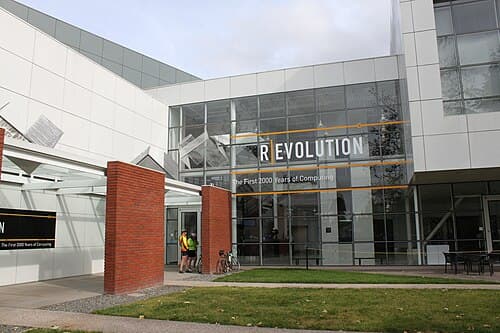
n undergraduate at MIT, he built a computer out of Tinkertoys. It has around 10,000 wooden parts, plays tic-tac-toe, and never loses; it’s now in the Computer History Museum, in Mountain View, California. As a graduate student at the MIT Computer Science and Artificial Intelligence Laboratory in the early 1980s, Danny de
3 mentions1 same-page
Page ?Same page
a topic absent from a typical computer-science education: the physical configuration of a 118 HOUSE_OVERSIGHT_016338 computation. Von Neumann and Turing posed their questions as theoretical studies, because it was beyond the technology of their day to realize them. But with the convergence of communic
ce in terms of feedback, exploring the cultural rather than engineering uptake of this idea. She begins with primary readings by Wiener, Shannon, and Turing and then pivots from the scientists and engineers to the work and ideas of artists, feminists, postmodern theorists. Her goal: to come up with a new
n undergraduate at MIT, he built a computer out of Tinkertoys. It has around 10,000 wooden parts, plays tic-tac-toe, and never loses; it’s now in the Computer History Museum, in Mountain View, California. As a graduate student at the MIT Computer Science and Artificial Intelligence Laboratory in the early 1980s, Danny de
Sponsored
Mutual Connections (380)
Entities connected to both Turing and Computer History Museum
Stephen Hawking
PERSON29 w/ Turing·3 w/ Computer
Alan Dershowitz
PERSON27 w/ Turing·3 w/ Computer
Samantha Power
PERSON19 w/ Turing·3 w/ Computer
Earth
LOCATION18 w/ Turing·3 w/ Computer
George W. Bush
PERSON18 w/ Turing·2 w/ Computer
Alan Turing
PERSON17 w/ Turing·3 w/ Computer
Marvin Minsky
PERSON18 w/ Turing·2 w/ Computer
Harvey Weinstein
PERSON17 w/ Turing·3 w/ Computer
Marc Rich
PERSON16 w/ Turing·3 w/ Computer
Wilbur Ross
PERSON16 w/ Turing·2 w/ Computer
Daniel Dennett
PERSON14 w/ Turing·3 w/ Computer
Richard Dawkins
PERSON15 w/ Turing·2 w/ Computer
Bill Gates
PERSON15 w/ Turing·2 w/ Computer
Robert Gates
PERSON14 w/ Turing·2 w/ Computer
Prince Andrew
PERSON13 w/ Turing·3 w/ Computer
Elon Musk
PERSON13 w/ Turing·2 w/ Computer
Quantum
ORGANIZATION12 w/ Turing·3 w/ Computer
WO
Wolfram
PERSON13 w/ Turing·2 w/ Computer
John Brockman
PERSON13 w/ Turing·2 w/ Computer
DB
Doug Band
PERSON11 w/ Turing·3 w/ Computer