Back to People & Entities






WO
Wolfram
Person
156
Total Mentions
138
Documents
1,198
Connected Entities
Ambiguous - refers to both Stephen Wolfram (scientist) and Wolfram Lange (Deutsche Bank) in Epstein documents
Stephen Wolfram appears in the Epstein documents primarily as a subject of discussion in government records, with his scientific work and computational tools referenced in contexts that include oversight and investigative materials.
The mentions are concentrated in government oversight records, where Wolfram's scientific contributions—particularly his book 'A New Kind of Science' and the Mathematica computational system—are discussed in detail. These appearances are in substantive contexts such as analysis of cellular automata models and computational approaches, rather than personal correspondence or flight logs. The documents reference his credentials, including his education at Eton, Oxford, and Caltech, and his founding of Wolfram Research, suggesting his work is being examined for its potential applications or implications in various fields.
Key Highlights
- •Wolfram's book 'A New Kind of Science' is referenced as a theoretical framework for understanding complex systems and cellular automata in government oversight documents
- •His creation of Mathematica and Wolfram Language is highlighted as a major contribution to computational science and symbolic computation
- •Multiple documents discuss his scientific background, including his Ph.D. in theoretical physics at age 20 and his role as CEO of Wolfram Research
Frequently Asked Questions
Related Links
Books for Further Reading
Perversion of Justice: The Jeffrey Epstein Story
Julie K. Brown
Investigative journalism that broke the Epstein case open
Filthy Rich: The Jeffrey Epstein Story
James Patterson
Bestselling account of Epstein's crimes and network
Relentless Pursuit: My Fight for the Victims of Jeffrey Epstein
Bradley J. Edwards
Victims' attorney's firsthand account
Document Mentions (20 of 138)
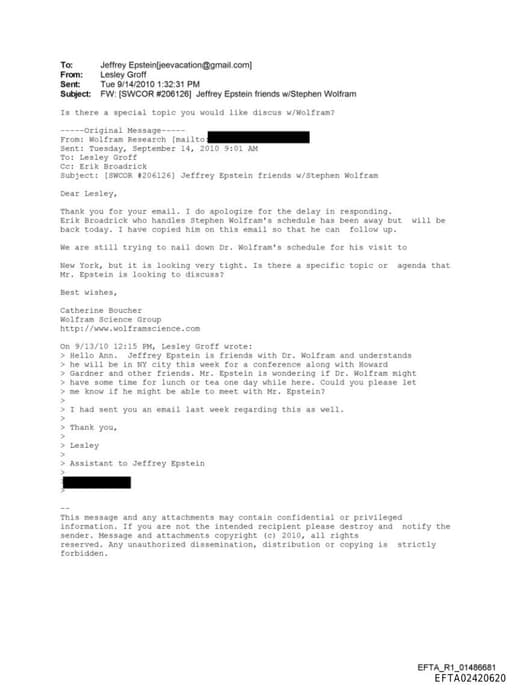
EFTA02420620.pdf
2 mentionsEFTA02420620
: Tue 9/14/2010 1:32:31 PM Subject FW: [SWCOR #206126] Jeffrey Epstein friends w/Stephen Wolfram Is there a special topic you would like discus w/Wolfram? Original Message From: Wolfram Research [mailto Sent: Tuesday, September 14, 2010 9:01 AM To: Lesley Groff Cc: Erik Broadrick Subject: (SWCO
ram's schedule has been away but will be back today. I have copied him on this email so that he can follow up. We are still trying to nail down Dr. Wolfram's schedule for his visit to New York, but it is looking very tight. Is there a specific topic or agenda that Mr. Epstein is looking to discuss? Be
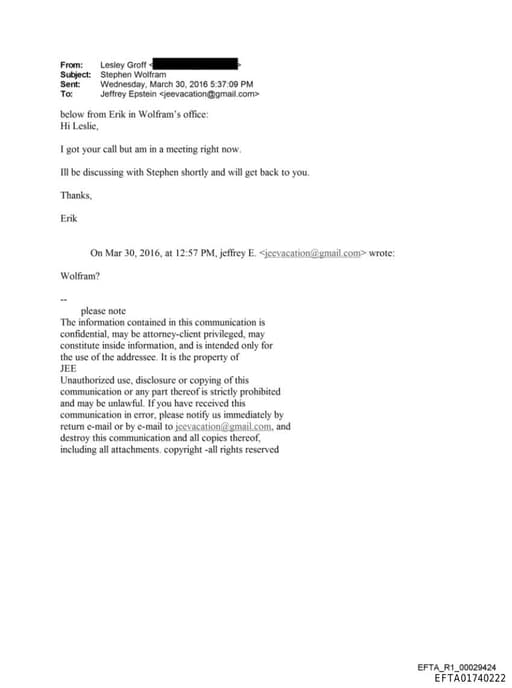
EFTA01740222.pdf
2 mentionsEFTA01740222
Lesley Groff Subject Stephen Wolfram Sent Wednesday, March 30, 2016 5:37:09 PM To: Jeffrey Epstein <jeevacationegmail.com> below from Erik in Wolfram's office: Hi Leslie, I got your call but am in a meeting right now. Ill be discussing with Stephen shortly and will get back to you. Thanks, Eri
be discussing with Stephen shortly and will get back to you. Thanks, Erik On Mar 30, 2016, at 12:57 PM, jeffrey E. <[email protected]> wrote: Wolfram? please note The information contained in this communication is confidential, may be attorney-client privileged, may constitute inside informatio
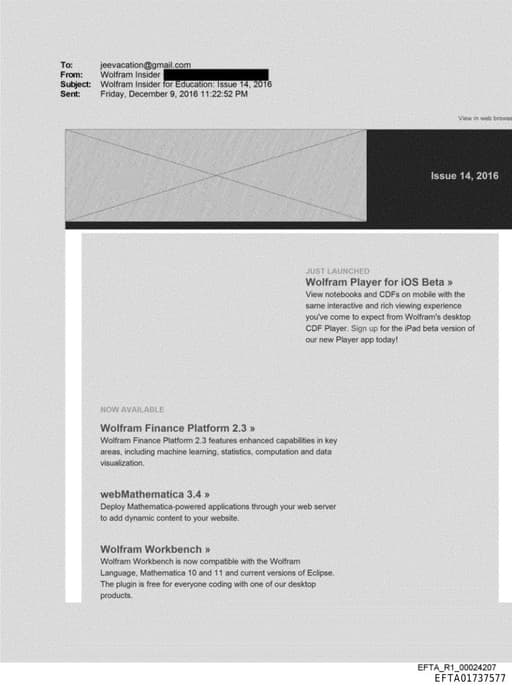
EFTA01737577.pdf
2 mentionsEFTA01737577
ered applications through your web server to add dynamic content to your website. Wolfram Workbench » Wolfram Workbench is now compatible with the Wolfram Language, Mathematica 10 and 11 and current versions of Eclipse. The plugin is free for everyone coding with one of our desktop products. EFTA_R1
Wolfram Player for iOS Beta » View notebooks and CDFs on mobile with the same interactive and rich viewing experience you've come to expect from Wolfram's desktop CDF Player. Sign up for the iPad beta version of our new Player app today! NOW AVAILABI.1 Wolfram Finance Platform 2.3 » Wolfram Finan
Sponsored
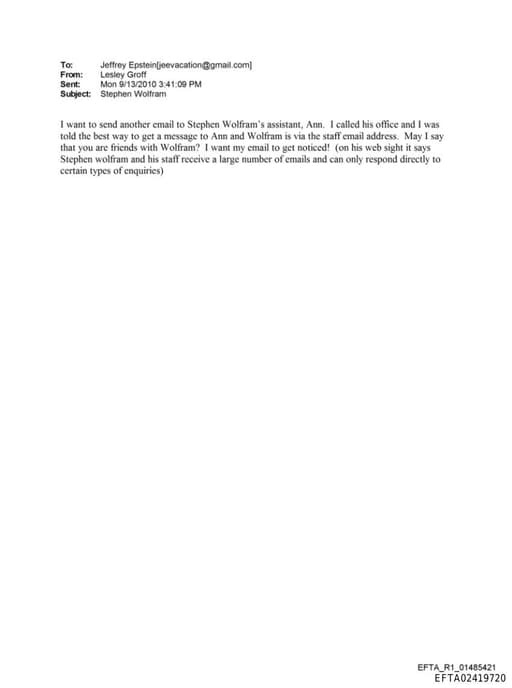
EFTA02419720.pdf
2 mentionsEFTA02419720
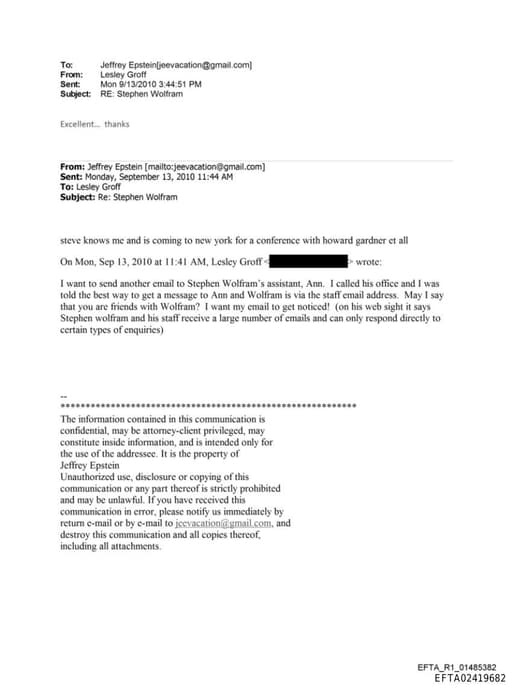
lled his office and I was told the best way to get a message to Ann and Wolfram is via the staff email address. May I say that you are friends with Wolfram? I want my email to get noticed! (on his web sight it says Stephen wolfram and his staff receive a large number of emails and can only respond direc
lfram I want to send another email to Stephen Wolfram's assistant, Ann. I called his office and I was told the best way to get a message to Ann and Wolfram is via the staff email address. May I say that you are friends with Wolfram? I want my email to get noticed! (on his web sight it says Stephen wolf
EFTA02454344.pdf
2 mentionsEFTA02454344
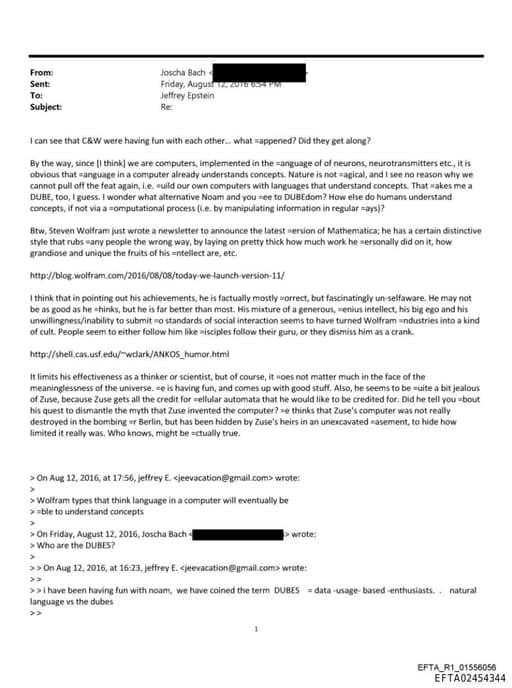
xture of a generous, =enius intellect, his big ego and his unwillingness/inability to submit =o standards of social interaction seems to have turned Wolfram =ndustries into a kind of cult. People seem to either follow him like =isciples follow their guru, or they dismiss him as a crank. http://shell.cas
nt, to hide how limited it really was. Who knows, might be =ctually true. > On Aug 12, 2016, at 17:56, jeffrey E. <[email protected]> wrote: > Wolfram types that think language in a computer will eventually be > =ble to understand concepts > On Friday, August 12, 2016, Joscha Bach > wrote: > Who
AreTheAndroids_James Tagg_small_p2.pdf
2 mentionsHOUSE_OVERSIGHT_015675_sub_005 - HOUSE_OVERSIGHT_016110
Source: House Oversight Committee
stitute of Personnel and Development, 2006. Wolf, Maryanne. Proust and the Squid: The Story and Science of the Reading Brain. Icon Books Ltd, 2008. Wolfram, Stephen. A New Kind of Science. First Edition. Wolfram Media Inc, 2002. Chapter 2 Carr, Jimmy, and Lucy Greeves. The Naked Jape: Uncovering the Hi
lder, Billy 128 Wiles, Andrew xi, 75, 242, 248, 251, 254, 259, 261, 351 Wiles Paradox 247 William of Occam 68 Winchester Drives 306 Wise, Michael 335 Wolfram, Stephen 173, 246, 352 Woods, Tiger 116 WordPress 237 World War I (First World War) 211, 337 World War II (Second World War) 17, 218, 337 code breake
Sponsored
EFTA00631633.pdf
2 mentionsEFTA00631633
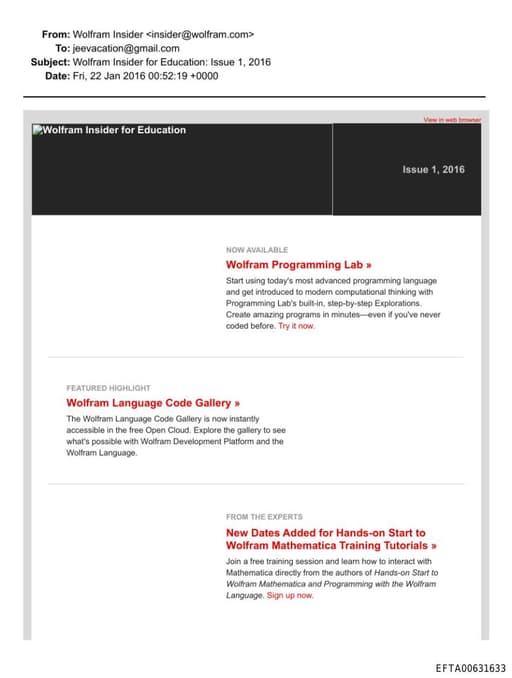
ning session and learn how to interact with Mathematica directly from the authors of Hands-on Start to Wolfram Mathematica and Programming with the Wolfram Language. Sign up now. EFTA00631633 Modeling and Simulation with Wolfram SystemModeler: Virtual Workshop » Discover new features in Wolfram Sys
rts on February 9. Seats are limited, so register today. JUST POSTED New Wolfram Language Books » Check out the latest publications incorporating Wolfram technologies. Popular new titles also include An Elementary Introduction to the Wolfram Language by Stephen Wolfram and Hands-on Start to Wolfram
EFTA00636246.pdf
2 mentionsEFTA00636246
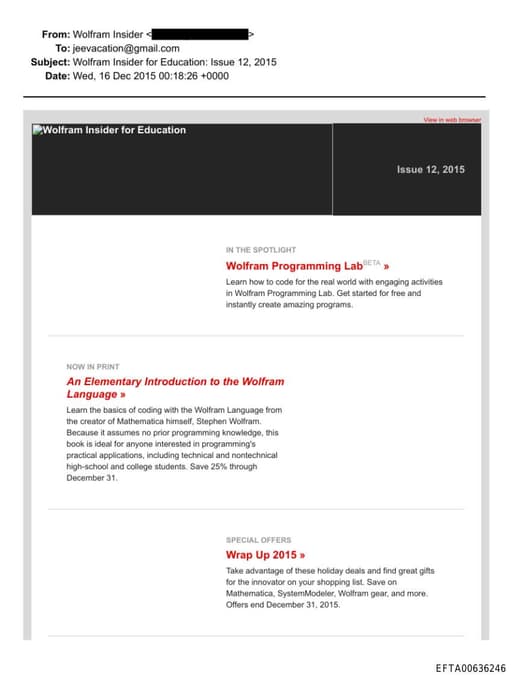
ap Up 2015 Take advantage of these holiday deals and find great gifts for the innovator on your shopping list. Save on Mathematica, SystemModeler, Wolfram gear, and more. Offers end December 31, 2015. LET EFTA00636246 FROM THE EXPERTS Exploring Programming for Computational Thinking » Explore meth
activities in Wolfram Programming Lab. Get started for free and instantly create amazing programs. NOW IN PRINT An Elementary Introduction to the Wolfram Language » Learn the basics of coding with the Wolfram Language from the creator of Mathematica himself, Stephen Wolfram. Because it assumes no p
EFTA01399175.pdf
2 mentionsEFTA01399175
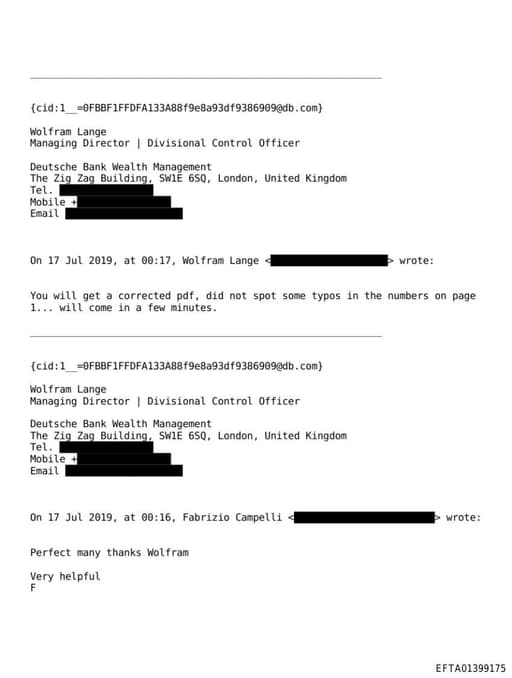
Zig Zag Building, SW1E 6SQ, London, United Kingdom Tel. Mobile Email On 17 Jul 2019, at 00:16, Fabrizio Campelli e > wrote: Perfect many thanks Wolfram Very helpful EFTA01399175 Sent from my iPhone On 16 Jul 2019, at 23:12, Wolfram Lange <O> wrote: Fabrizio Between my team and COO team, we ha
s. Note: some 3,600 of the 11,900 are MR/LR not yet remediated and not in electronic format, hence cannot show up in above results. Best regards, Wolfram PS: Here some more detail re US: KYC review scope: All active customers with DBforce KYCs 100% of HR client population and at a minimum 20% of LR
Sponsored
EFTA02419682.pdf
2 mentionsEFTA02419682
rote: I want to send another email to Stephen Wolfram's assistant, Ann. I called his office and I was told the best way to get a message to Ann and Wolfram is via the staff email address. May I say that you are friends with Wolfram? I want my email to get noticed! (on his web sight it says Stephen wolf
lled his office and I was told the best way to get a message to Ann and Wolfram is via the staff email address. May I say that you are friends with Wolfram? I want my email to get noticed! (on his web sight it says Stephen wolfram and his staff receive a large number of emails and can only respond direc
EFTA02438029.pdf
2 mentionsEFTA02438029
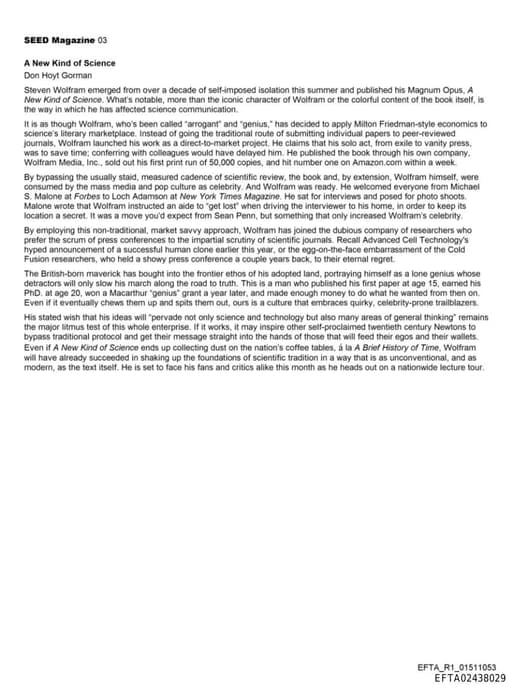
decade of self-imposed isolation this summer and published his Magnum Opus, A New Kind of Science. What's notable, more than the iconic character of Wolfram or the colorful content of the book itself, is the way in which he has affected science communication. It is as though Wolfram, who's been called "
easured cadence of scientific review, the book and, by extension, Wolfram himself, were consumed by the mass media and pop culture as celebrity. And Wolfram was ready. He welcomed everyone from Michael S. Malone at Forbes to Loch Adamson at New York Times Magazine. He sat for interviews and posed for pho
EFTA02451208.pdf
2 mentionsEFTA02451208
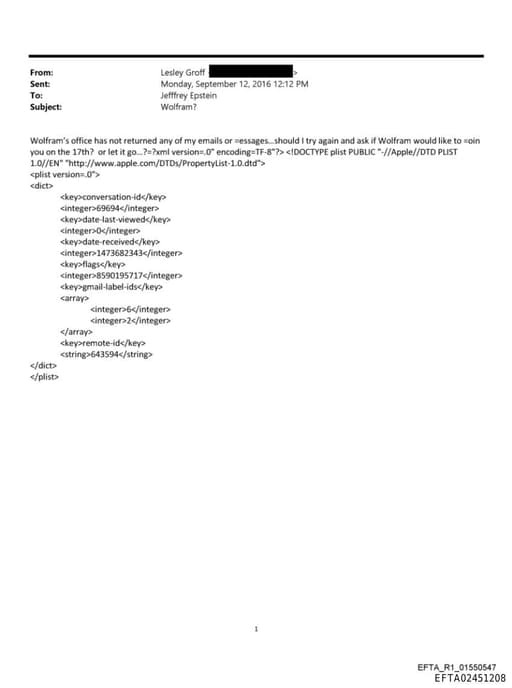
From: Lesley Groff Sent: Monday, September 12, 2016 12:12 PM To: Jefffrey Epstein Subject: Wolfram? Wolfram's office has not returned any of my emails or =essages...should I try again and ask if Wolfram would like to =oin you on the 17th? or let it go...?=
From: Lesley Groff Sent: Monday, September 12, 2016 12:12 PM To: Jefffrey Epstein Subject: Wolfram? Wolfram's office has not returned any of my emails or =essages...should I try again and ask if Wolfram would like to =oin you on the 17th? or let
Sponsored
EFTA02466409.pdf
2 mentionsEFTA02466409
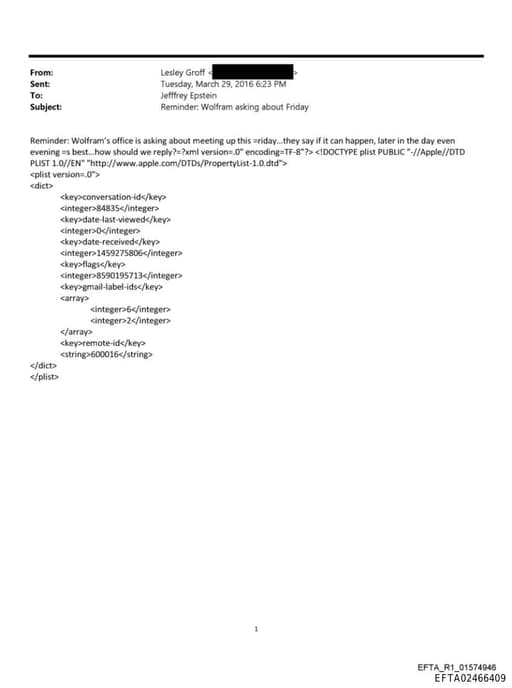
From: Lesley Groff < Sent: Tuesday, March 29, 2016 6:23 PM To: Jefffrey Epstein Subject: Reminder. Wolfram asking about Friday Reminder: Wolfram's office is asking about meeting up this =riday...they say if it can happen, later in the day even evening =s best...how should we reply?=?xml versi
From: Lesley Groff < Sent: Tuesday, March 29, 2016 6:23 PM To: Jefffrey Epstein Subject: Reminder. Wolfram asking about Friday Reminder: Wolfram's office is asking about meeting up this =riday...they say if it can happen, later in the day even evening =s
AreTheAndroids_James Tagg_small_p2.pdf
2 mentionsHOUSE_OVERSIGHT_015675_sub_002 - HOUSE_OVERSIGHT_015874
Source: House Oversight Committee
truth they derive from the most simple set of rules. You can check out the website to see a live version of Conway’s Game of Life. It’s a lot of fun. Wolfram’s Strange Attractor HOUSE_OVERSIGHT_015863 174 Are the Androids Dreaming Yet? thesis is that we could all be living in one of these games. Perhap
ed. Of course, there are no actual animals. The things you see on the screen, ‘gliders’ ‘walkers, and ‘cannons, just hang together accidentally. But, Wolfram considers these little digital creatures are animals. He argues our Universe is just like the Game of Life: A set of simple rules leading to complex
WWW Conf Program.pdf
2 mentionsHOUSE_OVERSIGHT_017526 - HOUSE_OVERSIGHT_017573
Sep 5, 2012Source: House Oversight Committee
r three revolutionary developments: the Mathematica computation system, A New Kind of Science, and the Wolfram|Alpha computational knowledge engine. Wolfram was educated at Eton, Oxford and Caltech, receiving his Ph.D. in theoretical physics at the age of 20. Wolfram’s work on basic science led him toa se
Page: HOUSE_OVERSIGHT_017565 →putation is done, and has been responsible for countless advances over the past two decades. Starting from a set of fundamental principles devised by Wolfram, Mathematica has continually grown, integrating more and more algorithmic domains, and spawning such technologies as the Computable Document Format (
Page: HOUSE_OVERSIGHT_017565 →Sponsored
EFTA00415502.pdf
2 mentionsEFTA00415502
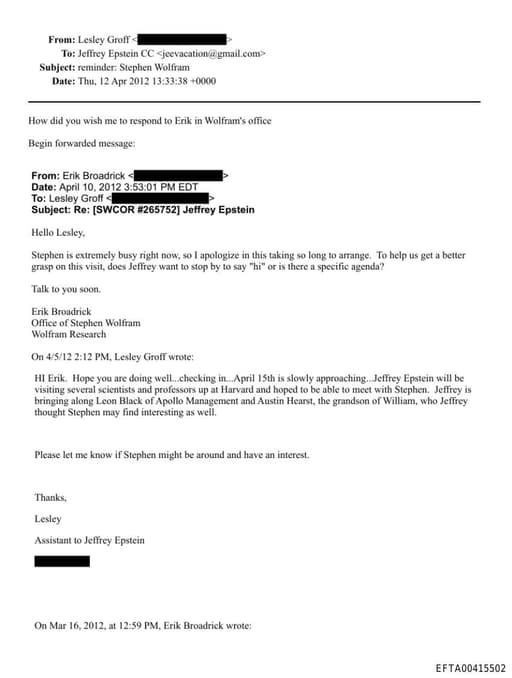
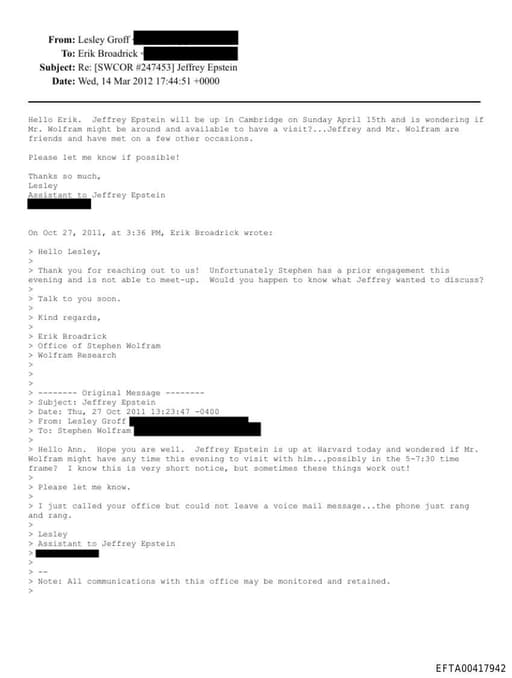
Research On 3/14/12 12:44 PM, Lesley Groff wrote: Hello Erik. Jeffrey Epstein will be up in Cambridge on Sunday April 15th and is wondering if Mr. Wolfram might be around and available to have a visit?...Jeffrey and Mr. Wolfram are friends and have met on a few other occasions. Please let me know if p
tein CC [email protected]> Subject: reminder: Stephen Wolfram Date: Thu, 12 Apr 2012 13:33:38 +0000 How did you wish me to respond to Erik in Wolfram's office Begin forwarded message: From: Erik Broadrick < Date: April 10, 2012 3:53:01 PM EDT To: Lesley Groff < Subject: Re: [SWCOR #265752] Jef
EFTA00647847.pdf
2 mentionsEFTA00647847
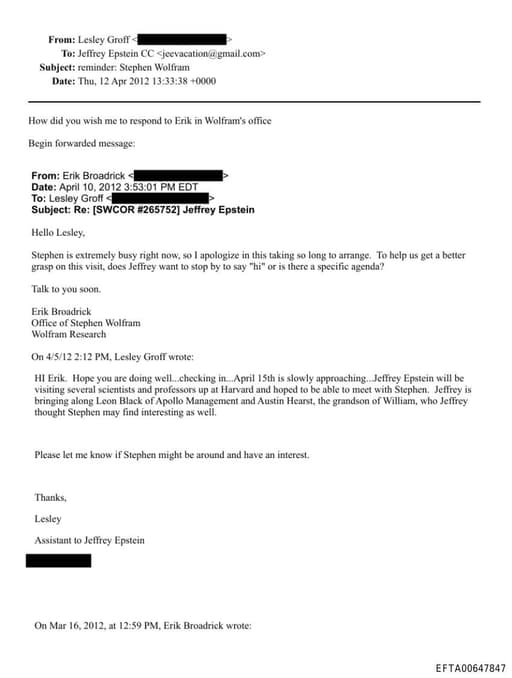
ein CC <[email protected]> Subject: reminder: Stephen Wolfram Date: Thu, 12 Apr 2012 13:33:38 +0000 How did you wish me to respond to Erik in Wolfram's office Begin forwarded message: From: Erik Broadrick < Date: April 10, 2012 3:53:01 PM EDT To: Lesley Groff < Subject: Re: [SWCOR #265752] Jef
Research On 3/14/12 12:44 PM, Lesley Groff wrote: Hello Erik. Jeffrey Epstein will be up in Cambridge on Sunday April 15th and is wondering if Mr. Wolfram might be around and available to have a visit?...Jeffrey and Mr. Wolfram are friends and have met on a few other occasions. Please let me know if p
EFTA00601577.pdf
2 mentionsEFTA00601577
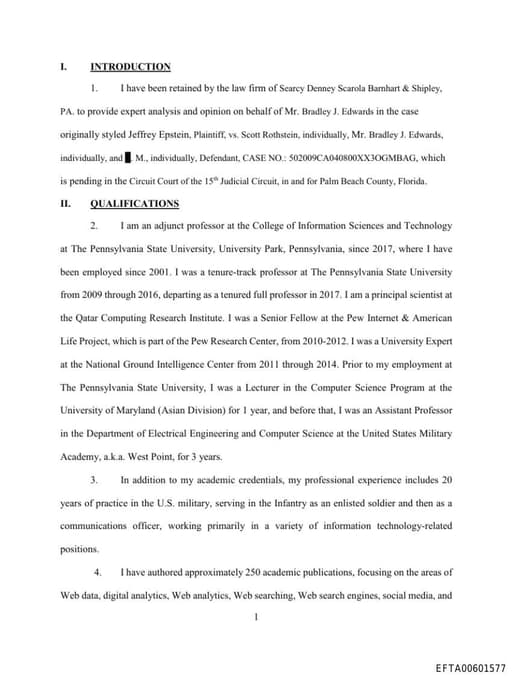
3-411. Spink, A., Jansen, B.J., Wolfram, D., and Saracevic, T. (2002) From e-sex to e-commerce: Web search changes, IEEE Computer. 35(3), 107-111. Wolfram, D., Spink, A., Jansen, B.J., and Saracevic, T. (2001) Vox populi: The public searching of the Web, Joumal of the American Society for Information S
ld. 27 EFTA00601603 Honors and Awards 2002 Worldwide press coverage and interviews 3/31/02- 4/5102 reference article: Spink, A., Jansen, B.J., Wolfram, D., and Saracevic, T. (2002). From e-sex to e-commerce: Web search changes, IEEE Computer, 35(3), 133-135. Including: Associated Press, BBC, CBC,
Sponsored
EFTA00417951.pdf
1 mentionEFTA00417951
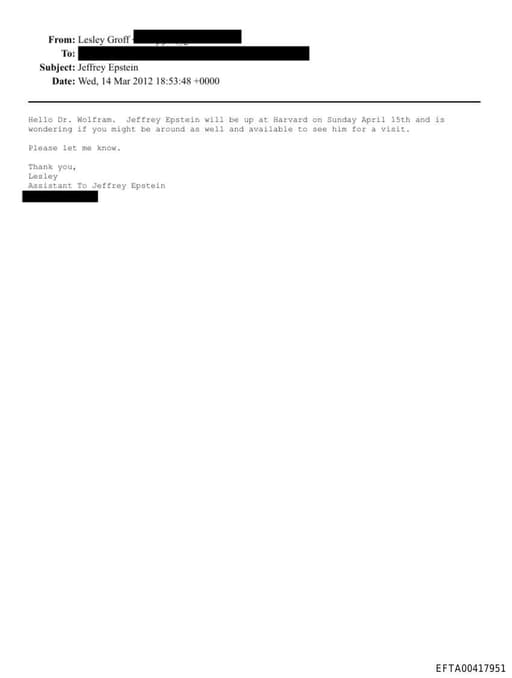
From: Lesley Groff =IMII To: Subject: Jeffrey Epstein Date: Wed, 14 Mar 2012 18:53:48 +0000 Hello Dr. Wolfram. Jeffrey Epstein will be up at Harvard on Sunday April 15th and is wondering if you might be around as well and available to see him for a visit. P
EFTA00417942.pdf
1 mentionEFTA00417942
rey Epstein Date: Wed, 14 Mar 2012 17:44:51 +0000 Hello Erik. Jeffrey Epstein will be up in Cambridge on Sunday April 15th and is wondering if Mr. Wolfram might be around and available to have a visit?...Jeffrey and Mr. Wolfram are friends and have met on a few other occasions. Please let me know if p
Sponsored
Connected Entities(20 of 1,198)
Jeffrey Epstein
PersonAmerican sex offender and financier (1953–2019)
88 docs88 co-mentions
Stephen Hawking
PersonBritish theoretical physicist, cosmologist and author (1942–2018)
66 docs66 co-mentions
Stephen Wolfram
PersonBritish-American scientist and businessman (born 1959)
47 docs47 co-mentions
Lesley Groff
PersonExecutive assistant to Jeffrey Epstein (2001-2019)
34 docs34 co-mentions
Champaign
LocationCity in Champaign County, Illinois, United States
32 docs32 co-mentions
Mathematica
OrganizationOrganization referenced in documents
31 docs31 co-mentions
Wolfram Research
OrganizationAmerican software company
25 docs25 co-mentions
Joscha Bach
PersonCognitive scientist
22 docs22 co-mentions
Noam Chomsky
PersonAmerican linguist and activist (born 1928)
20 docs20 co-mentions
EB
Erik Broadrick
PersonPerson referenced in documents
19 docs19 co-mentions
Wolfram Research.
OrganizationOrganization referenced in documents
16 docs16 co-mentions
Wolfram Alpha LLC
OrganizationOrganization referenced in documents
13 docs13 co-mentions
Turing
PersonEnglish computer scientist (1912–1954)
13 docs13 co-mentions
Martin Nowak
PersonAustrian scientist
13 docs13 co-mentions
Marvin Minsky
PersonAmerican cognitive scientist (1927-2016)
12 docs12 co-mentions
LB
Leon Black
PersonAmerican billionaire businessman (born 1951)
12 docs12 co-mentions
Marc Rich
PersonAmerican commodities trader (1934–2013)
12 docs12 co-mentions
John Brockman
PersonAmerican literary agent
11 docs11 co-mentions
Alan Dershowitz
PersonAmerican lawyer, author, and art collector (born 1938)
11 docs11 co-mentions
the Game of Life
OrganizationOrganization referenced in documents
10 docs10 co-mentions