Back to People & Entities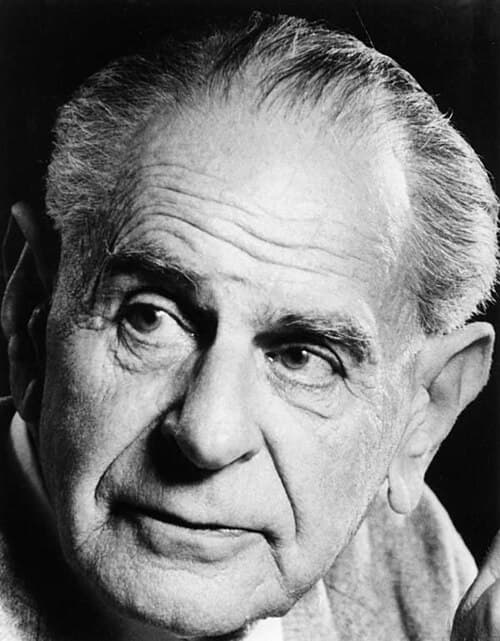



Karl Popper
Person
Also known as:
KARL POPPER
16
Total Mentions
16
Documents
436
Connected Entities
Austrian-British philosopher of science and social and política e falsificationism and for criticism of Plato, Hegel and Marx as totalitarian opponents of open society (1902-1994)
Document Mentions (16)
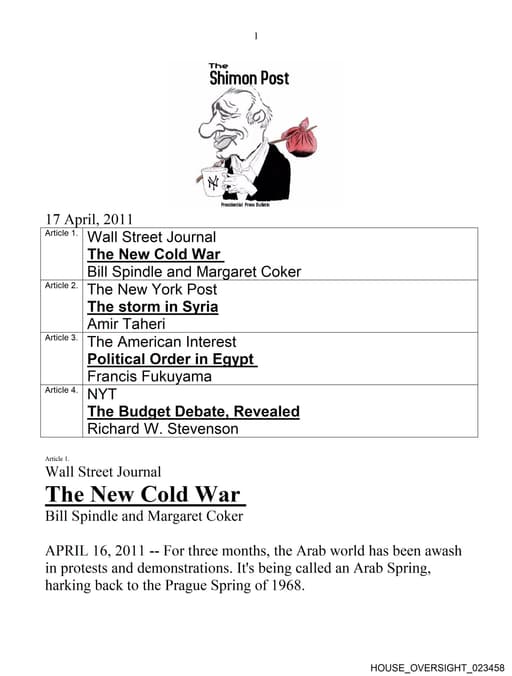
17 April.doc
1 mentionHOUSE_OVERSIGHT_023458 - HOUSE_OVERSIGHT_023486
Apr 16, 2011Source: House Oversight Committee
e to replicate the predictability and formality of certain natural sciences is, in the end, a hopeless endeavor. Human societies, as Friedrich Hayek, Karl Popper and others understood, are far too complex to model at an aggregate level. Contemporary macroeconomics, despite dealing with social phenomena that ar
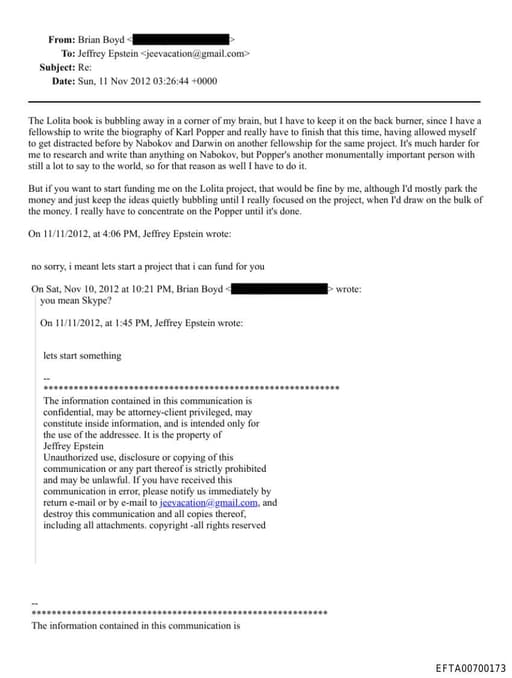
Page: HOUSE_OVERSIGHT_023482 →EFTA00700173.pdf
1 mentionEFTA00700173
Lolita book is bubbling away in a corner of my brain, but I have to keep it on the back burner, since I have a fellowship to write the biography of Karl Popper and really have to finish that this time, having allowed myself to get distracted before by Nabokov and Darwin on another fellowship for the same pr
EFTA00810767.pdf
1 mentionEFTA00810767
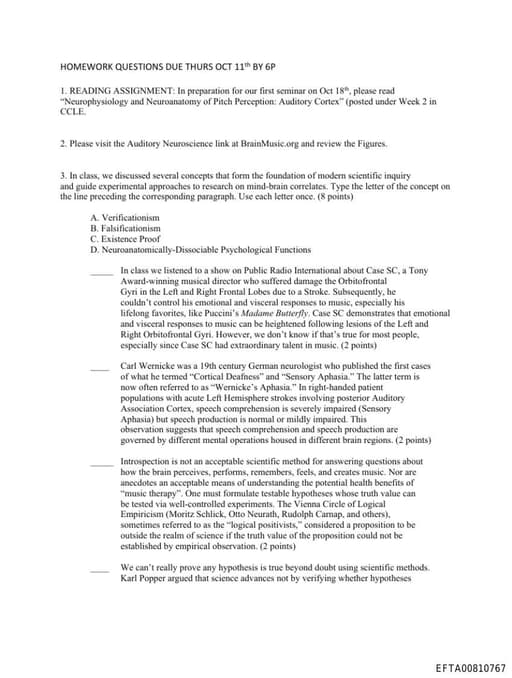
could not be established by empirical observation. (2 points) We can't really prove any hypothesis is true beyond doubt using scientific methods. Karl Popper argued that science advances not by verifying whether hypotheses EFTA00810767 are true but by generating conjectures that withstand empirical refu
Sponsored
EFTA00634449.pdf
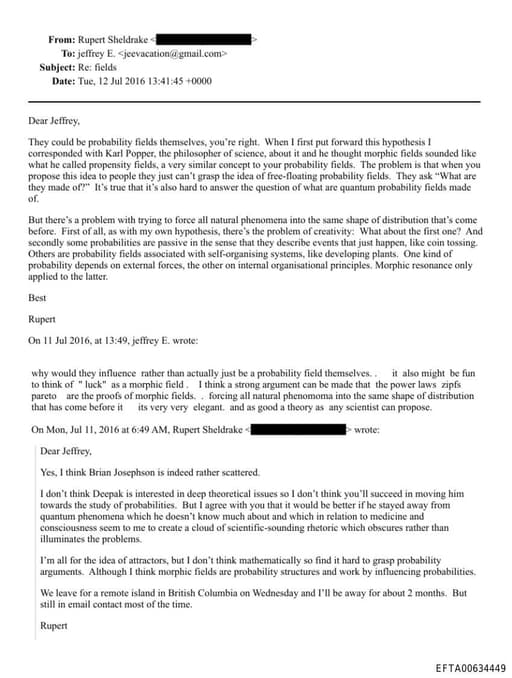
1 mentionEFTA00634449
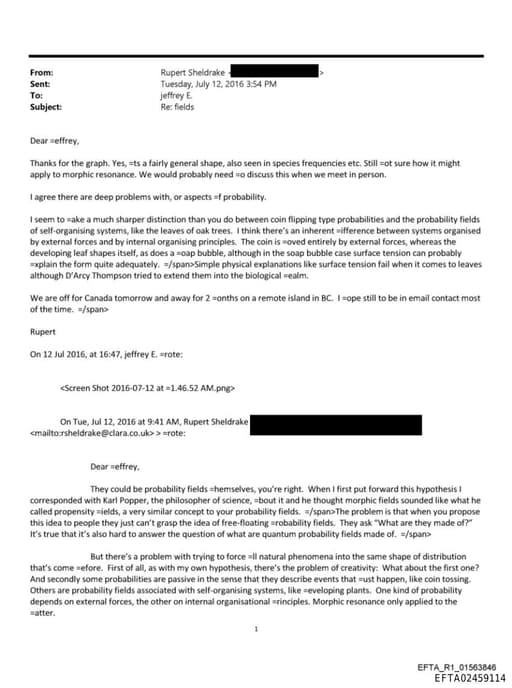
:41:45 +0000 Dear Jeffrey, They could be probability fields themselves, you're right. When I first put forward this hypothesis I corresponded with Karl Popper, the philosopher of science, about it and he thought morphic fields sounded like what he called propensity fields, a very similar concept to your pr
EFTA00655848.pdf
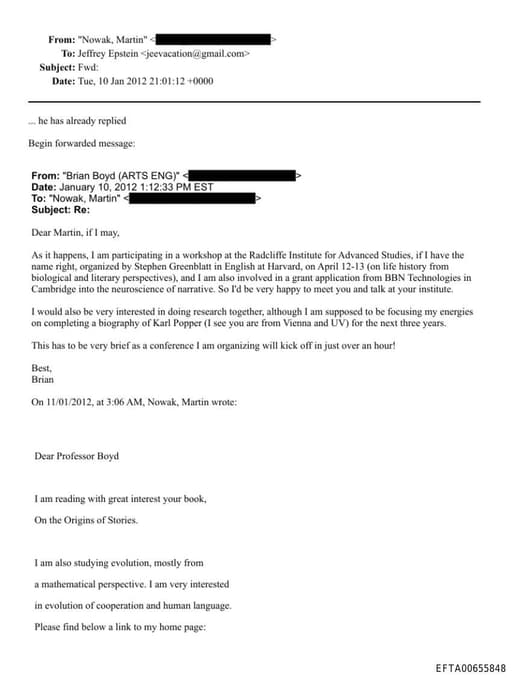
1 mentionEFTA00655848
stitute. I would also be very interested in doing research together, although I am supposed to be focusing my energies on completing a biography of Karl Popper (I see you are from Vienna and UV) for the next three years. This has to be very brief as a conference I am organizing will kick off in just over an
EFTA00578921.pdf
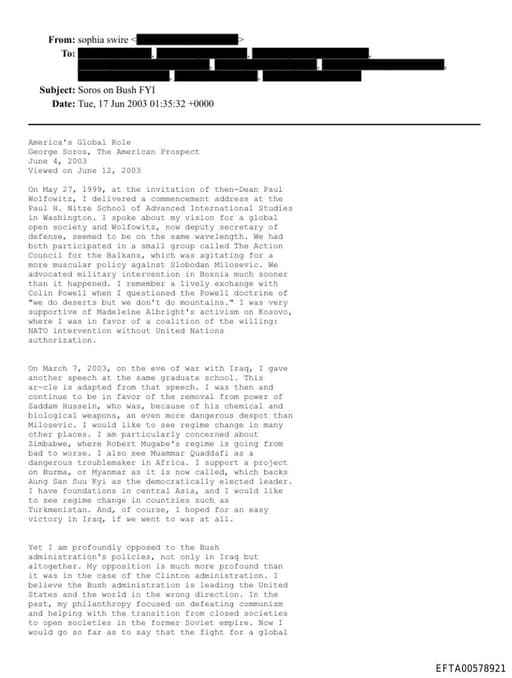
1 mentionEFTA00578921
act idea, I shall proceed from the abstract and general to the concrete and particular. The concept of "open society" was developed by philosopher Karl R. Popper, whose book "Open Society and Its Enemies" argued that totalitarian ideologies -- such as communism and fascism -- posed a threat to an open socie
Sponsored
EFTA01844581.pdf
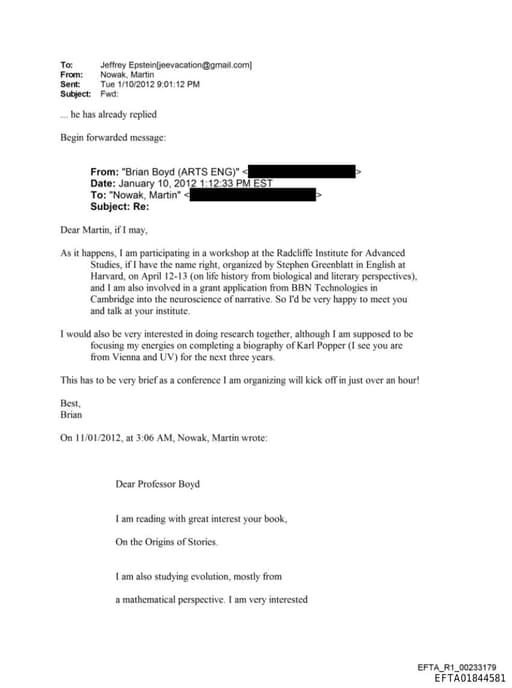
1 mentionEFTA01844581
stitute. I would also be very interested in doing research together, although I am supposed to be focusing my energies on completing a biography of Karl Popper (I sec you arc from Vienna and UV) for the next three years. This has to be very brief as a conference I am organizing will kick off in just over a
EFTA02456090.pdf
1 mentionEFTA02456090
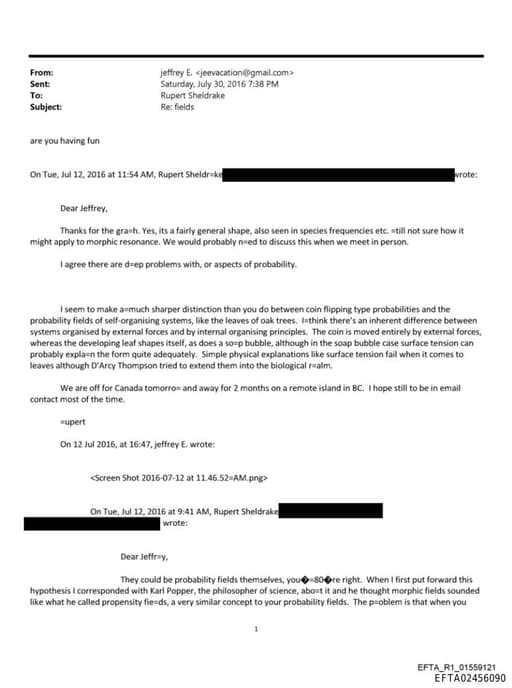
wrote: Dear Jeffr=y, They could be probability fields themselves, you4k=80.re right. When I first put forward this hypothesis I corresponded with Karl Popper, the philosopher of science, abo=t it and he thought morphic fields sounded like what he called propensity fie=ds, a very similar concept to your pr
EFTA02457133.pdf
1 mentionEFTA02457133
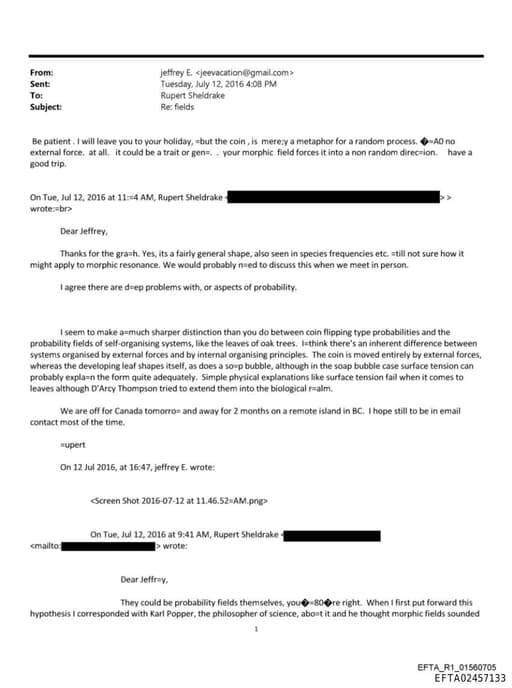
wrote: Dear Jeffr=y, They could be probability fields themselves, you4o=8040re right. When I first put forward this hypothesis I corresponded with Karl Popper, the philosopher of science, abo=t it and he thought morphic fields sounded EFTA_R1_01560705 EFTA02457133 like what he called propensity fie=ds,
Sponsored
EFTA02458538.pdf
1 mentionEFTA02458538
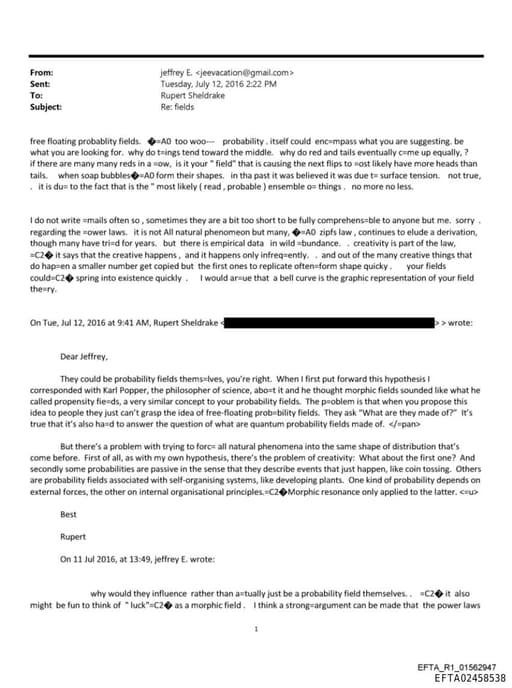
< > > wrote: Dear Jeffrey, They could be probability fields thems=lves, you're right. When I first put forward this hypothesis I corresponded with Karl Popper, the philosopher of science, abo=t it and he thought morphic fields sounded like what he called propensity fie=ds, a very similar concept to your pr
EFTA02459095.pdf
1 mentionEFTA02459095
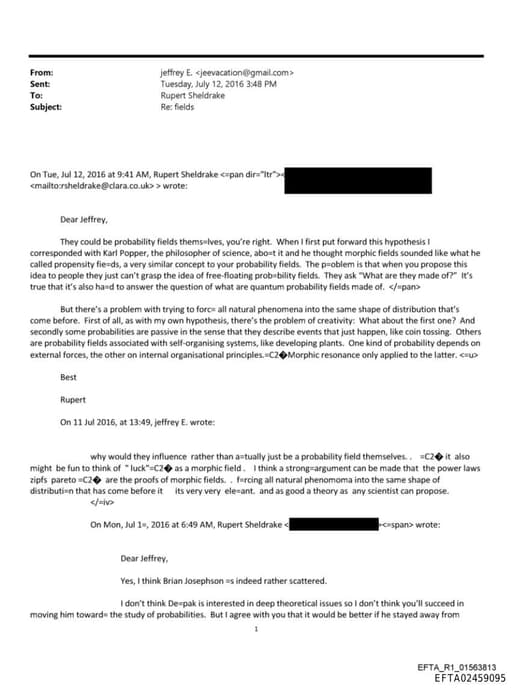
o.uk» wrote: Dear Jeffrey, They could be probability fields thems=lves, you're right. When I first put forward this hypothesis I corresponded with Karl Popper, the philosopher of science, abo=t it and he thought morphic fields sounded like what he called propensity fie=ds, a very similar concept to your pr
EFTA02459114.pdf
1 mentionEFTA02459114
o.uk> =rote: Dear =effrey, They could be probability fields =hemselves, you're right. When I first put forward this hypothesis I corresponded with Karl Popper, the philosopher of science, =bout it and he thought morphic fields sounded like what he called propensity =ields, a very similar concept to your pr
Sponsored
EFTA02344926.pdf
1 mentionEFTA02344926
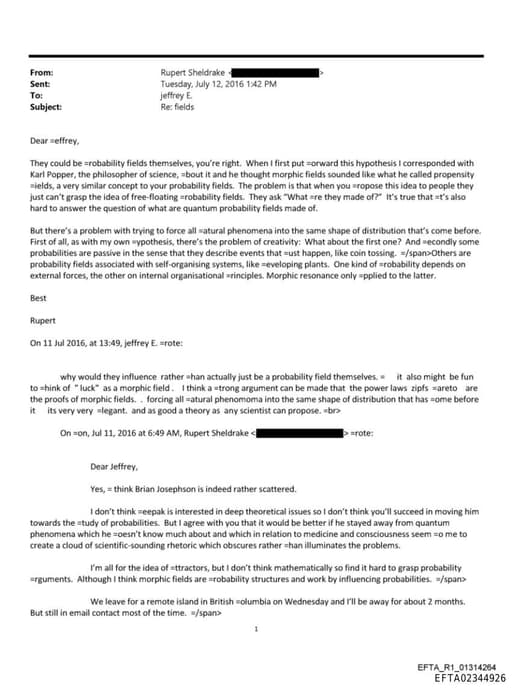
Re: fields Dear =effrey, They could be =robability fields themselves, you're right. When I first put =orward this hypothesis I corresponded with Karl Popper, the philosopher of science, =bout it and he thought morphic fields sounded like what he called propensity =ields, a very similar concept to your pr
Free Growth and Other Surprises.pdf
1 mentionHOUSE_OVERSIGHT_010912_sub_002 - HOUSE_OVERSIGHT_011111
Source: House Oversight Committee
theme from which both reason, as Herbert Spencer taught in the nineteenth century, is what he called “survival of the fittest.” Another philosopher, Karl Popper, found fault with this idea a century later. Popper was one of those | mentioned who disapprove of truisms. | haven’t read Popper, but gather that he
Brockman_DeepThinking.MS.pdf
1 mentionHOUSE_OVERSIGHT_016804_sub_001 - HOUSE_OVERSIGHT_016903
Source: House Oversight Committee
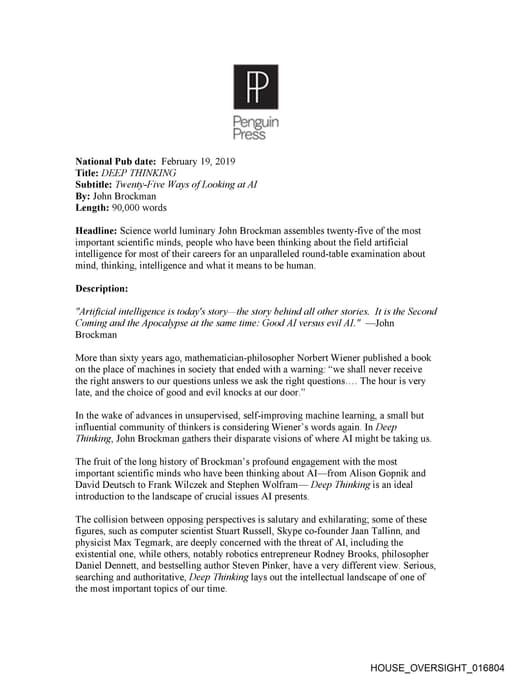
fe changing people's worldviews, his recognition among his peers as an intellectual goes well beyond his scientific achievement. He argues (following Karl Popper) that scientific theories are “bold conjectures, ” not derived from evidence but only tested by it. His two main lines of research at the moment—qubi
Sponsored
Brockman_DeepThinking.MS.pdf
1 mentionHOUSE_OVERSIGHT_016221_sub_001 - HOUSE_OVERSIGHT_016320
Source: House Oversight Committee
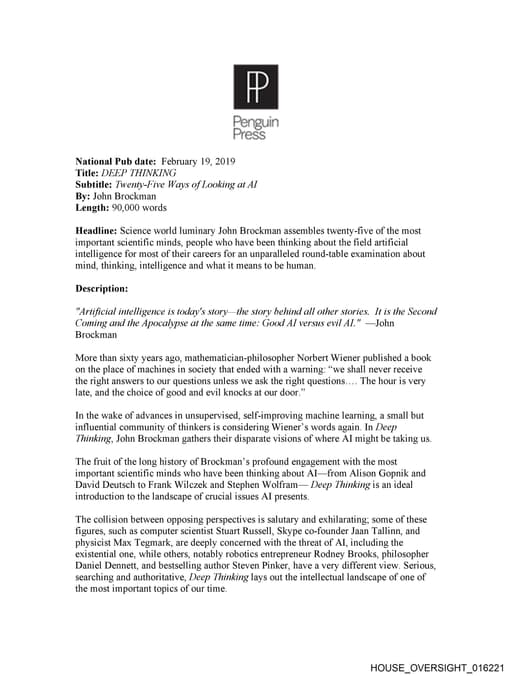
fe changing people's worldviews, his recognition among his peers as an intellectual goes well beyond his scientific achievement. He argues (following Karl Popper) that scientific theories are “bold conjectures, ” not derived from evidence but only tested by it. His two main lines of research at the moment—qubi
Sponsored
Connected Entities(20 of 436)
Jeffrey Epstein
PersonAmerican sex offender and financier (1953–2019)
10 docs10 co-mentions
Deepak
OrganizationRefers to Deepak Chopra, Indian-American author and alternative medicine advocate who corresponded with Jeffrey Epstein
7 docs7 co-mentions
RU
Rupert
PersonPrimarily refers to Rupert Sheldrake (biologist), also Rupert Murdoch and Rupert Adams in Epstein documents
7 docs7 co-mentions
RS
Rupert Sheldrake
PersonBritish biologist and parapsychology researcher, referenced in Epstein contact network
6 docs6 co-mentions
BJ
Brian Josephson
PersonPerson referenced in documents
6 docs6 co-mentions
Stephen Hawking
PersonBritish theoretical physicist, cosmologist and author (1942–2018)
5 docs5 co-mentions
British Columbia
LocationRegion in British Columbia, Canada
5 docs5 co-mentions
PO
Popper
PersonSurname reference in documents
4 docs4 co-mentions
Marc Rich
PersonAmerican commodities trader (1934–2013)
4 docs4 co-mentions
CW
Courtney Wild
PersonAmerican victim/survivor of Jeffrey Epstein who led legal battle for victims' rights
3 docs3 co-mentions
Brian Boyd
PersonPerson referenced in documents
3 docs3 co-mentions
George W. Bush
PersonPresident of the United States from 2001 to 2009
3 docs3 co-mentions
Gertrude Stein
PersonAmerican author (1874–1946)
3 docs3 co-mentions
David Hume
PersonScottish philosopher, economist, and historian (1711-1776)
3 docs3 co-mentions
Bertrand Russell
PersonBritish philosopher and logician (1872–1970)
3 docs3 co-mentions
Barack Obama
PersonPresident of the United States from 2009 to 2017
3 docs3 co-mentions
Alan Dershowitz
PersonAmerican lawyer, author, and art collector (born 1938)
3 docs3 co-mentions
D'Arcy Thompson
OrganizationOrganization referenced in documents
3 docs3 co-mentions
Bill Clinton
PersonPresident of the United States from 1993 to 2001 (born 1946)
3 docs3 co-mentions
Jerusalem
LocationCity in the Middle East, holy to the three Abrahamic religions
3 docs3 co-mentions