Back to People & Entities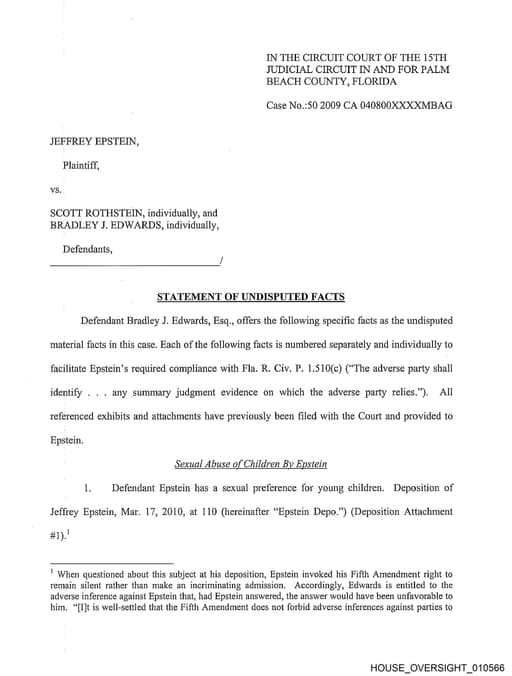


PA
Palmigiano
Person
10
Total Mentions
10
Documents
198
Connected Entities
Surname reference in documents
Palmigiano refers to the Supreme Court case Baxter v. Palmigiano (1976), not an individual person. This legal precedent is cited in multiple court documents related to Epstein cases to establish that adverse inferences can be drawn when parties invoke the Fifth Amendment in civil proceedings.
The term appears exclusively in legal citations within court filings and government records. Multiple documents cite Baxter v. Palmigiano, 425 U.S. 308, 318 (1976) to support arguments about drawing adverse inferences from a party's refusal to testify in civil cases. In at least one instance (DOJ-COURT-165), this case law is applied directly to Jeffrey Epstein's invocation of his Fifth Amendment privilege, with the filing arguing that an adverse inference is justified when Epstein 'remained silent when asked.' The citation appears in documents spanning government oversight records and DOJ court filings.
Key Highlights
- •Not a person - refers to landmark 1976 Supreme Court case about Fifth Amendment privileges in civil cases
- •Cited in multiple Epstein-related court documents to justify drawing negative inferences from silence
- •DOJ-COURT-165 explicitly applies this precedent to Epstein's refusal to answer questions
- •Legal principle allows courts to interpret invocation of Fifth Amendment rights against defendants in civil matters
Frequently Asked Questions
Related Links
Document Mentions (10)
Edwards'sNov2011StatementofUndisputedFacts.pdf
1 mentionHOUSE_OVERSIGHT_010566 - HOUSE_OVERSIGHT_010608
Nov 4, 2011Source: House Oversight Committee
g her vagina, inserting his fingers and civil actions when they refuse to testify in response to probative evidence offered against them.” Baxter v. Palmigiano, 425 U.S. 308, 318 (1976); accord Vasquez v. State, 777 So.2d 1200, 1203 (Fla. App. 2001). The reason for this rule “is both logical and utilitarian.
Page: HOUSE_OVERSIGHT_010567 →Defendant's Response in Opposition_20140117_144009853_0000.pdf
1 mentionHOUSE_OVERSIGHT_013304 - HOUSE_OVERSIGHT_013402
Jan 17, 2014Source: House Oversight Committee
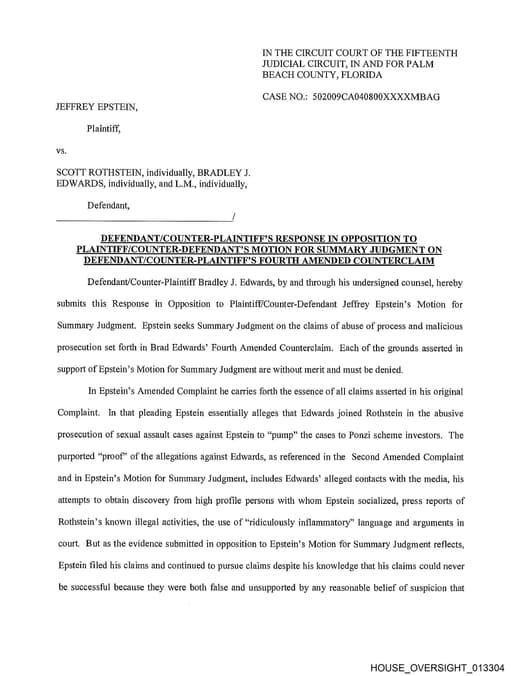
id adverse inferences against parties to civil actions when they refuse to testify in response to probative evidence offered against them.” Baxter v. Palmigiano, 425 U.S. 308, 318 (1976); Accord, Vasquez v. State, 777 So. 2d 1200, 1203 (Fla. at 2001). The reason for this rule “is both logical and utilitarian.
Page: HOUSE_OVERSIGHT_013315 →HOUSE_OVERSIGHT_029315 - HOUSE_OVERSIGHT_029323
1 mentionSource: House Oversight Committee
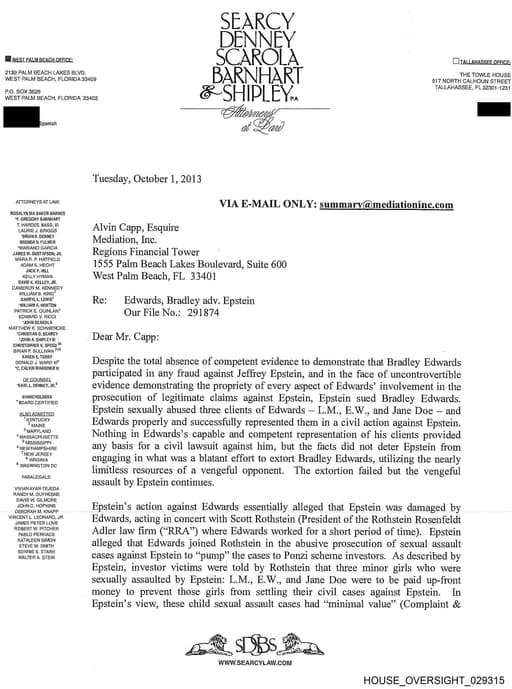
id adverse inferences against parties to civil actions when they refuse to testify in response to probative evidence offered against them." Baxter v. Palmigiano, 425 U.S. 308, 318 (1976); accord Vasquez v. State, 777 So.2d 1200, 1203 (Fla. App. 2001). The reason for this rule "is both logical and utilitarian.
Page: HOUSE_OVERSIGHT_029321 →Sponsored
1 mention
sertion of the Fifth Amendment privilege . . .” United States v. Custer Battles, L.L.C., 415 F. Supp. 2d 628, 632 (E.D. Va. 2006); accord Baxler v. Palmigiano, 425 U.S. 408, 318 (1976) (“the Fifth Amendment does not forbid adverse inferences against parties to civil actions when they refuse to testify in
1 mention
rawn in a civil case from a defendant’s refusal to testify or respond to discovery by invoking the privilege against self incrimination. Baxter v. Palmigiano, 425 U.S. 308, 318-20 (1976). He instead asserts that there is a “recognized exception” that applies in a case where the adverse inference is the s
1 mention
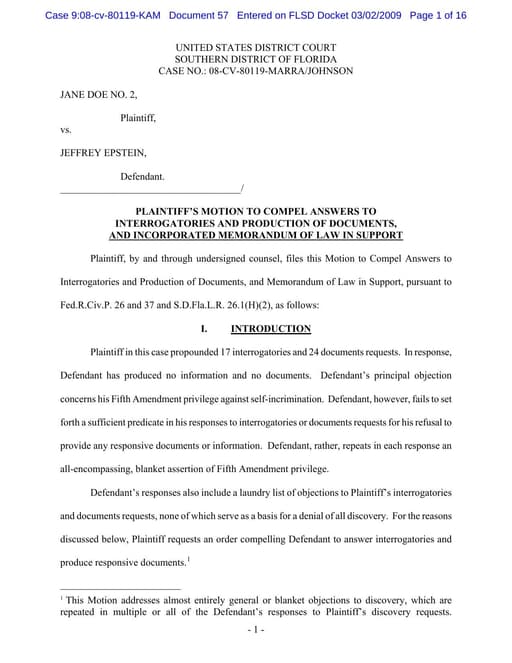
t an adverse inference to be drawn from exercise of the privilege does not implicate the policy considerations underlying the privilege." Baxter v. Palmigiano, 425 U.S.308, 335 (1976). An adverse inference is entirely justified in this case. Epstein has remained silent when asked such straightforward req
Sponsored
1 mention
equiring the complainant to produce evidence in support of its allegations would impose too great a cost and exceed the authorization of Baxter [v. Palmigiano, 425 U.S. 308 (1976)]." See LaSalle Bank Lake View, 54 F.3d at 391; see also National Acceptance v. Bathalter, 705 F.2d 924, 931-32 (7th Cir. 1983)
EFTA00221929.pdf
1 mentionEFTA00221929
requiring the complainant to produce evidence in support of its allegations would impose too great a cost and exceed the authorization of Baxter v. Palmigiano, 425 U.S. 308 (1976)]." See LaSalle Bank Lake View, 54 F.3d at 391; see also National Acceptance v. Bathalter, 705 F.2d 924, 931-32 (7th Cir. 1983)
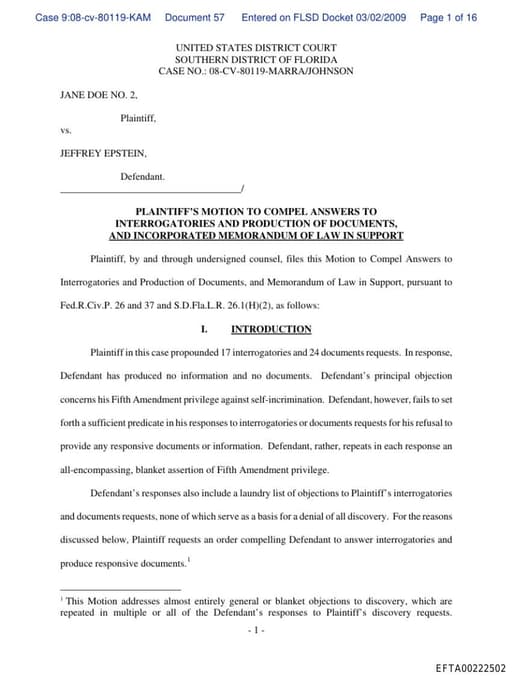
EFTA00222502.pdf
1 mentionEFTA00222502
assertion of the Fifth Amendment privilege ..." United States v. Custer Battles, L.L.C., 415 F. Supp. 2d 628, 632 (E.D. Va. 2006); accord Basler v. Palmigiano, 425 U.S. 408, 318 (1976) ("the Fifth Amendment does not forbid adverse inferences against parties to civil actions when they refuse to testify in
Sponsored
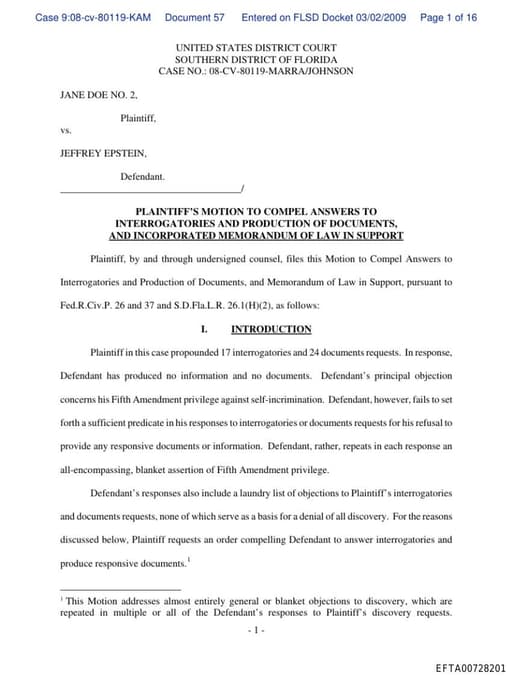
EFTA00728201.pdf
1 mentionEFTA00728201
assertion of the Fifth Amendment privilege ..." United States v. Custer Battles, L.L.C., 415 F. Supp. 2d 628, 632 (E.D. Va. 2006); accord Basler v. Palmigiano, 425 U.S. 408, 318 (1976) ("the Fifth Amendment does not forbid adverse inferences against parties to civil actions when they refuse to testify in
Sponsored
Connected Entities(20 of 198)
JD
Jane Doe
PersonPseudonym for anonymous victims/witnesses in Epstein legal proceedings
10 docs10 co-mentions
Jeffrey Epstein
PersonAmerican sex offender and financier (1953–2019)
10 docs10 co-mentions
JG
Jack Goldberger
PersonAmerican criminal defense attorney who represented Jeffrey Epstein, partner at Goldberger Weiss P.A. in West Palm Beach, Florida
9 docs9 co-mentions
Kenneth Marra
PersonAmerican judge
8 docs8 co-mentions
Baxter
PersonIndustrial robot
7 docs7 co-mentions
Adam D. Horowitz
PersonAmerican attorney specializing in sexual abuse cases, represented multiple Epstein victims
7 docs7 co-mentions
Alan Dershowitz
PersonAmerican lawyer, author, and art collector (born 1938)
6 docs6 co-mentions
Bradley Edwards
PersonAmerican attorney who represented Epstein victims, author of Relentless Pursuit
6 docs6 co-mentions
RC
Robert D. Critton
PersonIndividual referenced in Epstein legal documents
6 docs6 co-mentions
Donald Trump
PersonPresident of the United States (2017–2021, 2025–present)
6 docs6 co-mentions
SR
Scott Rothstein
PersonAmerican criminal
6 docs6 co-mentions
JS
Jack Scarola
PersonAmerican attorney who represented Jeffrey Epstein victims, partner at Searcy Denney Scarola Barnhart & Shipley
5 docs5 co-mentions
SM
Stuart S. Mermelstein
PersonAttorney involved in Jeffrey Epstein legal matters.
5 docs5 co-mentions
Alec Baldwin
PersonAmerican actor
5 docs5 co-mentions
Sarah Kellen
PersonAmerican assistant to Jeffrey Epstein, named as unindicted co-conspirator in 2008 non-prosecution agreement
5 docs5 co-mentions
Vicky Ward
PersonBritish investigative journalist
5 docs5 co-mentions
MP
Michael J. Pike
PersonPerson referenced in Epstein-related documents
4 docs4 co-mentions
WU
Wujkowski
PersonSurname reference in documents
4 docs4 co-mentions
Paul Cassell
PersonUnited States federal judge
4 docs4 co-mentions
Bill Clinton
PersonPresident of the United States from 1993 to 2001 (born 1946)
4 docs4 co-mentions