Back to People & Entities


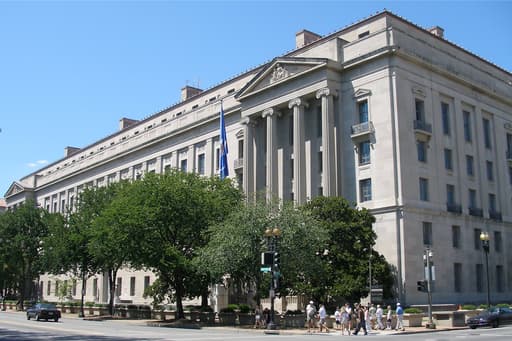


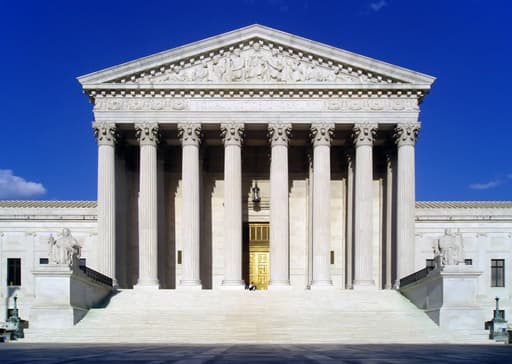


Second Circuit
Organization
533
Total Mentions
469
Documents
4,641
Connected Entities
U.S. Court of Appeals for the Second Circuit
The Second Circuit Court of Appeals appears throughout the Epstein documents as the federal appellate court with jurisdiction over New York, where it presided over numerous legal proceedings related to the Epstein-Maxwell cases, including Ghislaine Maxwell's criminal conviction appeal and civil document unsealing battles.
The Second Circuit appears primarily in legal filings, court documents, and scholarly articles discussing appellate jurisdiction, legal precedents, and case law. Most mentions involve citations to Second Circuit decisions in legal briefs and motions filed in Epstein-related cases, particularly regarding Crime Victims' Rights Act (CVRA) applications, immunity determinations, and document unsealing procedures. The court plays a substantive role as the appellate authority that ultimately decided Maxwell's criminal appeal (affirming her conviction) and ordered the unsealing of documents in the Giuffre v. Maxwell defamation case in 2019.
Key Highlights
- •Presided over Ghislaine Maxwell's appeal of her criminal conviction, affirming all charges in 2024 before the Supreme Court denied her petition
- •Ordered unsealing of documents in the 2019 Giuffre v. Maxwell defamation case appeal, leading to significant public disclosure
- •Frequently cited in legal briefs regarding CVRA rights, immunity determinations, and procedural matters in Epstein-related litigation
- •Has jurisdiction over federal cases from New York's Southern District, where most Epstein criminal and civil cases were filed
Frequently Asked Questions
Books for Further Reading
United States Court of Appeals for the Second Circuit: United States of America, Appellee, Against Alger Hiss, Appellant (Classic Reprint)
Reports of Cases Argued and Determined in the Circuit Court of the United States for the Second Circuit, Vol. 13 (Classic Reprint)
Perversion of Justice: The Jeffrey Epstein Story
Julie K. Brown
Investigative journalism that broke the Epstein case open
Document Mentions (20 of 469)
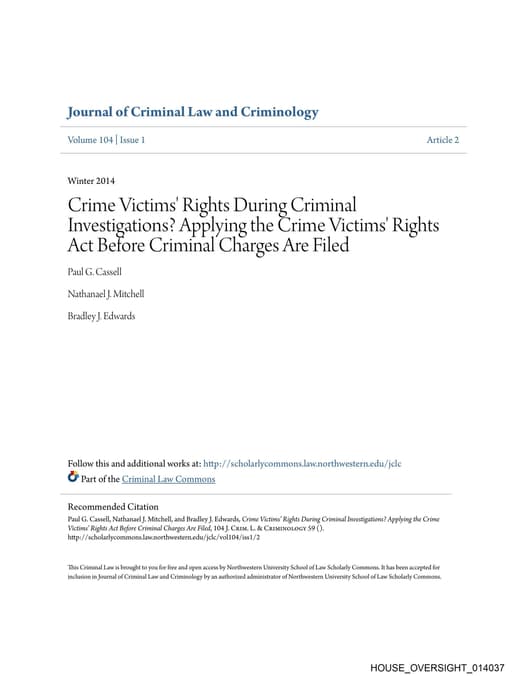
Crime Victims' Rights During Criminal Investigations? Applying the Crime Victims' Rights Act Before Criminal Charges Are Filed
3 mentionsHOUSE_OVERSIGHT_014037 - HOUSE_OVERSIGHT_014083
Feb 5, 2014Source: House Oversight Committee
stead, the courts simply cited to language from a Second Circuit decision that stated that the CVRA does not give
bstantive discussion of whether CVRA rights apply in criminal cases before the filing of charges. Instead, the courts simply cited to language from a Second Circuit decision that stated that the CVRA does not give victims any rights against defendants until those defendants have been convicted'!’—a holding clearl
Page: HOUSE_OVERSIGHT_014058 →t grant victims any rights against individuals who have not been convicted of a crime.”” (quoting In re W.R. Huff Asset Mgmt. Co., 409 F.3d 555, 564 (2d Cir. 2005))). '3 Of course, a defendant cannot be ordered to pay restitution as part of his sentence until he has been found guilty. See 18 U.S.C. § 3664
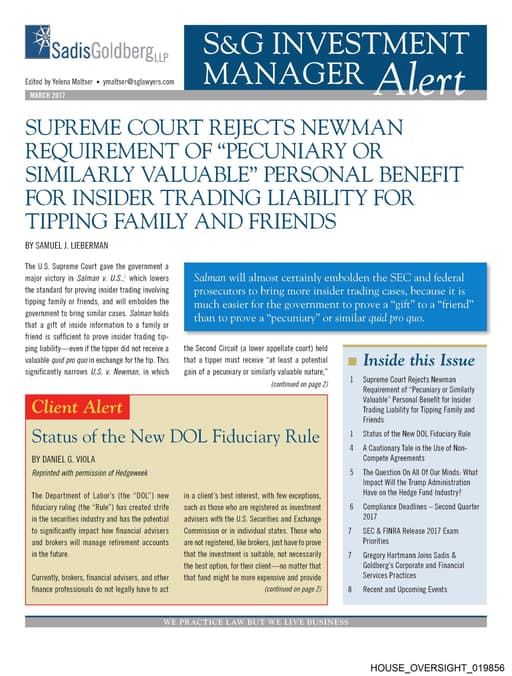
Page: HOUSE_OVERSIGHT_014059 →SG_IMA_News_Mar2017.pdf
3 mentionsHOUSE_OVERSIGHT_019856 - HOUSE_OVERSIGHT_019863
Mar 20, 2017Source: House Oversight Committee
de on the information to obtain a cash profit, the result should be the same. Importantly, the Supreme Court explicitly stated that it was narrowing the Second Circuit’s land- mark Newman decision. It stated, “[t]o the extent the Second Circuit held that the tipper must also receive something of a ‘pecuniary or simila
Page: HOUSE_OVERSIGHT_019858 →l immediately at the first hint of a government insider trading investigation. | Salman v. U.S., No. 15-628, 580 U.S. 6, 2016). 2773 F.3d 438, 452 (2d Cir. 2014). 3 Salman, Slip Op. at 9-10. "Id. at 10. ., Slip op. (Dec. Samuel J. Lieberman is a Partner in the Securities Litigation Group of Sadis & Gol
Page: HOUSE_OVERSIGHT_019858 →to prove a “pecuniary” or similar quid pro quo. the Second Circuit (a lower appellate court) held that a tipper must
CRIMINAL LAW: CRIME VICTIMS' RIGHTS DURING CRIMINAL INVESTIGATIONS? APPLYING THE CRIME VICTIMS' RIGHTS ACT BEFORE CRIMINAL CHARGES ARE FILED
3 mentionsHOUSE_OVERSIGHT_017603 - HOUSE_OVERSIGHT_017634
Feb 28, 2019Source: House Oversight Committee
"the CVRA does not grant victims any rights against individuals who have not been convicted of a crime. W.R. Huff Asset Mgmt. Co., 409 F.3d 555, 564 (2d Cir. 2005))). (quoting Jn re 3 Of course, a defendant cannot be ordered to pay restitution as part of his sentence until he has been found guilty. See /
Page: HOUSE_OVERSIGHT_017617 →bstantive discussion of whether CVRA rights apply in criminal cases before the filing of charges. Instead, the courts simply cited to language from a Second Circuit decision that stated that the CVRA does not give victims any rights against defendants until those defendants have been convicted !!* - a holding cle
Page: HOUSE_OVERSIGHT_017617 →stead, the courts simply cited to language from a Second Circuit decision that stated that the CVRA does not give
Sponsored
2 mentions
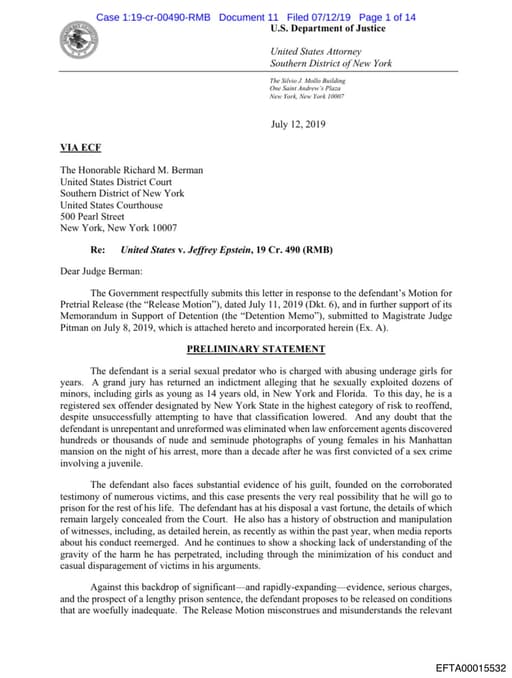
ed provides the motive for him do so and is another significant factor in assessing the risk of flight. See United States v. Jackson, 823 F.2d 4, 7 (2d Cir. 1987). So too is the strength of the evidence, detailed above and in the Government's Detention Memo. Indeed, that evidence, already robust less th
Page: EFTA00015536 →n to dozens of victims who were abused in Florida. 2 While beyond the scope of a bail hearing, as discussed further below, it is well-established in the Second Circuit that absent an express provision to the contrary in the agreement, one District is not bound by the terms of an agreement entered into between a def
Page: EFTA00015549 →2 mentions
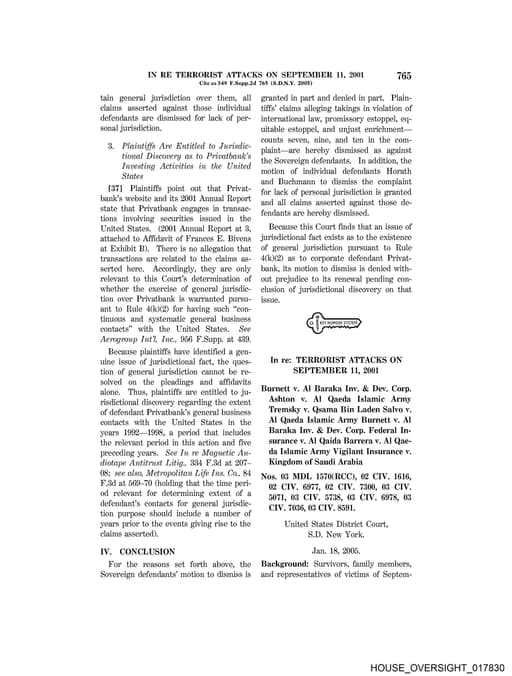
t of the Princes’ ac- tions. [22-24] Pursuant to the Second Cir- cuit’s instruction, the Court must first de- termine whe
very least, discovery should be ordered circumspectly and only to verify allega- tions of specific facts crucial to an immuni- ty determination.”)). The Second Circuit has instructed “that generally a plaintiff may be allowed limited discovery with re- spect to the jurisdictional issue; but until [plaintiff] has sho
Page: HOUSE_OVERSIGHT_017848 →2 mentions
ant presents a risk of flight.' English, 629 F.3d at 319 (quoting Mercedes, 254 F.3d at 436); see also United States v. Manly., 782 F.2d 1141, 1144 (2d Cir. 1986) ("The government retains the burden of persuasion [in a presumption case]."). Even when "a defendant has met his burden of production," howev
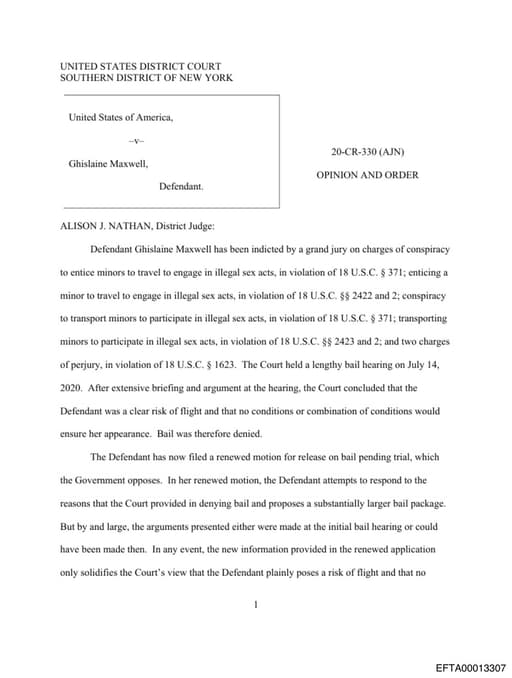
Page: EFTA00013310 →y, the Defendant's argument that private security guards could ensure her appearance at future proceedings runs afoul of the Bail Reform Act, which the Second Circuit has held "does not permit a two-tiered bail system in which defendants of lesser means are detained pending trial while wealthy defendants are rele
Page: EFTA00013325 →Sponsored
2 mentions
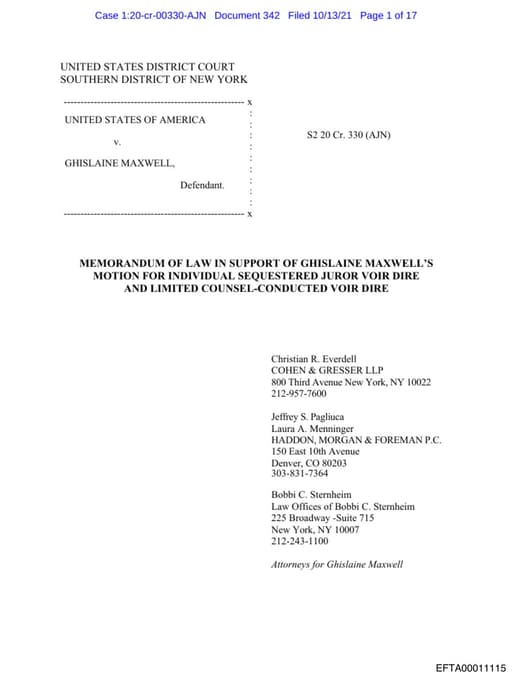
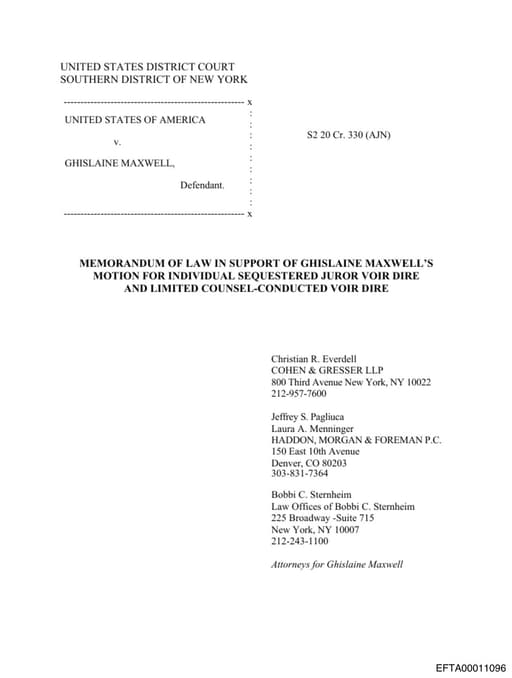
d 10/13/21 Page 4 of 17 ARGUMENT I. THE APPLICABLE LAW A prospective juror may be excused for cause based on many forms of bias or partiality. As the Second Circuit has explained, juror partiality can be actual, implied, or inferred: Actual bias is "bias in fact," generally evidenced by "express proof," such as
Page: EFTA00011118 →mandatory a presumption of bias." United States v. Quinones, 511 F.3d 289, 301 (2d Cir. 2007) (quoting United States v. Haynes, 398 F.2d 980, 984 (2d Cir. 1968) and United States v. Torres, 128 F.3d 38, 45 (2d Cir. 1997)). All types of bias can properly form the basis to excuse a juror for cause. See i
Page: EFTA00011118 →2 mentions
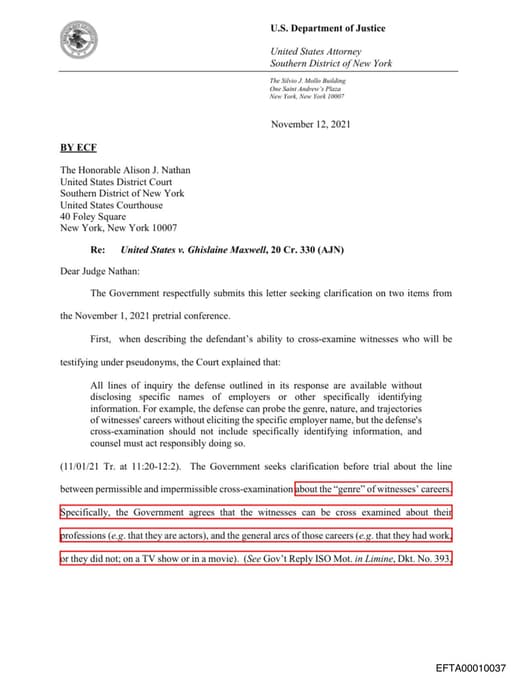
s proposed redactions are consistent with the three-part test articulated by the Second Circuit in Lugosch v. Pyramid Co. of Onondaga, 435 F.3d 110 (2d Cir. 2006). Although this letter is a judicial document subject to the common law presumption of access, the proposed redactions are narrowly tailored t
Page: EFTA00010038 →nty to these witnesses in advance of their testimony. ' The Government's proposed redactions are consistent with the three-part test articulated by the Second Circuit in Lugosch v. Pyramid Co. of Onondaga, 435 F.3d 110 (2d Cir. 2006). Although this letter is a judicial document subject to the common law presumptio
Page: EFTA00010038 →2 mentions
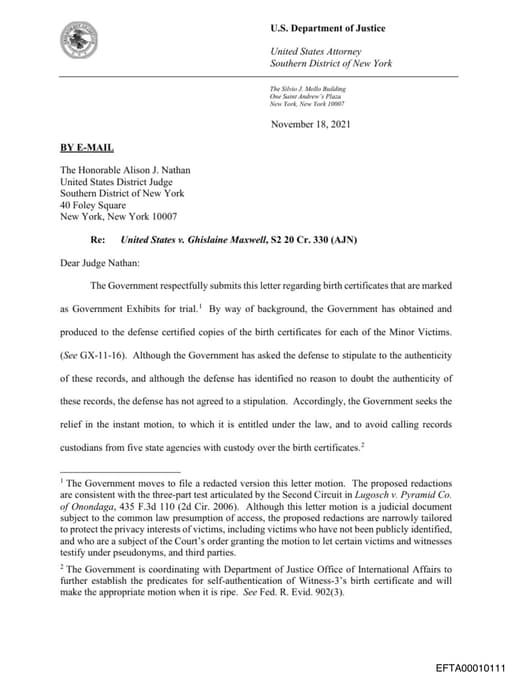
proposed redactions are consistent with the three-part test articulated by the Second Circuit in Lugosch v. Pyramid Co. of Onondaga, 435 F.3d 110 (2d Cir. 2006). Although this letter motion is a judicial document subject to the common law presumption of access, the proposed redactions are narrowly tail
Page: EFTA00010111 →' The Government moves to file a redacted version this letter motion. The proposed redactions are consistent with the three-part test articulated by the Second Circuit in Lugosch v. Pyramid Co. of Onondaga, 435 F.3d 110 (2d Cir. 2006). Although this letter motion is a judicial document subject to the common law pr
Page: EFTA00010111 →Sponsored
2 mentions
s, 511 F.3d 289, 301 (2d Cir. 2007) (quoting United States v. Haynes, 398 F.2d 980, 984 (2d Cir. 1968) and United States v. Torres, 128 F.3d 38, 45 (2d Cir. 1997)). All types of bias can properly form the basis to excuse a juror for cause. See id. Thus, the jury selection process should screen for each
Page: EFTA00011099 →98 --- PAGE BREAK --- ARGUMENT I. THE APPLICABLE LAW A prospective juror may be excused for cause based on many forms of bias or partiality. As the Second Circuit has explained, juror partiality can be actual, implied, or inferred: Actual bias is "bias in fact," generally evidenced by "express proof," such as
Page: EFTA00011099 →2 mentions
in which release of grand jury records is appropriate even outside of the boundaries of the rule. Id. at 102 (citations omitted). In Craig, the Second Circuit held the district court had authority to release grand jury materials based on special circumstances that went beyond the six exceptions listed in
is ‘older than our Nation itself,’ that proceedings before a grand jury shall generally remain secret.” In re Petition of Craig, 131 F.3d 99, 101 (2d Cir. 1997) (citations omitted). The rule of secrecy, however, is not without exceptions. Those exceptions have developed historically alongside th
2 mentions
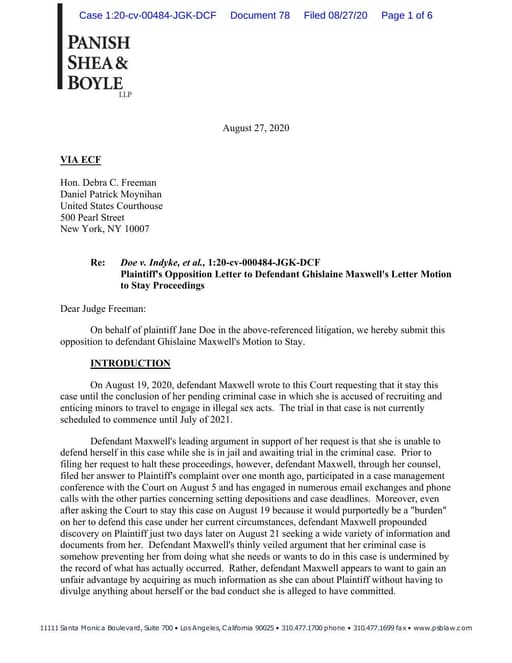
Plaintiff's claims against defendant Maxwell—the only actively litigated claims against her currently—to proceed in full public view. Courts in the Second Circuit recognize that the public benefits from civil litigation not only when it advances the justifiable interests of the Plaintiff, but also when the lit
a related criminal prosecution has been characterized as an "extraordinary remedy." Louis Vuitton Malletier S.A. v. LY USA, Inc., 676 F.3d 83, 98 (2d Cir. 2012) (emphasis added). As a result, a civil defendant urging a stay pending a parallel criminal prosecution bears the burden of establishing its n
Sponsored
In re Terrorist Attacks on September 11 2001-4.rtf
2 mentionsHOUSE_OVERSIGHT_017904 - HOUSE_OVERSIGHT_017934
Source: House Oversight Committee
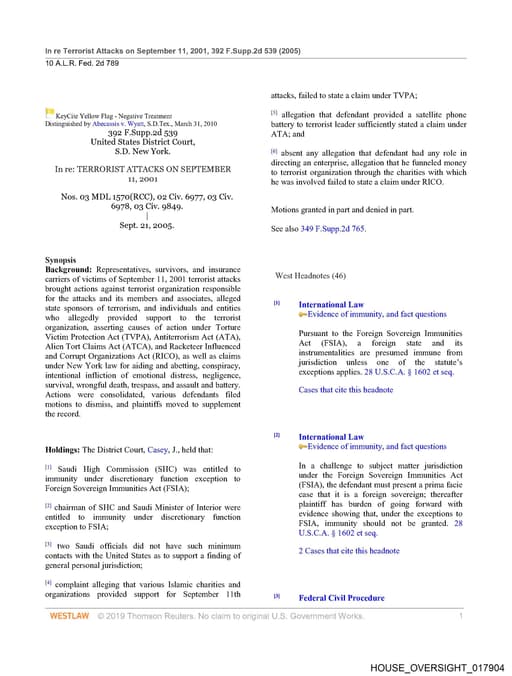
Accordingly, the only dispute regarding SHC’s status is whether it is an organ of the Kingdom. In Filler v. Hanvit Bank, 378 F.3d 213 (2d Cir.2004), the Second Circuit considered various factors to determine whether an entity could be considered an organ of a foreign sovereign. Jd. at 217. The factors include: (1)
Page: HOUSE_OVERSIGHT_017917 →bia’s relationship to NCB. The Supreme Court and Second Circuit agree that there are certain circumstances in whi
2 mentions
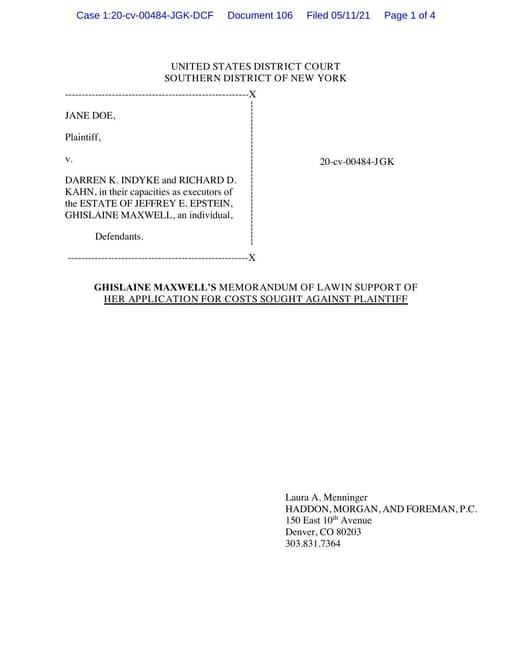
has discretion to award costs to the defendant.”); see also Carter v. Inc. Vill. of Ocean Beach, 759 F.3d 159, 165 (2d Cir. 2014) (disclaiming prior Second Circuit dicta which stated that “generally the defendant is not considered the prevailing party when, as here, there is a voluntary dismissal of the action
natively, that a district court has discretion to award costs to the defendant.”); see also Carter v. Inc. Vill. of Ocean Beach, 759 F.3d 159, 165 (2d Cir. 2014) (disclaiming prior Second Circuit dicta which stated that “generally the defendant is not considered the prevailing party when, as here, there
In re TERRORIST ATTACKS ON SEPTEMBER 11 2001.rtf
2 mentionsHOUSE_OVERSIGHT_023361 - HOUSE_OVERSIGHT_023415
Source: House Oversight Committee
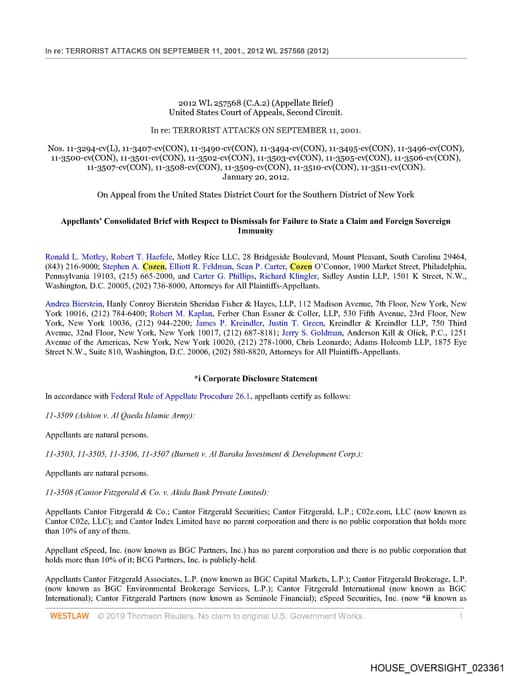
he orders dismissing those defendants should be vacated so that the district court can apply current law to defendants’ motions. Standard of Review The Second Circuit “review[s] de novo a district court’s dismissal of a complaint pursuant to Rule 12(b)(6), construing the complaint liberally, accepting all factual a
favor.” Amaker v. N.Y. State Dep’t of *63 Corr. Servs., 435 F. App’x 52, 54 (2d Cir. 2011) (quoting Chambers v. Time Warner, Inc., 282 F.3d 147, 152 (2d Cir. 2002)). WESTLAW HOUSE_OVERSIGHT_023384 --- PAGE BREAK --- In re: TERRORIST ATTACKS ON SEPTEMBER 11, 2001., 2012 WL 257568 (2012) Argument I. Th
Page: HOUSE_OVERSIGHT_023385 →Sponsored
2 mentions
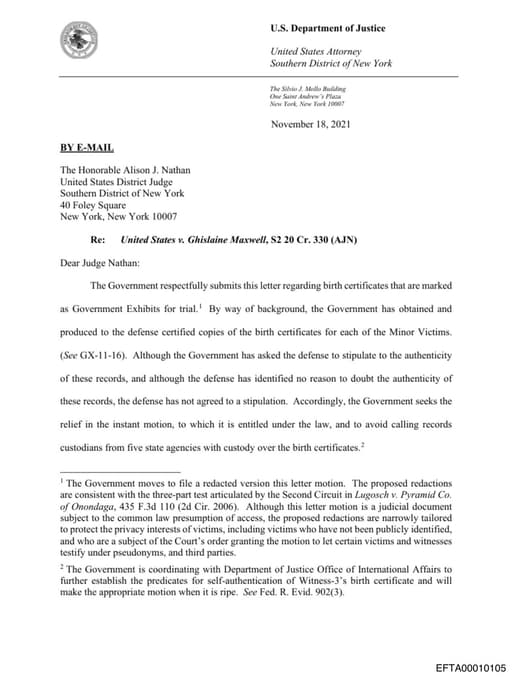
' The Government moves to file a redacted version this letter motion. The proposed redactions are consistent with the three-part test articulated by the Second Circuit in Lugosch v. Pyramid Co. of Onondaga, 435 F.3d 110 (2d Cir. 2006). Although this letter motion is a judicial document subject to the common law pr
Page: EFTA00010105 →proposed redactions are consistent with the three-part test articulated by the Second Circuit in Lugosch v. Pyramid Co. of Onondaga, 435 F.3d 110 (2d Cir. 2006). Although this letter motion is a judicial document subject to the common law presumption of access, the proposed redactions are narrowly tail
Page: EFTA00010105 →2 mentions
es, and thirty-some depositions, including depositions of and Maxwell as well as several third parties. See Brown v. Maxwell, 929 F.3d 41, 46, 51 (2d Cir. 2019) (explaining that discovery was "hard-fought" and "extensive" and noting that the court file, which includes only some of the documents created
Page: EFTA00011459 →rs, and courts strictly enforce them. See, e.g., Stewart v. Hudson Hall LLC, 20 Civ. 885 (SLC), 2020 WL 7239676, at *2 (S.D.N.Y. Dec. 9, 2020) ("In the Second Circuit, there is a strict standard for modification of a protective order entered by a district court." (citation and quotation marks omitted)). This case
Page: EFTA00011467 →2 mentions
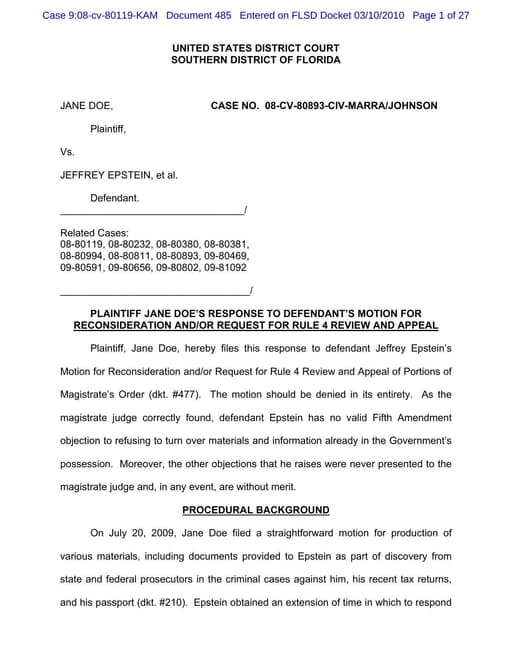
tion for tax returns – as the magistrate judge specifically noted in rejecting Epstein’s argument. See, e.g., Rajah v. Mukasey, 544 F.3d 427, 442 (2nd Cir. 2008) (“. . . a taxpayer’s W-2 forms are required records not subject to the Fifth Amendment because they are a mandatory part of a civil regulatory
his claim is said to be Trudeau v. New York State Consumer Protection Bd., 237 F.R.D. 325 (N.D.N.Y. 2006), which reviews some decisions from within the Second Circuit and Case 9:08-cv-80119-KAM Document 485 Entered on FLSD Docket 03/10/2010 Page 15 of 27 CASE NO: 08-CV-80119-MARRA/JOHNSO
Sponsored
1-main.pdf
2 mentionsHOUSE_OVERSIGHT_026384 - HOUSE_OVERSIGHT_026392
Jun 20, 2016Source: House Oversight Committee
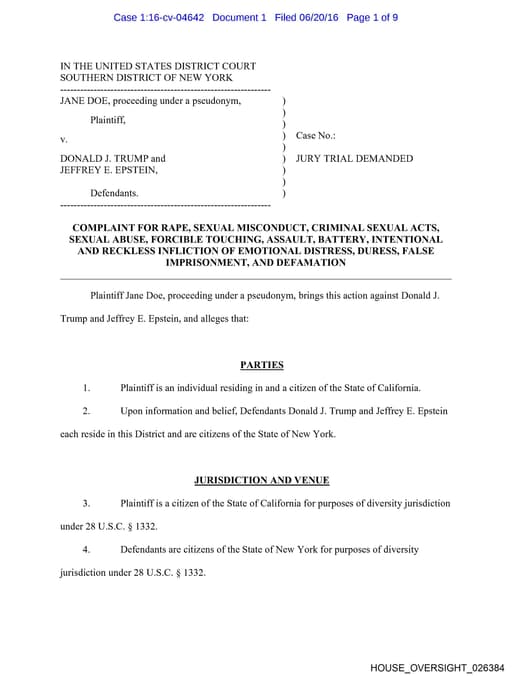
onal nature, and identification of Plaintiff would pose a risk of retaliatory physical harm to her and to others. Exh. A. All of the ten factors that the Second Circuit articulated as relevant to this analysis favor anonymity, especially factors 1-4, 7, and 10 (e.g., factors one and two: “whether the litigation invol
Page: HOUSE_OVERSIGHT_026386 →tweighs the public’s interest in knowing their identity and any prejudice to the defendants. Sealed Plaintiff-v. Sealed Defendant, 537 F.3d 185, 189 (2d Cir. 2008). This litigation involves matters that are highly sensitive and of a personal nature, and identification of Plaintiff would pose a risk of reta
Page: HOUSE_OVERSIGHT_026386 →2 mentions
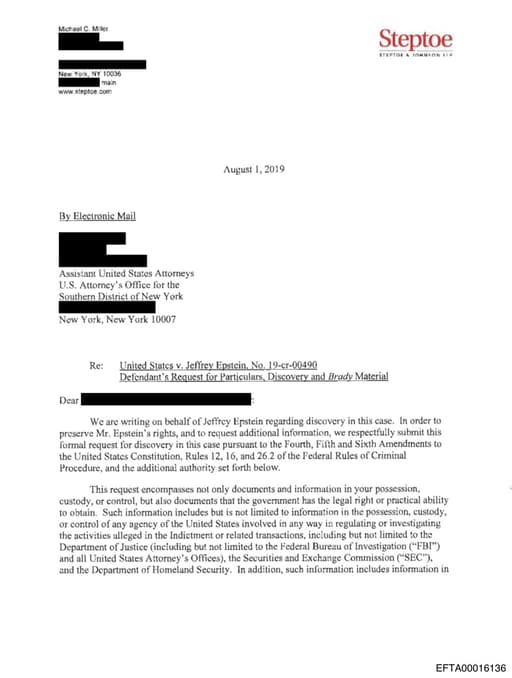
"during a conversation with an agent or a witness is no less discoverable than if that same information were contained in an email." Id. Similarly, the Second Circuit has recognized that attorney proffers are equally subject to Brady obligations as witness proffers. States V. Triumph Capital Group, Inc., 544 F.3d
Page: EFTA00016146 →that attorney proffers are equally subject to Brady obligations as witness proffers. States V. Triumph Capital Group, Inc., 544 F.3d 149, 157, 165 (2d Cir. 2008) (recognizing that "[a]n attorney proffer apprises the government of what the client would be able to provide by way of testimony" and finding
Page: EFTA00016146 →Sponsored
Connected Entities(20 of 4,641)
Jeffrey Epstein
PersonAmerican sex offender and financier (1953–2019)
336 docs336 co-mentions
Ghislaine Maxwell
PersonBritish socialite and sex trafficker, daughter of Robert Maxwell, accomplice of Jeffrey Epstein
287 docs287 co-mentions
United States
LocationCountry located primarily in North America
159 docs159 co-mentions
the Southern District
LocationFederal judicial district in New York City
116 docs116 co-mentions
Department of Justice
OrganizationUnited States Department of Justice, federal executive department responsible for law enforcement
110 docs110 co-mentions
Prince Andrew
PersonThird child of Queen Elizabeth II and Prince Philip, Duke of Edinburgh (born 1960)
107 docs107 co-mentions
Julie K. Brown
PersonAmerican journalist
93 docs93 co-mentions
JD
Jane Doe
PersonPseudonym for anonymous victims/witnesses in Epstein legal proceedings
92 docs92 co-mentions
Bradley Edwards
PersonAmerican attorney who represented Epstein victims, author of Relentless Pursuit
88 docs88 co-mentions
Michael Cohen
PersonAmerican former attorney and former Republican official
87 docs87 co-mentions
Supreme Court
OrganizationHighest court of jurisdiction in the US
78 docs78 co-mentions
Southern District of New York
OrganizationFederal judicial district covering Manhattan and surrounding areas
73 docs73 co-mentions
JP
Jeffrey Pagliuca
PersonAmerican attorney, defense lawyer for Ghislaine Maxwell during her criminal trial
70 docs70 co-mentions
David Boies
PersonAmerican lawyer and chairman
67 docs67 co-mentions
MW
Martin Weinberg
PersonAmerican attorney (born 1946)
63 docs63 co-mentions
Court of Appeals
OrganizationU.S. federal court of appeals
59 docs59 co-mentions
New York
LocationMost populous city in the United States
58 docs58 co-mentions
Donald Trump
PersonPresident of the United States (2017–2021, 2025–present)
58 docs58 co-mentions
George W. Bush
PersonPresident of the United States from 2001 to 2009
58 docs58 co-mentions
Michael Jackson
PersonAmerican singer, songwriter, record producer, and dancer (1958–2009)
57 docs57 co-mentions