Back to People & Entities




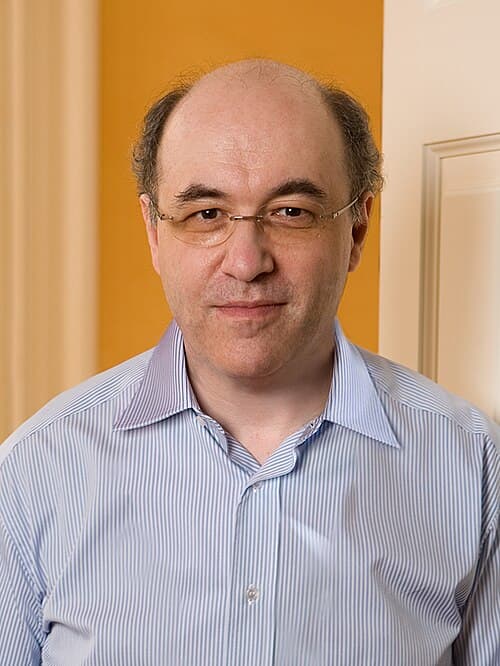
Seymour Papert
Person
8
Total Mentions
8
Documents
460
Connected Entities
MIT mathematician, computer scientist, and educator (1928–2016)
Document Mentions (8)
EFTA00284089.pdf
1 mentionEFTA00284089
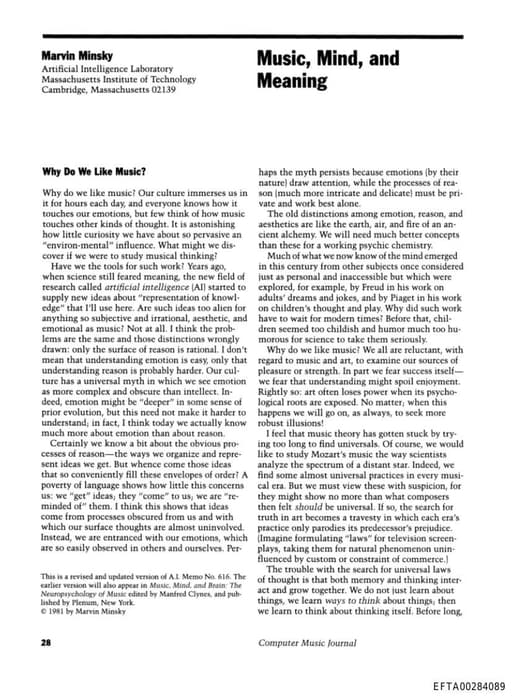
instead, that inside each mind work many different agents. (The idea of societies of agents (Minsky 1977; 1980a; 19806) originated in my work with Seymour Papert.) All we really need to know about agents is this: each agent knows what happens to some others, but little of what happens to the rest. It means
EFTA00740586.pdf
1 mentionEFTA00740586
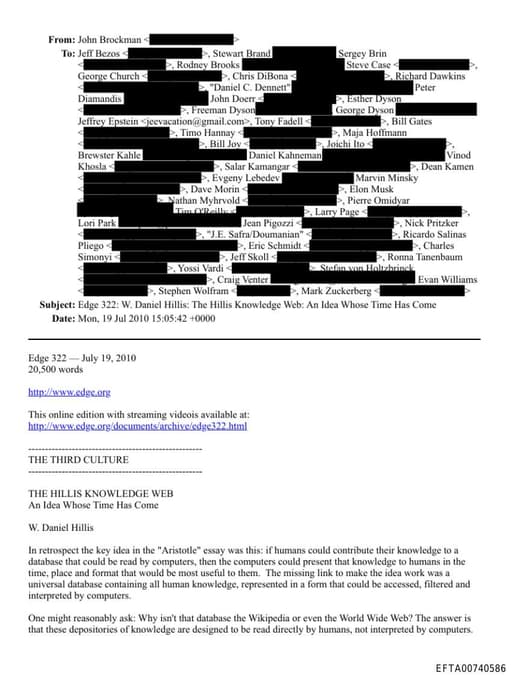
ticipated: Douglas Rushkoff, Marc D. Hauser, Stewart Brand, Jim O'Donnell, Jaron Lanier, Bruce Sterling, Roger Schank, George Dyson, Howard Gardner, Seymour Papert, Freeman Dyson, Esther Dyson, Kai Krause, ans Pamela McCorduck. In 2005, George Dyson noted in his prescient EDGE essay "Turing's Cathedral": My v
EFTA00740603.pdf
1 mentionEFTA00740603
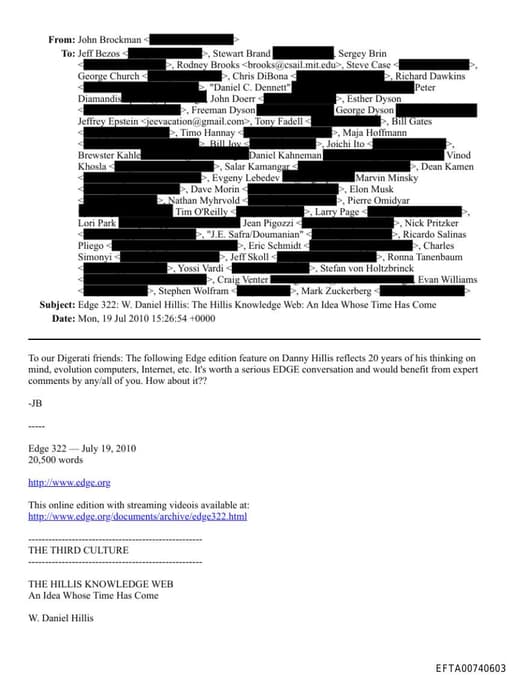
ticipated: Douglas Rushkoff, Marc D. Hauser, Stewart Brand, Jim O'Donnell, Jaron Lanier, Bruce Sterling, Roger Schank, George Dyson, Howard Gardner, Seymour Papert, Freeman Dyson, Esther Dyson, Kai Krause, ans Pamela McCorduck. In 2005, George Dyson noted in his prescient EDGE essay "Turing's Cathedral": My v
Sponsored
EFTA00698873.pdf
1 mentionEFTA00698873
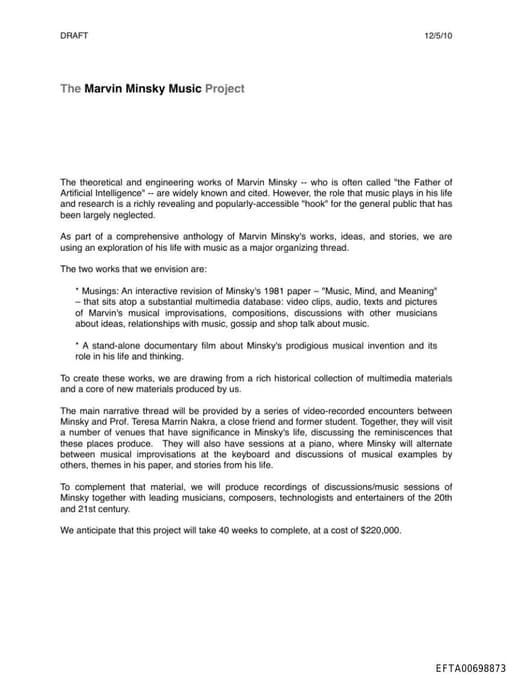
Cynthia Solomon is a computer scientist, educator and an inventor of the Logo programming language for children. She has been engaged -- along with Seymour Papert, Marvin Minsky, and others -- in foundational research on children constructing knowledge with computers. Holding an MS in Computer Science from Bo
EFTA02539827.pdf
1 mentionEFTA02539827
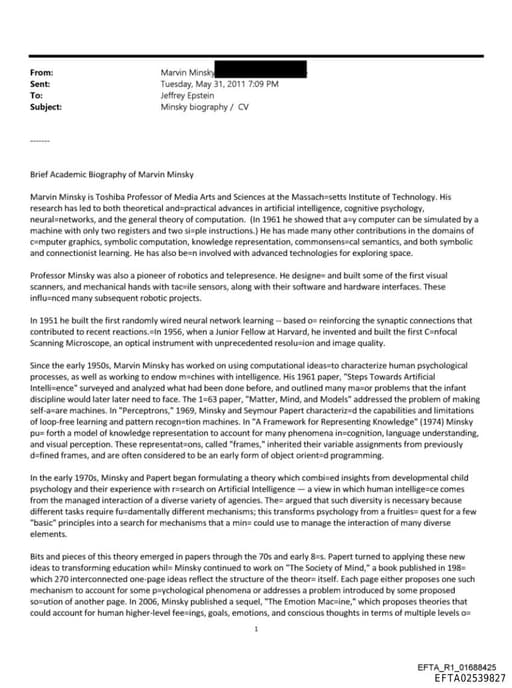
ter need to face. The 1=63 paper, "Matter, Mind, and Models" addressed the problem of making self-a=are machines. In "Perceptrons," 1969, Minsky and Seymour Papert characteriz=d the capabilities and limitations of loop-free learning and pattern recogn=tion machines. In "A Framework for Representing Knowledge" (
EFTA02514075.pdf
1 mentionEFTA02514075
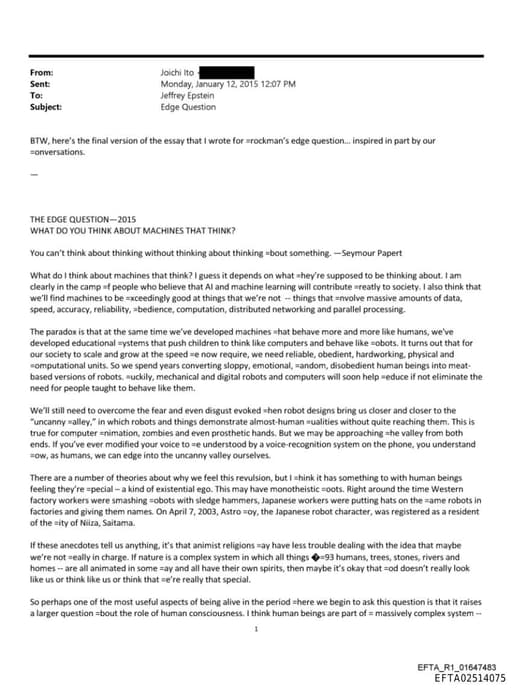
HE EDGE QUESTION-2015 WHAT DO YOU THINK ABOUT MACHINES THAT THINK? You can't think about thinking without thinking about thinking =bout something. —Seymour Papert What do I think about machines that think? I guess it depends on what =hey're supposed to be thinking about. I am clearly in the camp =f people who
Sponsored
Brockman_DeepThinking.MS.pdf
1 mentionHOUSE_OVERSIGHT_016804_sub_002 - HOUSE_OVERSIGHT_016995
Source: House Oversight Committee
h. Frank Rosenblatt invented a learning device he called the perceptron, which was a one-layer neural network. In the late sixties, Marvin Minsky and Seymour Papert wrote a book titled Perceptrons, in which they basically proved that perceptrons couldn’t do anything interesting, which is correct. Perceptrons coul
Brockman_DeepThinking.MS.pdf
1 mentionHOUSE_OVERSIGHT_016221_sub_002 - HOUSE_OVERSIGHT_016412
Source: House Oversight Committee
h. Frank Rosenblatt invented a learning device he called the perceptron, which was a one-layer neural network. In the late sixties, Marvin Minsky and Seymour Papert wrote a book titled Perceptrons, in which they basically proved that perceptrons couldn’t do anything interesting, which is correct. Perceptrons coul
Sponsored
Connected Entities(20 of 460)
Stephen Hawking
PersonBritish theoretical physicist, cosmologist and author (1942–2018)
6 docs6 co-mentions
Alan Dershowitz
PersonAmerican lawyer, author, and art collector (born 1938)
5 docs5 co-mentions
Danny Hillis
PersonAmerican computer scientist (born 1956)
5 docs5 co-mentions
Marvin Minsky
PersonAmerican cognitive scientist (1927-2016)
5 docs5 co-mentions
George W. Bush
PersonPresident of the United States from 2001 to 2009
5 docs5 co-mentions
Eric Trump
PersonAmerican businessman and reality television personality (born 1984)
5 docs5 co-mentions
John Brockman
PersonAmerican literary agent
4 docs4 co-mentions
Richard Dawkins
PersonEnglish ethologist, evolutionary biologist and author (born 1941)
4 docs4 co-mentions
Elon Musk
PersonBusinessman and entrepreneur (born 1971)
4 docs4 co-mentions
Alan Turing
PersonEnglish computer scientist (1912–1954)
4 docs4 co-mentions
Perceptrons
OrganizationOrganization referenced in documents
4 docs4 co-mentions
Bill Gates
PersonAmerican businessman, investor, and philanthropist (born 1955)
4 docs4 co-mentions
Julie K. Brown
PersonAmerican journalist
4 docs4 co-mentions
Prince Andrew
PersonThird child of Queen Elizabeth II and Prince Philip, Duke of Edinburgh (born 1960)
4 docs4 co-mentions
PM
Pamela McCorduck
PersonPerson referenced in documents
4 docs4 co-mentions
Eric Schmidt
PersonSoftware engineer, businessman, former Google CEO
4 docs4 co-mentions
Robert Gates
PersonCIA director, U.S. Secretary of Defense, and university president
4 docs4 co-mentions
Wired
OrganizationAmerican technology magazine
4 docs4 co-mentions
Aristotle
Person4th-century BCE Classical Greek philosopher and polymath
4 docs4 co-mentions
Stephen Wolfram
PersonBritish-American scientist and businessman (born 1959)
4 docs4 co-mentions