Back to People & Entities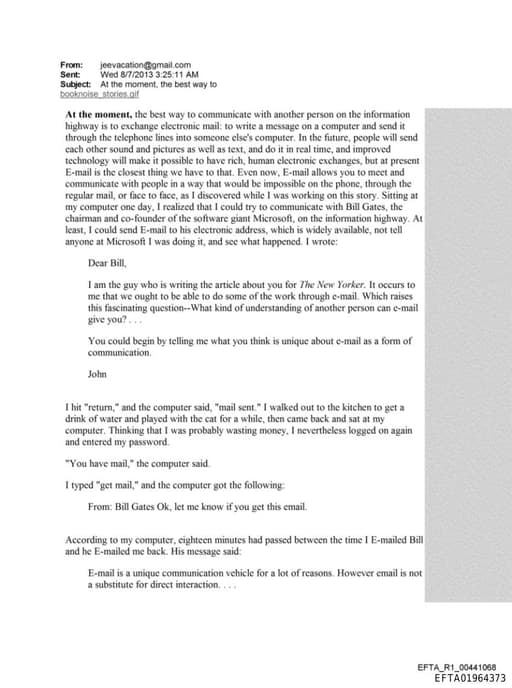







Document Mentions (10)
EFTA01964373.pdf
1 mentionEFTA01964373
i" " is a picture of Gates in the computer room with a stocking cap pulled over his head and lying on a table, over the caption "Who is this man?" Joseph Wcizenbaum, a computer scientist at M.I.T., perhaps overstating the case a little for effect, wrote, in "Computer Power and Human Reason," this early portrait
EFTA02572919.pdf
1 mentionEFTA02572919
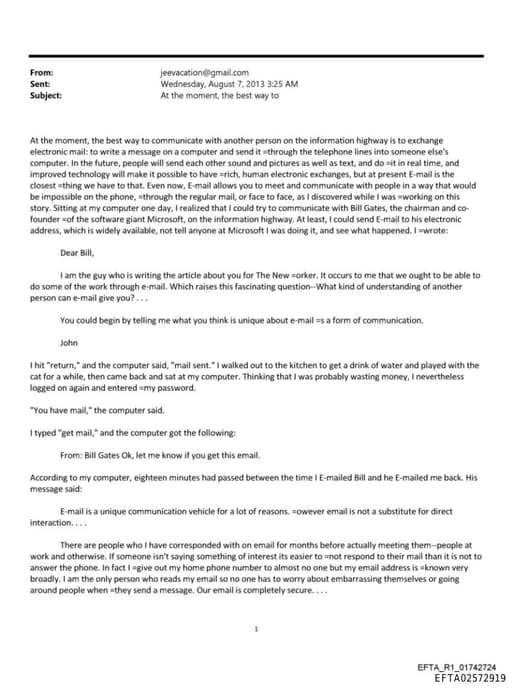
ere is a picture =of Gates in the computer room with a stocking cap pulled over his head =and lying on a table, over the caption "Who is this man?" Joseph Weizenbaum, a computer scientist at M.I.T., perhaps overstating the case a little for effect, wrote, in "Computer Power and Human Reason," this early portrait
EFTA02673568.pdf
1 mentionEFTA02673568
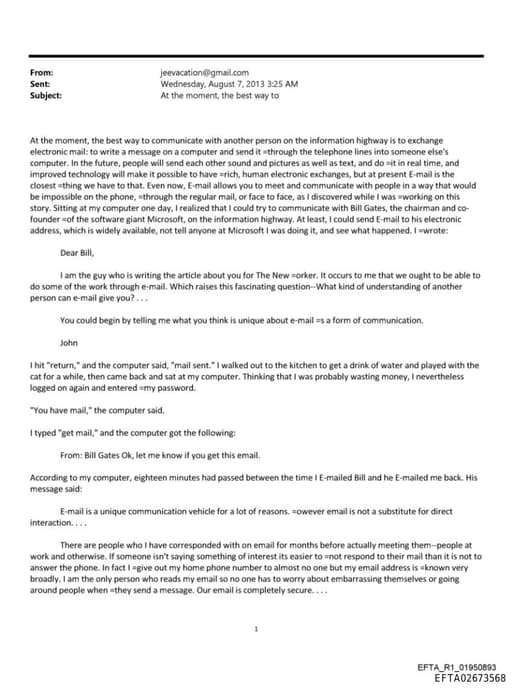
ere is a picture =of Gates in the computer room with a stocking cap pulled over his head =and lying on a table, over the caption "Who is this man?" Joseph Weizenbaum, a computer scientist at M.I.T., perhaps overstating the case a little for effect, wrote, in "Computer Power and Human Reason," this early portrait
Sponsored
AreTheAndroids_James Tagg_small_p2.pdf
1 mentionHOUSE_OVERSIGHT_015675_sub_001 - HOUSE_OVERSIGHT_015774
Source: House Oversight Committee
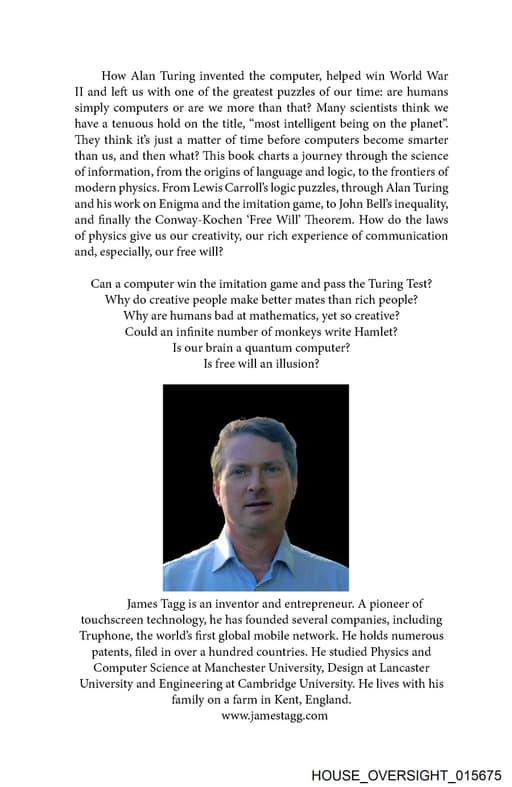
d on interview, rather than practical tests. Could a computer hold a conversation with me and persuade me it is intelligent? Meet Eliza. Invented by Joseph Weizenbaum of the Massachusetts Institute of Technology, and named after George Bernard Shaw’s character in Pygmalion, Eliza runs an algorithm pretending to be
1 mention
lding - this is fine. Wonderful even. But it’s also not enough. “It happens that programming is a relatively easy craft to learn,” the MIT scientist Joseph Weizenbaum observed in the 1970s, as computers emerged into academic life. “Almost anyone with a reasonably ordered mind can become a good programmer with just
government (or our enemies) behave. We are, ina sense, being engineered by the damn opaque systems we are using. In 1965 the MIT computer scientist Joseph Weizenbaum found himself, somewhat unexpectedly, considering this same problem. 175 Weizenbaum had written a primitive computer program to perform what is now k
Sponsored
Brockman_DeepThinking.MS.pdf
1 mentionHOUSE_OVERSIGHT_016804_sub_001 - HOUSE_OVERSIGHT_016903
Source: House Oversight Committee
owing it to detect dissent and subversion as it arises and make resistance to state power futile. Orwell’s telescreens are the prototype, and in 1976 Joseph Weizenbaum, one of the gloomiest tech prophets of all time, warned my class of graduate students not to pursue automatic speech recognition because government s
Brockman_DeepThinking.MS.pdf
1 mentionHOUSE_OVERSIGHT_016804_sub_002 - HOUSE_OVERSIGHT_016995
Source: House Oversight Committee
e; the Fair Access to Science and Technology Research Act (FASTR); and the Open Humans Foundation. In his 1976 book Computer Power and Human Reason, Joseph Weizenbaum argued that machines should not replace Homo in situations requiring respect, dignity, or care, while others (author Pamela McCorduck and computer sc
Brockman_DeepThinking.MS.pdf
1 mentionHOUSE_OVERSIGHT_016221_sub_001 - HOUSE_OVERSIGHT_016320
Source: House Oversight Committee
owing it to detect dissent and subversion as it arises and make resistance to state power futile. Orwell’s telescreens are the prototype, and in 1976 Joseph Weizenbaum, one of the gloomiest tech prophets of all time, warned my class of graduate students not to pursue automatic speech recognition because government s
Sponsored
Brockman_DeepThinking.MS.pdf
1 mentionHOUSE_OVERSIGHT_016221_sub_002 - HOUSE_OVERSIGHT_016412
Source: House Oversight Committee
e; the Fair Access to Science and Technology Research Act (FASTR); and the Open Humans Foundation. In his 1976 book Computer Power and Human Reason, Joseph Weizenbaum argued that machines should not replace Homo in situations requiring respect, dignity, or care, while others (author Pamela McCorduck and computer sc
Sponsored
Connected Entities(20 of 848)
Samantha Power
PersonIrish-American academic, author and diplomat
10 docs10 co-mentions
Stephen Hawking
PersonBritish theoretical physicist, cosmologist and author (1942–2018)
10 docs10 co-mentions
Marc Rich
PersonAmerican commodities trader (1934–2013)
10 docs10 co-mentions
Cambridge University
OrganizationOrganization referenced in documents
8 docs8 co-mentions
Gordon Moore
PersonAmerican businessman, co-founder of Intel Corporation (1929–2023)
8 docs8 co-mentions
Robert Gates
PersonCIA director, U.S. Secretary of Defense, and university president
8 docs8 co-mentions
Bill Gates
PersonAmerican businessman, investor, and philanthropist (born 1955)
8 docs8 co-mentions
DB
Doug Band
PersonAmerican presidential advisor
7 docs7 co-mentions
Silicon Valley
Location2014–2019 American television series
7 docs7 co-mentions
Alan Dershowitz
PersonAmerican lawyer, author, and art collector (born 1938)
7 docs7 co-mentions
LB
Leon Black
PersonAmerican billionaire businessman (born 1951)
7 docs7 co-mentions
Prince Andrew
PersonThird child of Queen Elizabeth II and Prince Philip, Duke of Edinburgh (born 1960)
7 docs7 co-mentions
Harvey Weinstein
PersonAmerican film producer and sex offender (born 1952)
7 docs7 co-mentions
Menlo Park
LocationCity in San Mateo County, California, United States
7 docs7 co-mentions
Earth
LocationThird planet from the Sun in the Solar System
6 docs6 co-mentions
Claude Shannon
PersonAmerican mathematician and information theorist (1916–2001)
6 docs6 co-mentions
Steve Jobs
PersonAmerican entrepreneur; co-founder of Apple Inc. (1955–2011)
6 docs6 co-mentions
Deep Blue
PersonPerson referenced in documents
6 docs6 co-mentions
Wired
OrganizationAmerican technology magazine
6 docs6 co-mentions
Feynman
PersonSurname reference in Epstein-related documents
6 docs6 co-mentions