Back to People & Entities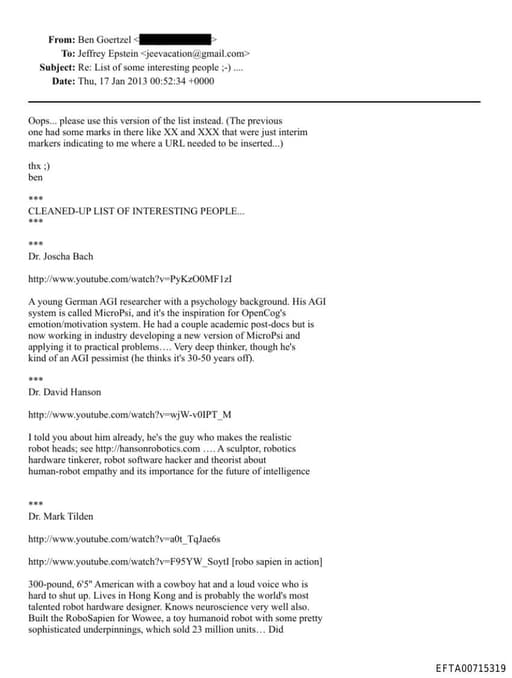




KU
Kurzweil
Person
14
Total Mentions
13
Documents
543
Connected Entities
Surname reference in documents
Document Mentions (13)
EFTA00715319.pdf
2 mentionsEFTA00715319
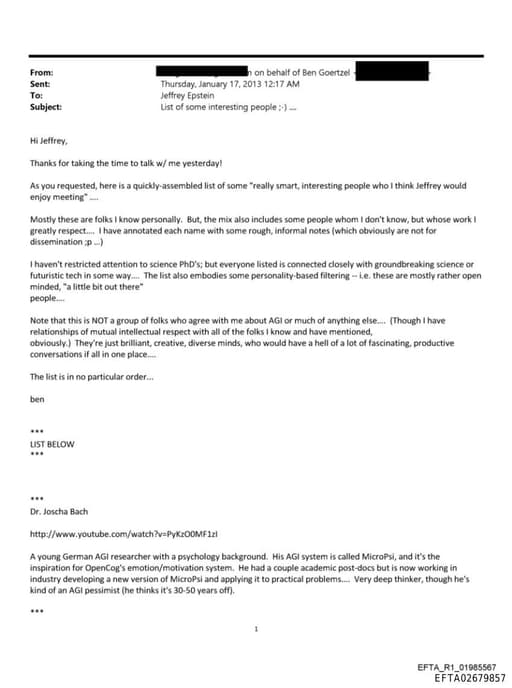
> Dr. Damien Broderick > Best known as a science fiction writer, Damien also wrote a book > called "The Spike" in XX, which was basically just like Kurzweil's > "The Singularity is Near", but too far ahead of its time (and > better-written).... Has edited some other books on futurist tech.. *** > Heat
ien Broderick Best known as a science fiction writer, Damien also wrote a book called "The Spike" in the late 1990s, which was basically just like Kurzweil's "The Singularity is Near", but too far ahead of its time (and better-written).... Has edited some other books on futurist tech.. *5* Heather Kni
EFTA00608225.pdf
1 mentionEFTA00608225
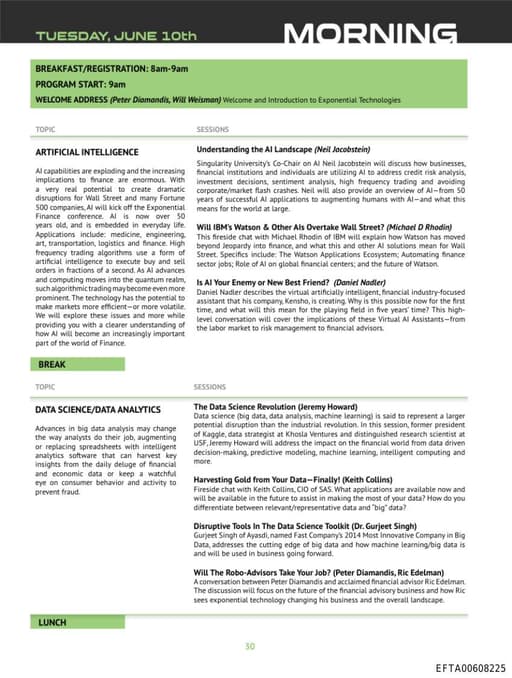
tless genius' by The Wall Street Journal and "the ultimate thinking machine" by Forbes magazine. In his role as a Director of Engineering at Google, Kurzweil heads up a team developing machine intelligence and natural language understanding. During this keynote he will share his thoughts on accelerating t
EFTA00683473.pdf
1 mentionEFTA00683473
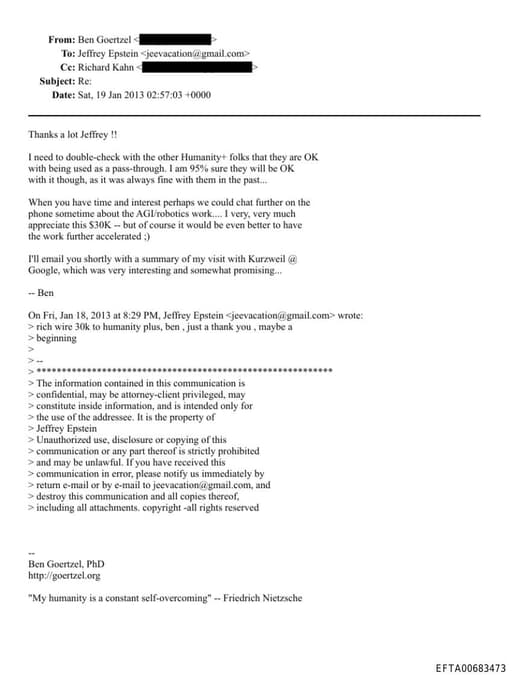
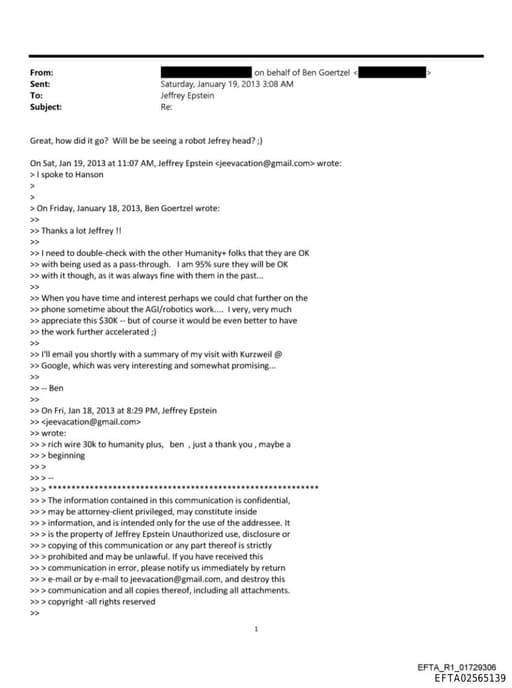
e this $30K -- but of course it would be even better to have the work further accelerated ;) I'll email you shortly with a summary of my visit with Kurzweil @ Google, which was very interesting and somewhat promising... -- Ben On Fri, Jan 18, 2013 at 8:29 PM, Jeffrey Epstein [email protected]> wrot
Sponsored
EFTA01457175.pdf
1 mentionEFTA01457175
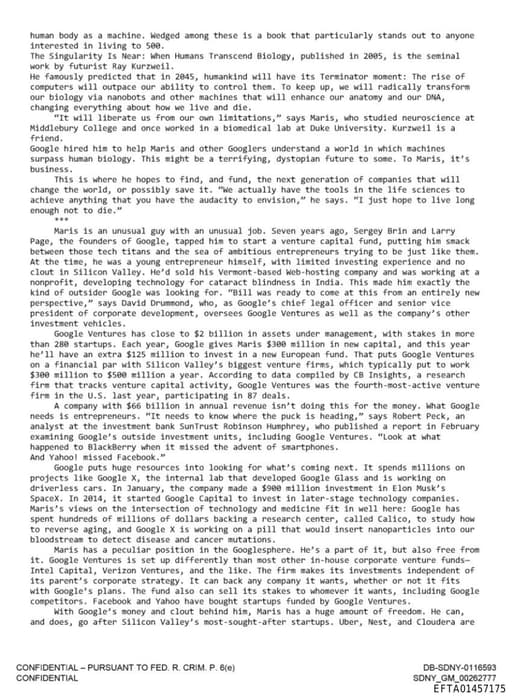
ate us from our own limitations," says Maris, who studied neuroscience at Middlebury College and once worked in a biomedical lab at Duke University. Kurzweil is a friend. Google hired him to help Maris and other Googlers understand a world in which machines surpass human biology. This might be a terrify
EFTA02679857.pdf
1 mentionEFTA02679857
••• Dr. Damien Broderick Best known as a science fiction writer, Damien also wrote a book called "The Spike" in XX, which was basically just like Kurzweil's "The Singularity is Near", but too far ahead of its time (and better-written).... Has edited some other books on futurist tech.. ••• 7 EFTA_R1_
EFTA02707041.pdf
1 mentionEFTA02707041
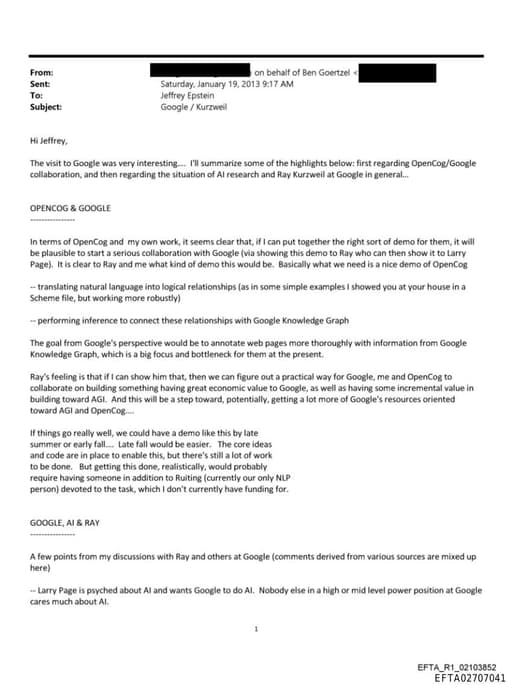
wspaper headlines) is working on applying this sort of deep learning to speech processing. To my mind, this stuff basically embodies the notions in Kurzweil's book already. But Ray, I think, sees his approach as more distinct from Ng's -- Ray's current, germinal team does not seem to strongly agree with
Sponsored
EFTA02565139.pdf
1 mentionEFTA02565139
is $30K -- but of course it would be even better to have » the work further accelerated ;) » I'll email you shortly with a summary of my visit with Kurzweil @ » Google, which was very interesting and somewhat promising... »--Ben » On Fri, Jan 18, 2013 at 8:29 PM, Jeffrey Epstein » <[email protected]
EFTA02575966.pdf
1 mentionEFTA02575966
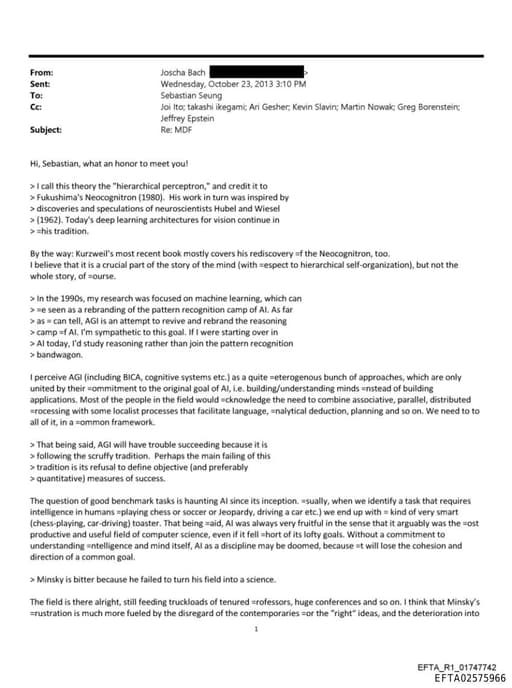
peculations of neuroscientists Hubel and Wiesel > (1962). Today's deep learning architectures for vision continue in > =his tradition. By the way: Kurzweil's most recent book mostly covers his rediscovery =f the Neocognitron, too. I believe that it is a crucial part of the story of the mind (with =espec
AreTheAndroids_James Tagg_small_p2.pdf
1 mentionHOUSE_OVERSIGHT_015675_sub_001 - HOUSE_OVERSIGHT_015774
Source: House Oversight Committee
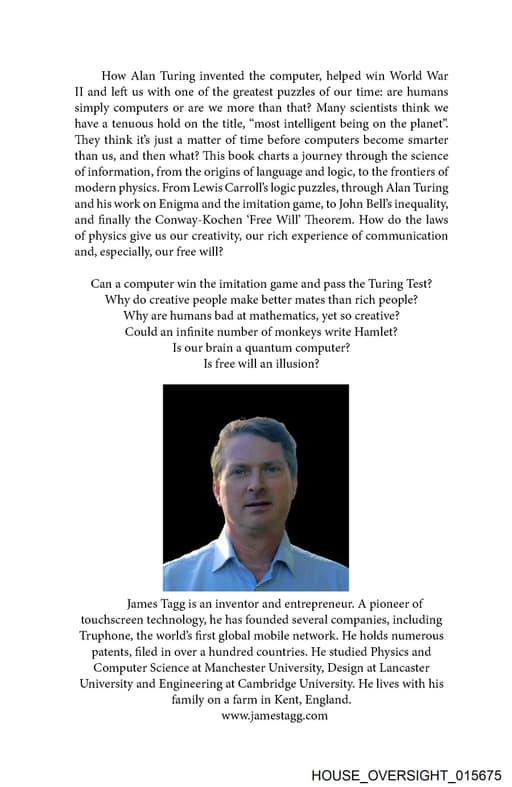
lso respond exponentially, albeit somewhat delayed, so we survive. In the case of computer power there is no opposing immune system fighting back, so Kurzweil thinks computers will achieve almost limitless processing power; perhaps even within our lifetime. He thinks this will lead to some interesting conse
Sponsored
AreTheAndroids_James Tagg_small_p2.pdf
1 mentionHOUSE_OVERSIGHT_015675_sub_005 - HOUSE_OVERSIGHT_016110
Source: House Oversight Committee
sed edition. Penguin, 2001. Jr, Frederick P. Brooks. The Mythical Man Month and Other Essays on Software Engineering. 2nd ed. Addison Wesley, 1995. Kurzweil, Ray. How to Create a Mind: The Secret of Human Thought Revealed. Penguin, 2012. Matiyasevich, Yuri. HILBERT’S TENTH PROBLEM: What Can We Do with Di
Brockman_DeepThinking.MS.pdf
1 mentionHOUSE_OVERSIGHT_016804_sub_001 - HOUSE_OVERSIGHT_016903
Source: House Oversight Committee
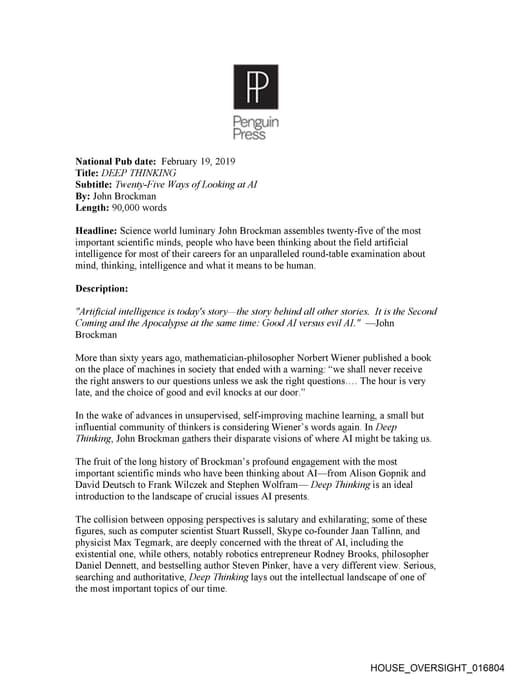
blication of Ray Kurzweil’s The Singularity is Near, the idea of technological advance leading to superintelligence is back in force. Some believers, Kurzweil included, regard this singularity as an opportunity: Humans can merge their brains with the superintelligence and thereby live forever. Others, such
EFTA00693914.pdf
1 mentionEFTA00693914
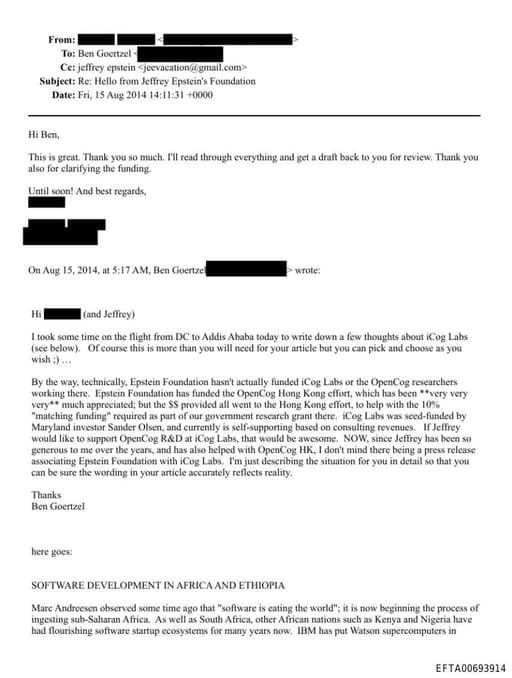
Getnet Aseffa Gezaw. Amara knew Ben from various futurist conferences in the US, as well as due to Goertzel's ongoing relationship with her employer Kurzweil; she knew Getnet due to corresponding with him via email and video-chat about a variety of futurist topics. Getnet had been giving a series of lect
Sponsored
Brockman_DeepThinking.MS.pdf
1 mentionHOUSE_OVERSIGHT_016221_sub_001 - HOUSE_OVERSIGHT_016320
Source: House Oversight Committee
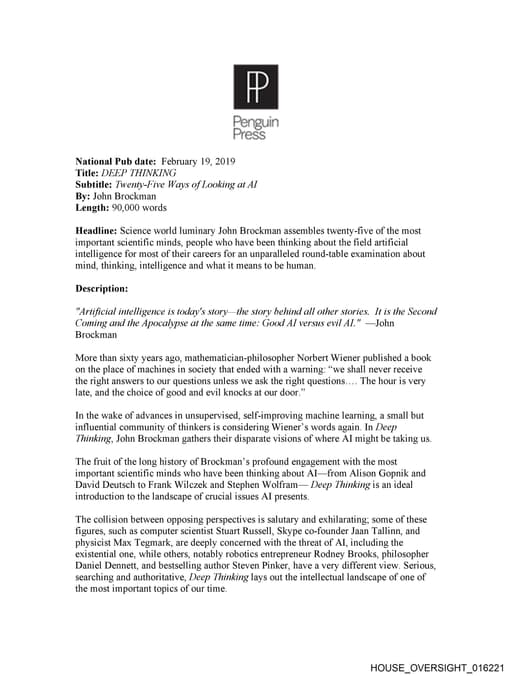
blication of Ray Kurzweil’s The Singularity is Near, the idea of technological advance leading to superintelligence is back in force. Some believers, Kurzweil included, regard this singularity as an opportunity: Humans can merge their brains with the superintelligence and thereby live forever. Others, such
Sponsored
Connected Entities(20 of 543)
Marc Rich
PersonAmerican commodities trader (1934–2013)
8 docs8 co-mentions
Jeffrey Epstein
PersonAmerican sex offender and financier (1953–2019)
7 docs7 co-mentions
Marvin Minsky
PersonAmerican cognitive scientist (1927-2016)
6 docs6 co-mentions
Alan Dershowitz
PersonAmerican lawyer, author, and art collector (born 1938)
6 docs6 co-mentions
Ben Goertzel
PersonAuthor and researcher in the field of Artificial Intelligence
5 docs5 co-mentions
Eric Trump
PersonAmerican businessman and reality television personality (born 1984)
5 docs5 co-mentions
Prince Andrew
PersonThird child of Queen Elizabeth II and Prince Philip, Duke of Edinburgh (born 1960)
5 docs5 co-mentions
Jeopardy
OrganizationTelevision game show
5 docs5 co-mentions
OpenCog
OrganizationArtificial intelligence research project
4 docs4 co-mentions
Feynman
PersonSurname reference in Epstein-related documents
4 docs4 co-mentions
Garry Kasparov
PersonRussian chess grandmaster and activist
4 docs4 co-mentions
MA
Marvin
PersonFirst name reference to multiple individuals in Epstein documents, possibly including Marvin Minsky
4 docs4 co-mentions
Cambridge University
OrganizationOrganization referenced in documents
4 docs4 co-mentions
Quantum
OrganizationQuantum Fund or entity referenced in documents
4 docs4 co-mentions
Gorbachev
PersonLeader of the Soviet Union from 1985 to 1991 (1931–2022)
4 docs4 co-mentions
LB
Leon Black
PersonAmerican billionaire businessman (born 1951)
4 docs4 co-mentions
Nick Bostrom
PersonPhilosopher and writer (born 1973)
4 docs4 co-mentions
Sergey Brin
PersonAmerican billionaire businessman (born 1973)
4 docs4 co-mentions
William Shakespeare
PersonEnglish playwright and poet (1564–1616)
4 docs4 co-mentions
Joe Biden
Person46th President of the United States (2021–2025)
4 docs4 co-mentions