Back to People & Entities










OpenCog
Organization
136
Total Mentions
101
Documents
1,344
Connected Entities
Artificial intelligence research project
Document Mentions (20 of 101)
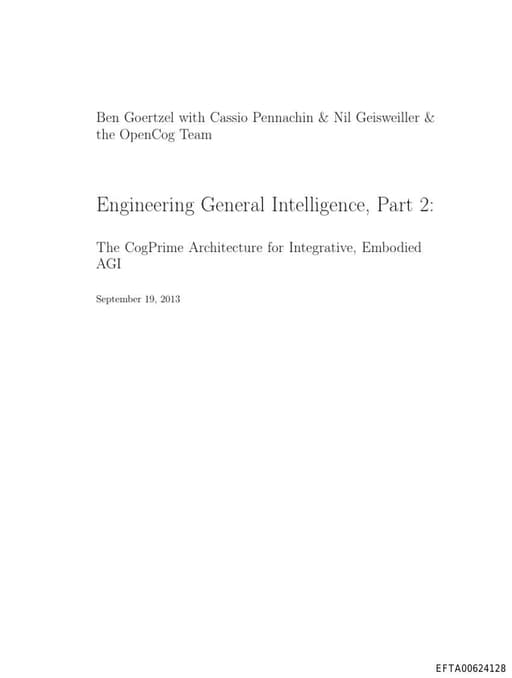
EFTA00624128.pdf
3 mentionsEFTA00624128_sub_002 - EFTA00624128_200
connecting CogPrime to a virtual world (such as Second Life, Multiverse, or Unity3D, to name sonic of the virtual world / gaming platforms to which OpenCog has already been connected in practice). EFTA00624278 132 26 Perceptual and Motor Hierarchies 26.3.1 Perceiving the Virtual World The most comp
can be used for color vision, and multi-sensory and perception-action integration. The approach presented here begins with two separate Al systems, OpenCog (introduced in Chapter 6.3) and DeSTIN (introduced in Chapter 4.3.1) - both currently implemented in open-source software. Here are the relevant fe
somewhat in the de- tails from the manner in which these things would be incorporated into a standalone DeSTIN, but pursuing the same concepts in an OpenCog integration context. What we describe here is a way to make a "Uniform DeSTIN", in which the internal repre- sentation of perceived visual forms is
EngGenInt_Vol_One.pdf
3 mentionsHOUSE_OVERSIGHT_012899_sub_001 - HOUSE_OVERSIGHT_012998
Source: House Oversight Committee
ing used as the basis for an open-source software project called OpenCog, which is being worked on by software developers around the world. Right now OpenCog embodies only a percentage of the overall CogPrime design as described here. But if OpenCog continues to attract sufficient funding or volunteer inte
at the ideas presented here are not mere armchair speculation — they are currently being used as the basis for an open-source software project called OpenCog, which is being worked on by software developers around the world. Right now OpenCog embodies only a percentage of the overall CogPrime design as des
be validated or refuted via practice. (As a related note: here and there in this book, we will refer to the "current" CogPrime implementation (in the OpenCog framework); in all cases this refers to OpenCog as of late 2013.) To state one believes one knows a workable path to creating a human-level (and pot
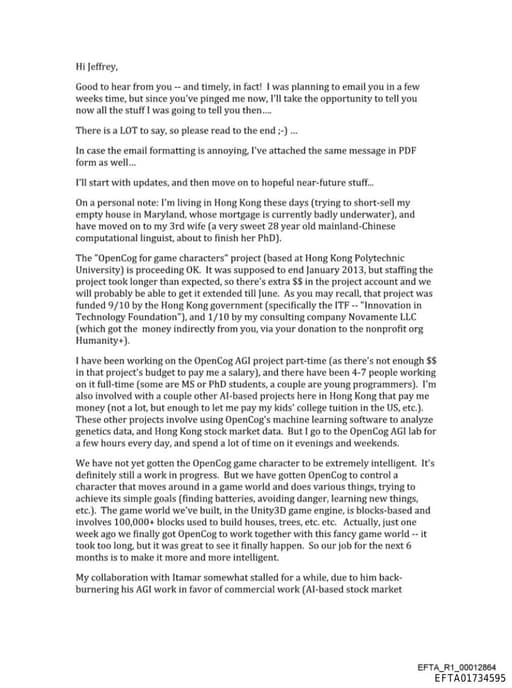
EFTA01734595.pdf
3 mentionsEFTA01734595
N, and will never be more than a perceptual cortex. Another option is open-source development, like the way Linux was built We're trying this with OpenCog (http://opencog.org). But building AGI requires people with much more specialized expertise than building a "mere" computer operating system like L
a small team working closely with me in a single location. Another option is that someone like Jeffrey Epstein, decides to fund an AGi project like OpenCog. So, summing up.... What would be a VERY GOOD avenue for getting from here to human-level AGI? -- Jeffrey Epstein funds the $350K OpenCog/Robokind
e in Hong Kong that pay me money (not a lot, but enough to let me pay my kids' college tuition in the US, etc.). These other projects involve using OpenCog's machine learning software to analyze genetics data, and Hong Kong stock market data. But I go to the OpenCog AGI lab for a few hours every day, a
Sponsored
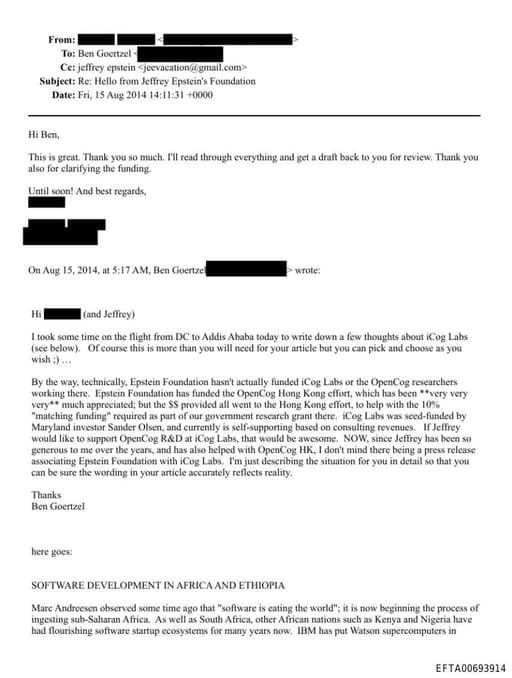
EFTA00693914.pdf
3 mentionsEFTA00693914
eed for your article but you can pick and choose as you wish ;) By the way, technically, Epstein Foundation hasn't actually funded iCog Labs or the OpenCog researchers working there. Epstein Foundation has funded the OpenCog Hong Kong effort, which has been **very very very** much appreciated; but the
some seed funding to enable the training of an initial programming team. And so iCog was born. Our idea was to have iCog do a mix of AI R&D on the OpenCog project, and commercial outsourcing for AI projects based around the world. The commercial projects would fund the AI R&D, and might also lead to e
every location on the planet. While IBM has put a supercomputing facility in Kenya, none of the major tech firms has moved into Ethiopia yet -- but OpenCog is there, gaining benefit from the large volume of tech graduates produced by Ethiopian universities, and at the same time producing a population of
EFTA00623759.pdf
3 mentionsEFTA00623759_sub_001 - EFTA00623759_100
g used as the basis for an open-source software project called OpenCog, which is being worked on by software developers around the world. Right now OpenCog embodies only a percentage of the overall CogPrime design as described here. But if OpenCog continues to attract sufficient funding or volunteer in
the ideas presented here are not mere armchair speculation - they are currently being used as the basis for an open-source software project called OpenCog, which is being worked on by software developers around the world. Right now OpenCog embodies only a percentage of the overall CogPrime design as d
validated or refuted via practice. (As a related note: here and there in this book, we will refer to the "current" CogPrime implementation (in the OpenCog framework); in all cases this refers to OpenCog as of late 2013.) To state one believes one knows a workable path to creating a human-level (and po
EFTA00624128.pdf
2 mentionsEFTA00624128_sub_001 - EFTA00624128_100
ledge and intuition regarding CogPrime. For example, beyond the ideas presented here, there is a body of work on the OpenCog wiki site, and then the OpenCog codebase itself. More extensive introductory remarks may be found in Preface of Part 1, including a brief history of the book and acknowledgements
sign. No doubt it will evolve in some respects as implementation progresses; one of the principles kept in mind during the design and development of OpenCog was modular- ity, enabling substantial modifications to particular parts of the framework to occur without requiring wholesale changes throughout th
Sponsored
EFTA00709554.pdf
2 mentionsEFTA00709554
nt funding is for natural language dialogue, and I >> believe that by the end of 2015 we can get an interesting NL dialogue >> system created using OpenCog -- and connected to David Hanson's >> robots, which will be a very effective demo. I don't think this is >> as scientifically profound as the virtu
it will be based on >> underlying reasoning and understanding. » EFTA00709554 >> As you know, since I am associated with the sponsorship of the OpenCog >> HK grant at HK Poly U, I can't be funded under that grant. However, >> I am very very eager to be able to spend my own time on AGI R&D once >>
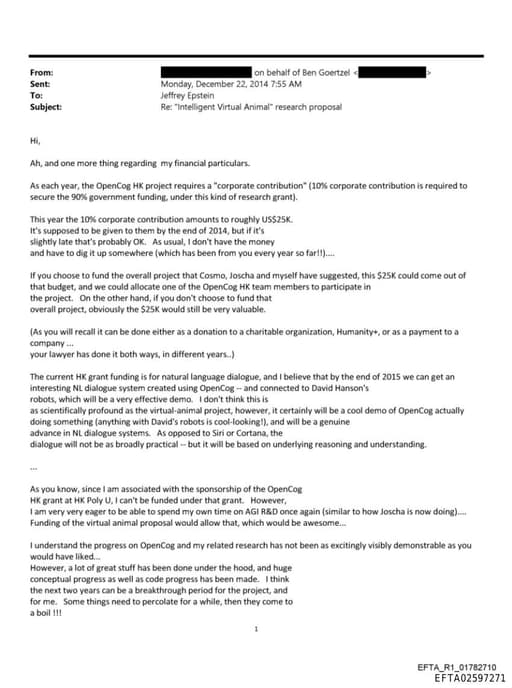
EFTA02597271.pdf
2 mentionsEFTA02597271
g on some of the > powerful tools that Joscha and I have built over the last years), and > aim to scientifically validate our approach (a subset of OpenCog, > including OpenPsi which is modeled on Joscha' Psi/MicroPsi model and > which Joscha would like to help evolve further) in the context of a > vi
HK grant funding is for natural language dialogue, and I believe that by the end of 2015 we can get an interesting NL dialogue system created using OpenCog -- and connected to David Hanson's robots, which will be a very effective demo. I don't think this is as scientifically profound as the virtual-ani
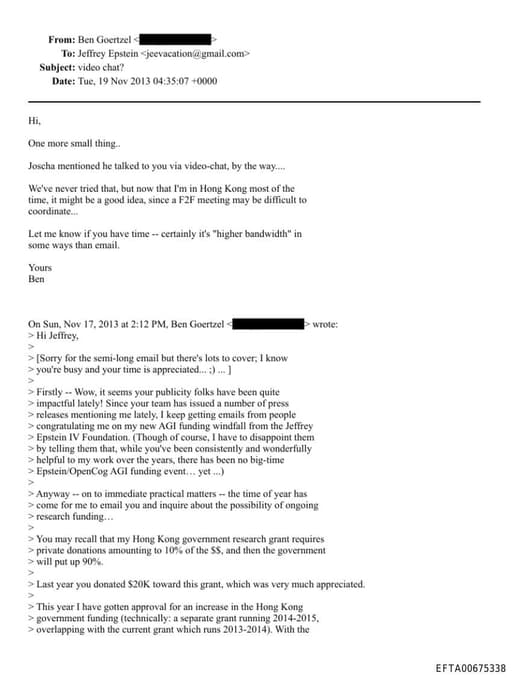
EFTA00675338.pdf
2 mentionsEFTA00675338
exciting stuff... with this > increased grant funding, we should be able to finally make an honest > effort at implementing a non-trivial subset of OpenCog... [I can also > send you the full grant proposals if you wish, though they are > somewhat a mix of science-ese and proposal-ese as is usual in suc
in N years. However, I am very bored with financial market > analysis and eager to spend more of my time on AGI, especially with > this additional OpenCog grant money. During 2014 I plan to segue into > spending more and more time on OpenCog and the quest for AGI, which > is what I really love, while
Sponsored
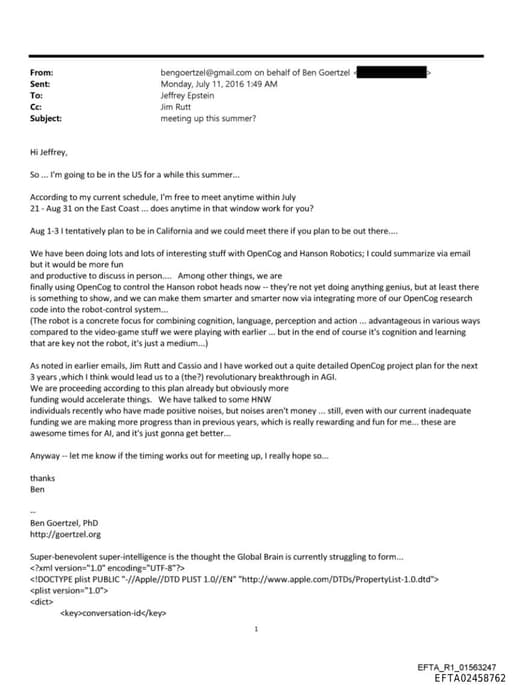
EFTA02458762.pdf
2 mentionsEFTA02458762
tatively plan to be in California and we could meet there if you plan to be out there.... We have been doing lots and lots of interesting stuff with OpenCog and Hanson Robotics; I could summarize via email but it would be more fun and productive to discuss in person.... Among other things, we are final
're not yet doing anything genius, but at least there is something to show, and we can make them smarter and smarter now via integrating more of our OpenCog research code into the robot-control system... (The robot is a concrete focus for combining cognition, language, perception and action ... advantag
EFTA02458906.pdf
2 mentionsEFTA02458906
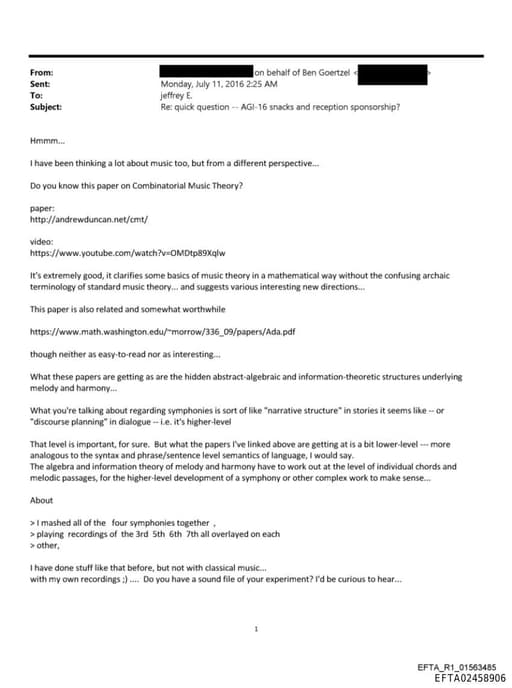
_R1_01563485 EFTA02458906 Interestingly, the "plumbing" work we've been doing to connect OpenCog to the Hanson robots would also enable us to use OpenCog for music composition / improvisation experimentation ... (i.e. we've been dealing with real-time input and output, which we hadn't been doing befo
d file of your experiment? I'd be curious to hear... EFTA_R1_01563485 EFTA02458906 Interestingly, the "plumbing" work we've been doing to connect OpenCog to the Hanson robots would also enable us to use OpenCog for music composition / improvisation experimentation ... (i.e. we've been dealing with rea
EFTA02708722.pdf
2 mentionsEFTA02708722
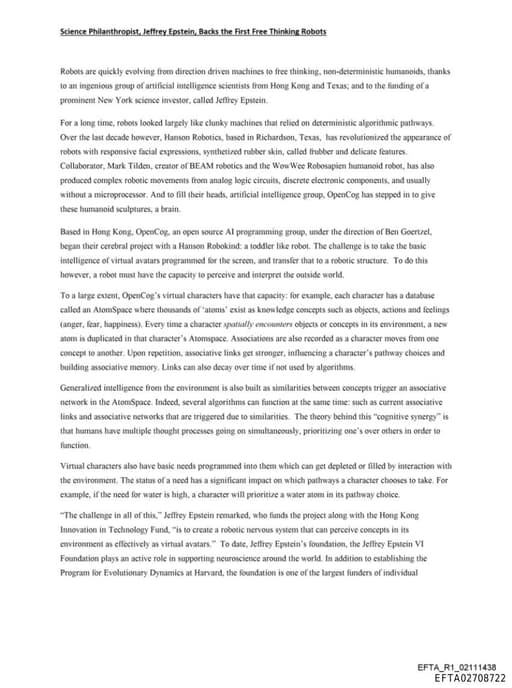
analog logic circuits, discrete electronic components, and usually without a microprocessor. And to fill their heads, artificial intelligence group, OpenCog has stepped in to give these humanoid sculptures, a brain. Based in Hong Kong, OpenCog, an open source AI programming group, under the direction of
sor. And to fill their heads, artificial intelligence group, OpenCog has stepped in to give these humanoid sculptures, a brain. Based in Hong Kong, OpenCog, an open source AI programming group, under the direction of Ben Goertzel, began their cerebral project with a Hanson Robokind: a toddler like robot
Sponsored
EFTA00597456.pdf
2 mentionsEFTA00597456
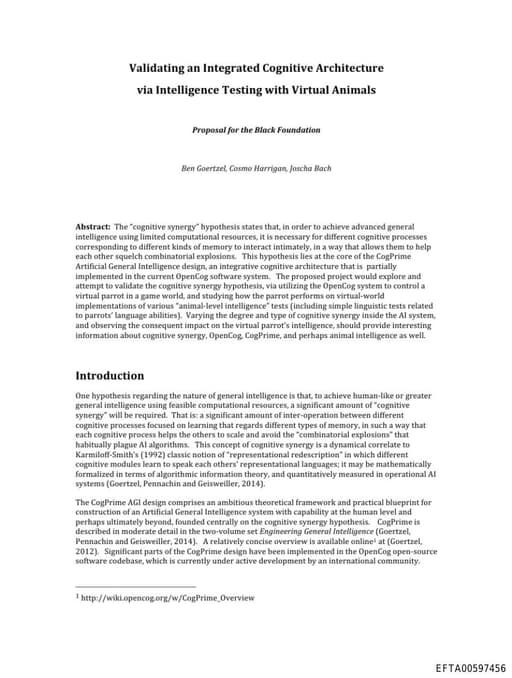
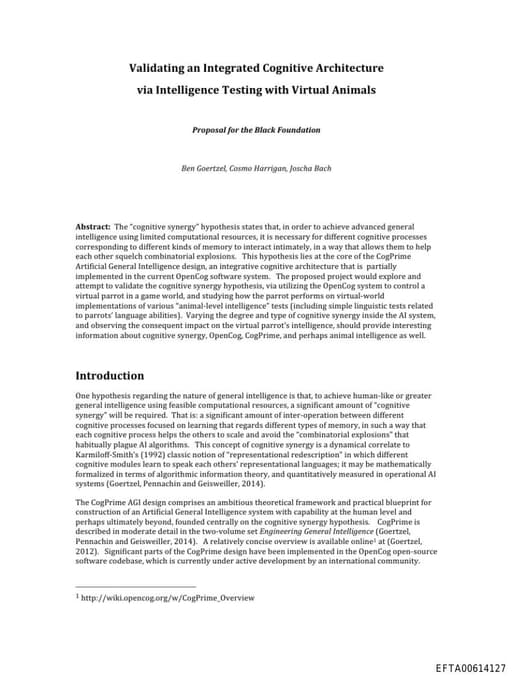
the core of the CogPrime Artificial General Intelligence design, an integrative cognitive architecture that is partially implemented in the current OpenCog software system. The proposed project would explore and attempt to validate the cognitive synergy hypothesis, via utilizing the OpenCog system to co
the current OpenCog software system. The proposed project would explore and attempt to validate the cognitive synergy hypothesis, via utilizing the OpenCog system to control a virtual parrot in a game world, and studying how the parrot performs on virtual-world implementations of various "animal-level
EFTA00728505.pdf
2 mentionsEFTA00728505
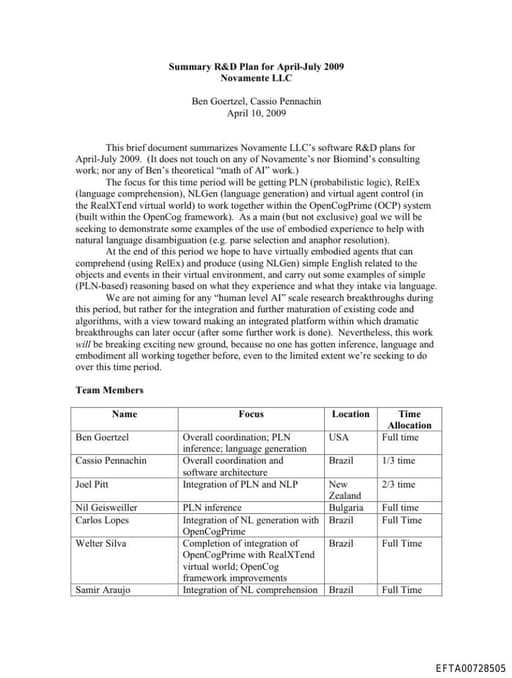
ning, etc. It is time to finally perform this integration. Carlos will complete the integration of RelEx (including the RelEx2Frame component) with OpenCog, and then carry out various RelEx improvements needed to make RelEx useful to virtually embodied agents. Samir will integrate the NLGen language ge
uage generation) and virtual agent control (in the RealXTend virtual world) to work together within the OpenCogPrime (OCP) system (built within the OpenCog framework). As a main (but not exclusive) goal we will be seeking to demonstrate some examples of the use of embodied experience to help with natur
EFTA00678280.pdf
2 mentionsEFTA00678280
h value help meeting the $45K obligation for the 10% "Corporate Sponsorship" of my 2014 "10 AI programmer" Hong Kong grant. This will help us get OpenCog to do cool enough stuff that you will have an easier time getting interest from others in the broader proposal.... For instance,. pretty sure that
is nice. One possibility, if you're agreeable, would be for you to fund me to have a research professorship at Hong Kong Poly U, which is where the OpenCog programmers here are situated. That way I could spend the bulk of my time on OpenCog AGI work, which would be great.... Of course that is not as go
Sponsored
EFTA00614127.pdf
2 mentionsEFTA00614127
the core of the CogPrime Artificial General Intelligence design, an integrative cognitive architecture that is partially implemented in the current OpenCog software system. The proposed project would explore and attempt to validate the cognitive synergy hypothesis, via utilizing the OpenCog system to co
the current OpenCog software system. The proposed project would explore and attempt to validate the cognitive synergy hypothesis, via utilizing the OpenCog system to control a virtual parrot in a game world, and studying how the parrot performs on virtual-world implementations of various "animal-level
EFTA01786410.pdf
2 mentionsEFTA01786410
mind, as we were briefly discussing at your house... Linas and I have been talking and thinking more about unified language and music learning via OpenCog, but I'll email you more about that later... ;} Ben Ben Goertzel, PhD http://goertzel.org Super-benevolent super-intelligence is the thought th
be out here too for part of the time though that's less certain... With a little more work this should be an amazing platform for teaching a young OpenCog mind, as we were briefly discussing at your house... Linas and I have been talking and thinking more about unified language and music learning via
EFTA02707041.pdf
2 mentionsEFTA02707041
penCog/Google collaboration, and then regarding the situation of Al research and Ray Kurzweil at Google in general... OPENCOG & GOOGLE In terms of OpenCog and my own work, it seems clear that, if I can put together the right sort of demo for them, it will be plausible to start a serious collaboration w
ocus and bottleneck for them at the present. Ray's feeling is that if I can show him that, then we can figure out a practical way for Google, me and OpenCog to collaborate on building something having great economic value to Google, as well as having some incremental value in building toward AGI. And th
Sponsored
EFTA00322050.pdf
2 mentionsEFTA00322050
S COTERIE Alexey Potapov, U. Petersburg (a pioneer in probabilistic programming as an AGI approach) Linas Vepstas, OpenCog, Hanson Robotics (Lead OpenCog developer, physics PhD, former IBM Linux guru, the guy who will make AI understand language) David Weinbaum, Global Brain Institute, Brussels (The
Mallah, Cambridge Semantics >> > Jim Babcock, Machine Intelligence Research Institute >> > Zarathustra Goertzel, U. Copenhagen >> > Linas Vepstas, OpenCog >> > Cosmo Harrigan >» David Weinbaum, Global Brain Institute, Brussels >» Alexey Potapov, U. Petersburg >> > >> > >> > thx ;) >» ben >> > >
EFTA02571001.pdf
2 mentionsEFTA02571001
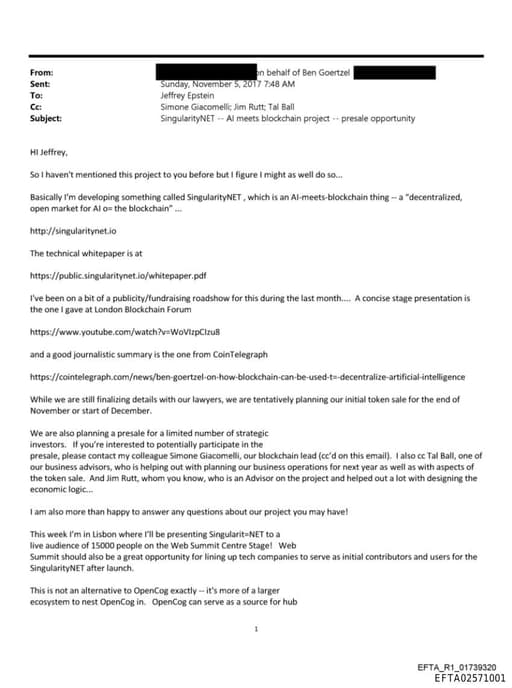
system to nest OpenCog in. OpenCog can serve as a source for hub EFTA_R1_01739320 EFTA02571001 nodes for the SingularityNET, but the Net can help OpenCog connect with a lot of other Als too, to achieve combined effects.... Finally, on the more purely intellectual side, some moderately rambling though
ortunity for lining up tech companies to serve as initial contributors and users for the SingularityNET after launch. This is not an alternative to OpenCog exactly -- it's more of a larger ecosystem to nest OpenCog in. OpenCog can serve as a source for hub EFTA_R1_01739320 EFTA02571001 nodes for the
Sponsored
Connected Entities(20 of 1,344)
Jeffrey Epstein
PersonAmerican sex offender and financier (1953–2019)
86 docs86 co-mentions
Ben Goertzel
PersonAuthor and researcher in the field of Artificial Intelligence
56 docs56 co-mentions
Joscha Bach
PersonCognitive scientist
40 docs40 co-mentions
Friedrich Nietzsche
PersonGerman philosopher, referenced in Epstein reading and intellectual documents
23 docs23 co-mentions
Marc Rich
PersonAmerican commodities trader (1934–2013)
23 docs23 co-mentions
Novamente LLC
OrganizationAI research company
23 docs23 co-mentions
Xiamen
LocationPrefecture-level city in Fujian, China
19 docs19 co-mentions
Hanson
PersonPrimarily refers to Steve Hanson, CEO of BR Guest Hospitality restaurant group and associate of Epstein
18 docs18 co-mentions
JK
James T. Kirk
PersonPerson referenced in documents
17 docs17 co-mentions
Biomind LLC
OrganizationOrganization referenced in documents
17 docs17 co-mentions
DeSTIN
OrganizationOrganization referenced in documents
16 docs16 co-mentions
Novamente
OrganizationOrganization referenced in documents
16 docs16 co-mentions
CogPrime
OrganizationOrganization referenced in documents
14 docs14 co-mentions
Itamar
PersonFirst name reference to multiple individuals in Epstein-related documents
13 docs13 co-mentions
Marvin Minsky
PersonAmerican cognitive scientist (1927-2016)
13 docs13 co-mentions
Ethiopia
LocationCountry in the Horn of Africa
12 docs12 co-mentions
Jeffrey Epstein VI Foundation
OrganizationJeffrey Epstein VI Foundation, private foundation based in the US Virgin Islands used for Epstein philanthropy
12 docs12 co-mentions
ConceptNodes
OrganizationOrganization referenced in documents
12 docs12 co-mentions
AGI Summer School
OrganizationOrganization referenced in documents
12 docs12 co-mentions
ME
Meyer
PersonAmbiguous surname reference to multiple individuals in Epstein documents
10 docs10 co-mentions