Back to People & Entities











Descartes
Person
23
Total Mentions
19
Documents
722
Connected Entities
Surname reference in documents
Descartes appears 12 times across 8 documents, primarily in philosophical discussions rather than direct evidence of involvement with Jeffrey Epstein or his associates.
The mentions are overwhelmingly LOW SIGNAL - Descartes is referenced in philosophical essays, intellectual debates, and critical commentary about consciousness and existence. Multiple identical snippets from EFTA00008020 discuss whether Descartes would have changed his philosophy if he'd received a massage. There are NO flight logs, personal correspondence, or direct connections to Epstein's activities. The mentions are essentially academic citations or rhetorical devices in unrelated documents.
Key Highlights
- •All 12 mentions are philosophical citations, not evidence of any relationship with Epstein or his network
- •The repetitive nature of mentions (5 identical snippets from EFTA00008020) suggests these are automated or copied text rather than substantive investigation
- •No direct emails, flight records, or financial connections exist - Descartes is used as a historical reference point in various discussions
- •The documents containing Descartes mentions are primarily government oversight records that appear to include unrelated philosophical content
Frequently Asked Questions
Related Links
Books for Further Reading
Perversion of Justice: The Jeffrey Epstein Story
Julie K. Brown
Investigative journalism that broke the Epstein case open
Filthy Rich: The Jeffrey Epstein Story
James Patterson
Bestselling account of Epstein's crimes and network
Relentless Pursuit: My Fight for the Victims of Jeffrey Epstein
Bradley J. Edwards
Victims' attorney's firsthand account
Document Mentions (19)
EFTA00008020 - EFTA00008119
5 mentionsSource: DOJ EFTA Records
only specific:types of electrical activityinside their skulls that proved they indeed existed. VVhat's.glossed over in the history books is that Descartes neverreceived a great massage from an expert holistically oriented practitioner. If he had, he certainly would have modified his state- ment a bit,
Page: EFTA00008108 →only specific:types of electrical activityinside their skulls that proved they indeed existed. VVhat's.glossed over in the history books is that Descartes neverreceived a great massage from an expert holistically oriented practitioner. If he had, he certainly would have modified his state- ment a bit,
Page: EFTA00008108 →only specific:types of electrical activityinside their skulls that proved they indeed existed. VVhat's.glossed over in the history books is that Descartes neverreceived a great massage from an expert holistically oriented practitioner. If he had, he certainly would have modified his state- ment a bit,
Page: EFTA00008108 →EFTA00734270.pdf
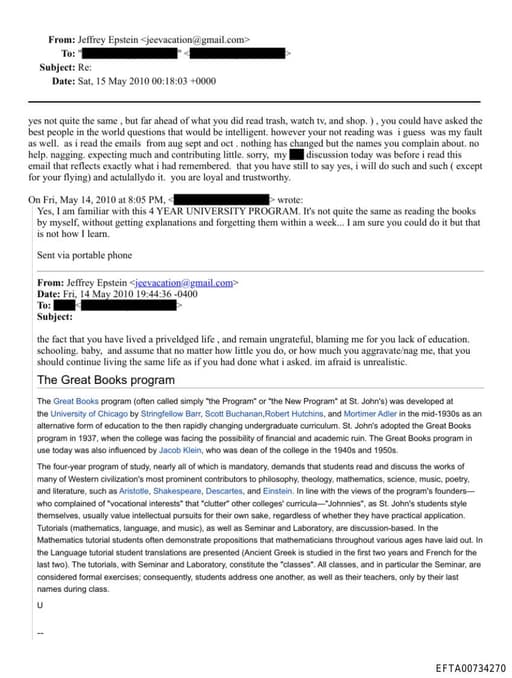
1 mentionEFTA00734270
lization's most prominent contributors to philosophy, theology, mathematics, science, music, poetry, and literature, such as Aristotle, Shakespeare, Descartes, and Einstein. In line with the views of the program's founders— who complained of "vocational interests" that "clutter" other colleges' curricula—"J
EFTA00853429.pdf
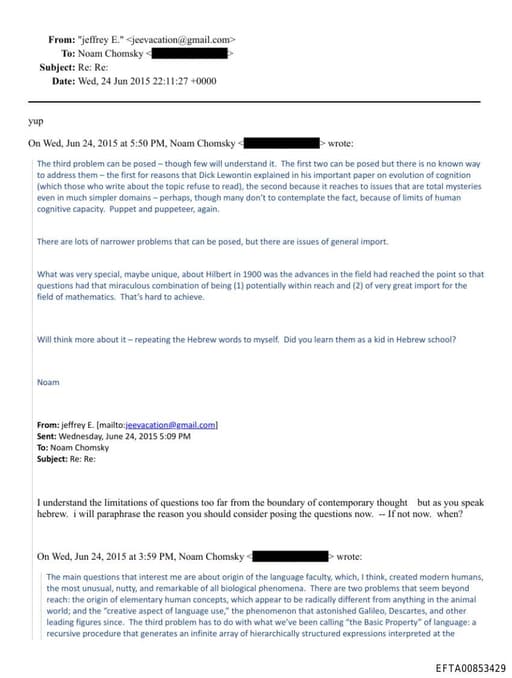
1 mentionEFTA00853429
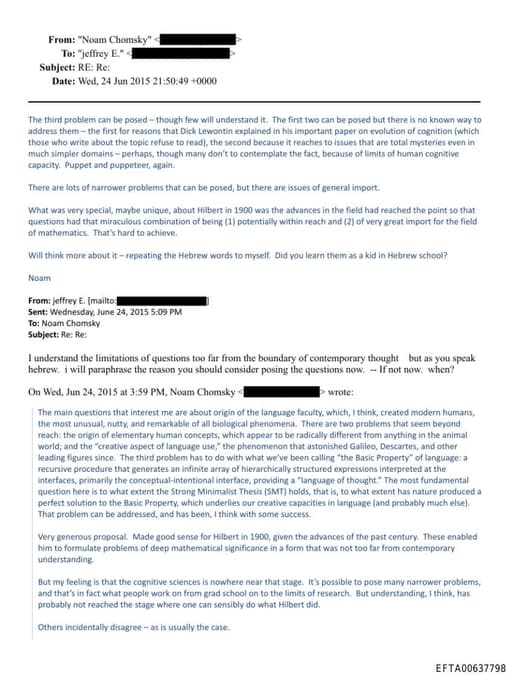
pear to be radically different from anything in the animal world; and the "creative aspect of language use," the phenomenon that astonished Galileo, Descartes, and other leading figures since. The third problem has to do with what we've been calling "the Basic Property" of language: a recursive procedure
Sponsored
EFTA00315128.pdf
1 mentionEFTA00315128
and movement disorders. Damasio's books deal with the relationship between emotions and feelings, and what their brain substrates. His 1994 book, Descartes' Error: Emotion, Reason and the Human Brain, won the Science et Vie prize, was a finalist for the Los Angela Times Book Award, and is translated in
EFTA00685202.pdf
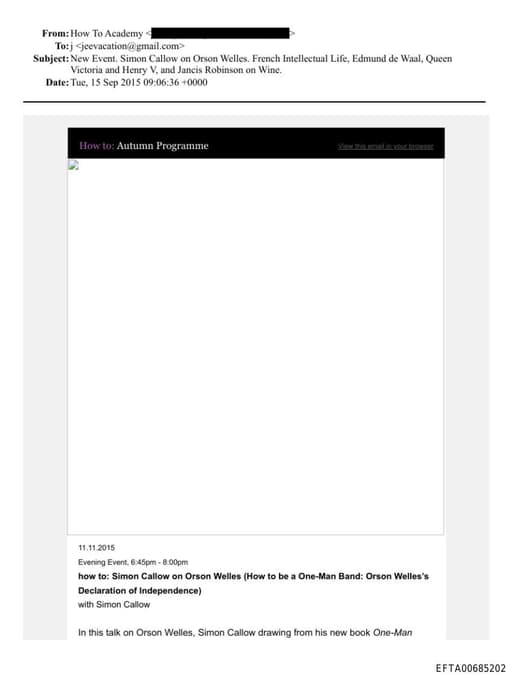
1 mentionEFTA00685202
tual tradition, exploring its long-term characteristics and evolutions over the past 400 years. Ranging from the philosophical ideas of Voltaire and Descartes, to the symbolic significance of Asterix, Sudhir Hazareesingh will show how bold, imaginative and sweeping French thought has been, tracing its tum
EFTA01618541.pdf
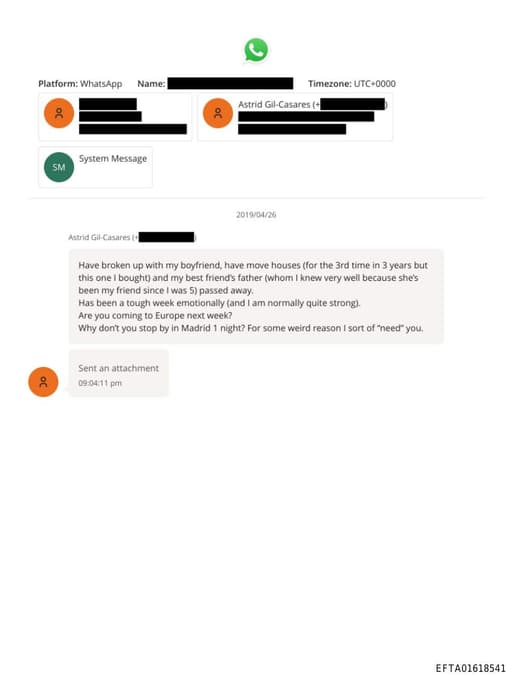
1 mentionEFTA01618541
m shame its great poetry Sent an attachment 11:41:12 pm Astrid Gil-Casaresek But there was never any doubt that Galileo or Da Vinci or Newton or Descartes or.... Sent an attachment 11:41:14 pm Were them Sent an attachment 11:41:20 pm There is a good reason to doubt Shakespeare was Shakespeare EFT
Sponsored
EFTA01721097.pdf
1 mentionEFTA01721097
as only specific types of electrical activity inside their skulls that proved they indeed existed. Wharsglossed over in the history books is that Descartes never-received a great massage from an expert holistically oriented practitioner. If he had, he certainly would have modified his state- ment a bit
EFTA02433232.pdf
1 mentionEFTA02433232
efuge from information provoked attention deficit disorder. ... EFTA_R1_01504427 EFTA02433237 PAUL BLOOM Psychologist, Yale University; Author, Descartes' Baby I AM REALIZING HOW NICE PEOPLE CAN BE When I was a boy, I loved the science-fiction idea of a machine that could answer any factual question
EFTA02497004.pdf
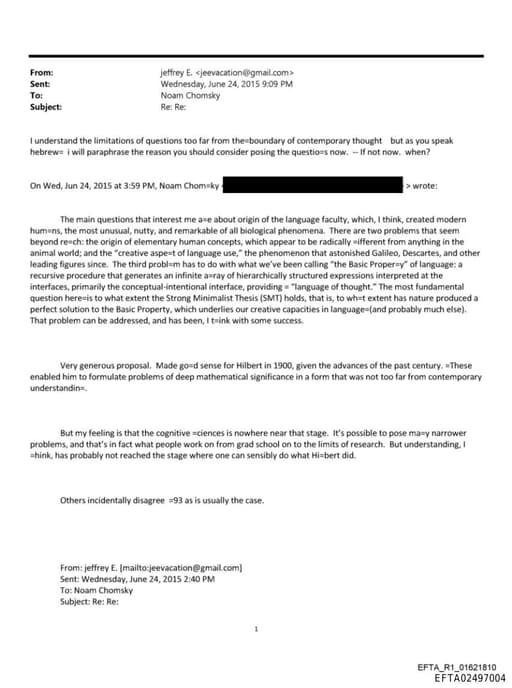
1 mentionEFTA02497004
pear to be radically =ifferent from anything in the animal world; and the "creative aspe=t of language use," the phenomenon that astonished Galileo, Descartes, and other leading figures since. The third probl=m has to do with what we've been calling "the Basic Proper=y" of language: a recursive procedure
Sponsored
EFTA02645872.pdf
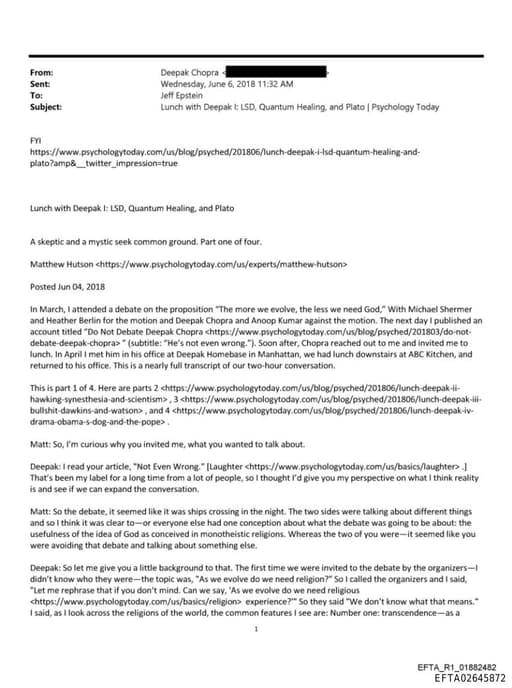
1 mentionEFTA02645872
t. Then you have the idealists going back to Plato who are saying it's all mental. But even mental ideas are constructs. Then you have the dualists, Descartes, the two are separate, mind and body. But then how do you explain their interaction? It violates simple laws like thermodynamics. If mind is separa
EFTA00637798.pdf (email 1: RE: Re:)
1 mentionEFTA00637798
pear to be radically different from anything in the animal world; and the "creative aspect of language use," the phenomenon that astonished Galileo, Descartes, and other leading figures since. The third problem has to do with what we've been calling "the Basic Property" of language: a recursive procedure
EFTA02348953.pdf (email 1: RE: Re:)
1 mentionEFTA02348953
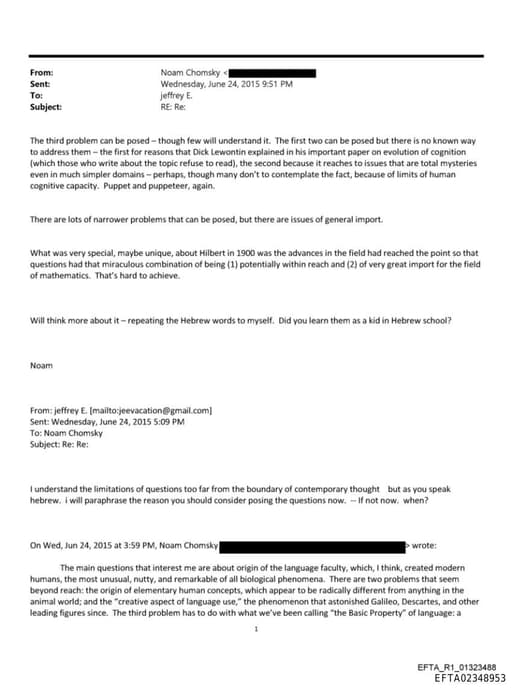
pear to be radically different from anything in the animal world; and the "creative aspect of language use," the phenomenon that astonished Galileo, Descartes, and other leading figures since. The third problem has to do with what we've been calling "the Basic Property" of language: a EFTA_R1_01323488 EF
Sponsored
AreTheAndroids_James Tagg_small_p2.pdf
1 mentionHOUSE_OVERSIGHT_015675_sub_001 - HOUSE_OVERSIGHT_015774
Source: House Oversight Committee
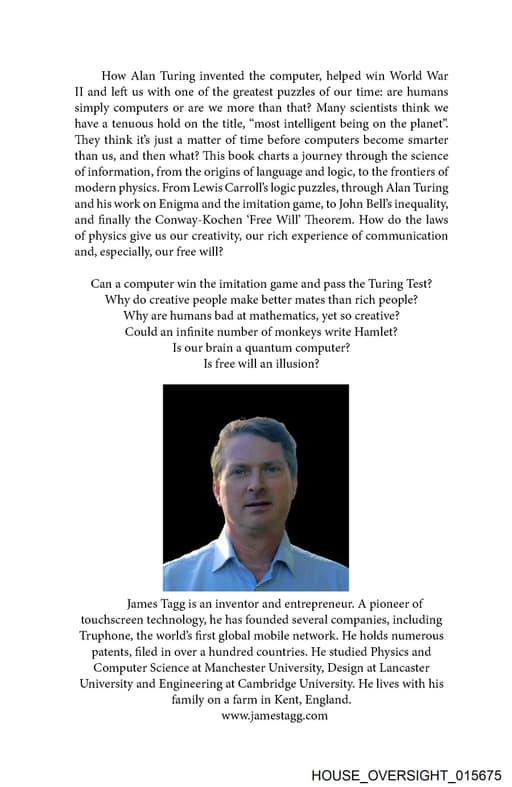
ng the terminals of the circuit of a black box. How can we know our experience of the world is real? Understanding the World The French philosopher Descartes gave us an explanation for this paradox. He spent a long time looking skeptically at everything we perceive. For example, when we poke a stick into a
CURREN DRAFT 04.02.12.docx
1 mentionHOUSE_OVERSIGHT_017088_sub_001 - HOUSE_OVERSIGHT_017187
Source: House Oversight Committee
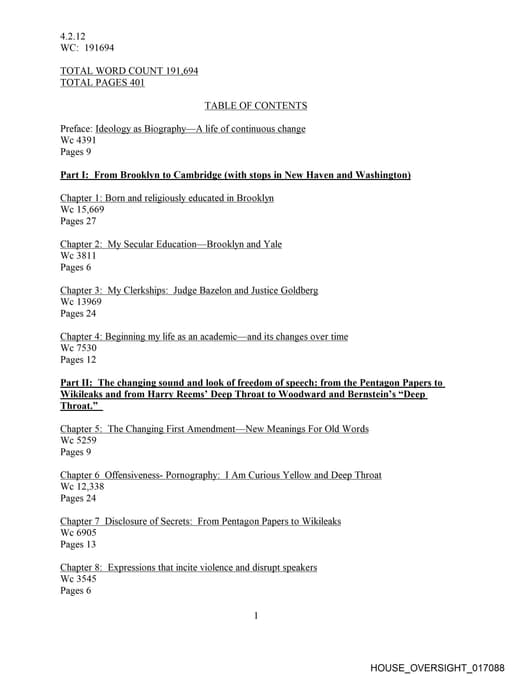
o us, and how we reacted to our experiences. Ideology is complex. Its causes are multifaceted and rarely subject to quantification. The philosopher, Descartes, who famously said, “I think therefore I am” got it backwards. I am—I was, I will be—therefore I think what I think. The ability to think is inborn—a
EFTA00285909.pdf
1 mentionEFTA00285909_sub_001 - EFTA00285909_100
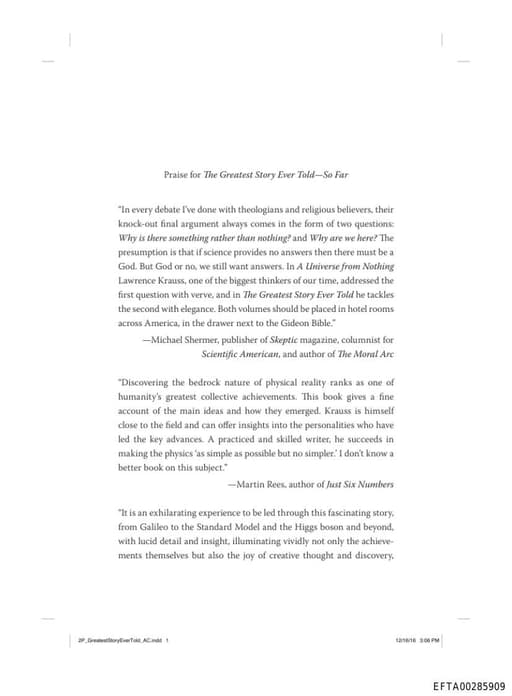
is motivation, but because of what he discovered. Newton was convinced that light was made of particles, which he re- ferred to as corpuscles, while Descartes, and later Newton's nemesis Robert Hooke, and still later the Dutch scientist Christiaan Huygens, all claimed that light was a wave. One of the key
Sponsored
Brockman_DeepThinking.MS.pdf
1 mentionHOUSE_OVERSIGHT_016804_sub_002 - HOUSE_OVERSIGHT_016995
Source: House Oversight Committee
it allowed us to make sense of the world around us, to plan ahead, and thus cope with all sorts of unexpected things in order to survive. However, as Descartes stated, we humans define our very existence by our ability to think. So it is not surprising that, in an anthropomorphic way, our fears about AI refl
Brockman_DeepThinking.MS.pdf
1 mentionHOUSE_OVERSIGHT_016221_sub_002 - HOUSE_OVERSIGHT_016412
Source: House Oversight Committee
it allowed us to make sense of the world around us, to plan ahead, and thus cope with all sorts of unexpected things in order to survive. However, as Descartes stated, we humans define our very existence by our ability to think. So it is not surprising that, in an anthropomorphic way, our fears about AI refl
HOUSE_OVERSIGHT_029509 - HOUSE_OVERSIGHT_029515
1 mentionSource: House Oversight Committee
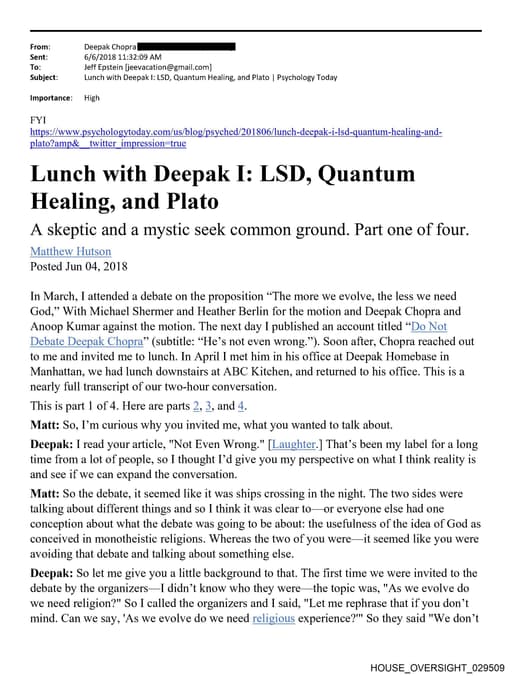
ct. Then you have the idealists going back to Plato who are saying it's all mental. But even mental ideas are constructs. Then you have the dualists, Descartes, the two are separate, mind and body. But then how do you explain their interaction? It violates simple laws like thermodynamics. If mind is separate
Page: HOUSE_OVERSIGHT_029514 →Sponsored
Evilicious.pdf
1 mentionHOUSE_OVERSIGHT_012747_sub_002 - HOUSE_OVERSIGHT_012897
Source: House Oversight Committee
bursts of creativity in art, music, literature and science. A promiscuous brain enabled Bach and Bono, Picasso and Pollock, Shakespeare and Shaw, and Descartes and Darwin. A promiscuous brain enables us to imagine things we have never directly experienced, to create once unimaginable worlds, including blissf
Sponsored
Connected Entities(20 of 722)
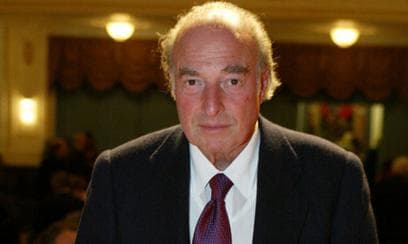
Marc Rich
PersonAmerican commodities trader (1934–2013)
12 docs12 co-mentions
Jeffrey Epstein
PersonAmerican sex offender and financier (1953–2019)
9 docs9 co-mentions
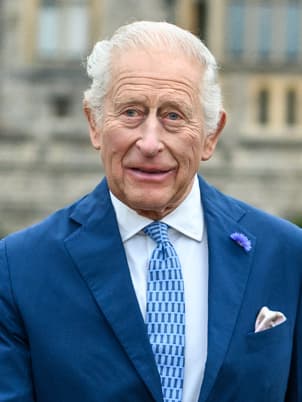
Prince Charles
PersonKing of the United Kingdom and other Commonwealth realms since 2022 (born 1948)
9 docs9 co-mentions
Harvey Weinstein
PersonAmerican film producer and sex offender (born 1952)
8 docs8 co-mentions
DB
Doug Band
PersonAmerican presidential advisor
8 docs8 co-mentions
Noam Chomsky
PersonAmerican linguist and activist (born 1928)
8 docs8 co-mentions
William Shakespeare
PersonEnglish playwright and poet (1564–1616)
8 docs8 co-mentions
John F. Kennedy
PersonPresident of the United States from 1961 to 1963 (1917–1963)
7 docs7 co-mentions
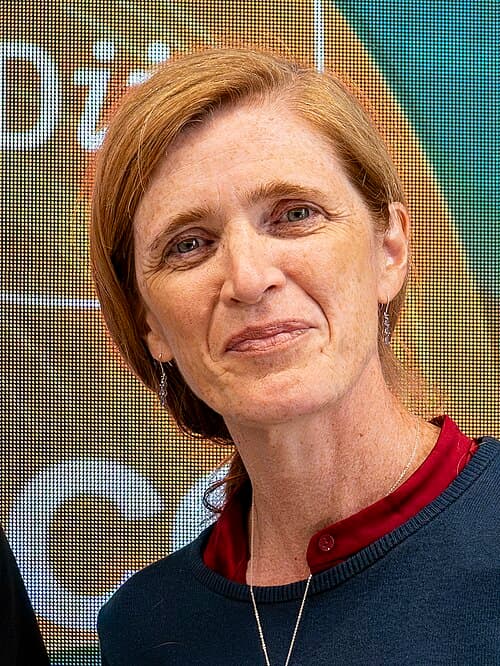
Samantha Power
PersonIrish-American academic, author and diplomat
7 docs7 co-mentions
Prince Andrew
PersonThird child of Queen Elizabeth II and Prince Philip, Duke of Edinburgh (born 1960)
7 docs7 co-mentions
Julie K. Brown
PersonAmerican journalist
6 docs6 co-mentions
LB
Leon Black
PersonAmerican billionaire businessman (born 1951)
6 docs6 co-mentions
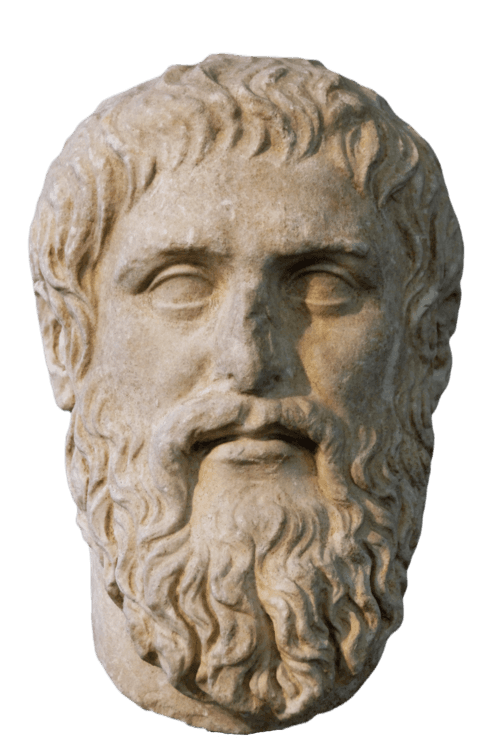
Plato
Person4th-century BCE Greek philosopher
6 docs6 co-mentions
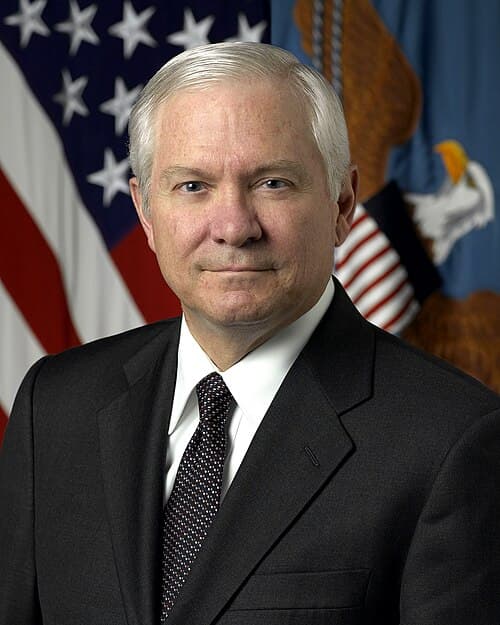
Robert Gates
PersonCIA director, U.S. Secretary of Defense, and university president
6 docs6 co-mentions
George W. Bush
PersonPresident of the United States from 2001 to 2009
6 docs6 co-mentions
Stephen Hawking
PersonBritish theoretical physicist, cosmologist and author (1942–2018)
5 docs5 co-mentions
Richard Dawkins
PersonEnglish ethologist, evolutionary biologist and author (born 1941)
5 docs5 co-mentions
Vietnam
LocationCountry in Southeast Asia
5 docs5 co-mentions
Alan Dershowitz
PersonAmerican lawyer, author, and art collector (born 1938)
5 docs5 co-mentions
Bill Clinton
PersonPresident of the United States from 1993 to 2001 (born 1946)
5 docs5 co-mentions