EFTA00030910 - EFTA00030911
Court order from Judge Alison J. Nathan regarding Ghislaine Maxwell's request to seal bail-related letters in her criminal case.
This is a December 3, 2020 court order in United States v. Ghislaine Maxwell (Case 20-CR-330) addressing Maxwell's request to seal letters related to a renewed bail motion. Judge Nathan applied the Second Circuit's three-part test from Lugosch v. Pyramid Co. to evaluate the sealing request. The order approves redactions to Maxwell's November 25 and November 30 letters that were consented to by the Government, balancing the presumption of public access against privacy and law enforcement interests.
Key Highlights
- •Maxwell's defense team sought to seal bail motion letters entirely, but later proposed redactions instead
- •Judge Nathan applied the Lugosch three-part test for judicial document sealing: determining if documents are 'judicial documents,' assessing presumption of access, and balancing competing interests
- •Government consented to the proposed redactions, which were approved by the court
- •Document reflects ongoing pretrial proceedings in Maxwell's criminal case approximately 6 months after her July 2020 arrest
Frequently Asked Questions
Books for Further Reading

Document Information
Bates Range
EFTA00030910 - EFTA00030911
Pages
2
Document Content
Page 1 - EFTA00030910
Case 1:20-cr-00330-AJN Document 81 Filed 12/03/20 Par" 1 rtf 9 UNITED STATES DISTRICT COURT SOUTHERN DISTRICT OF NEW YORK United States of America, —v— Ghislaine Maxwell, Defendant. USDC SONY DOCUMENT ELECTRONICALLY FILED DOC DATE FILED: 12/3/20 20-CR-330 (MN) ORDER ALISON J. NATHAN, District Judge: On November 25, 2020, counsel for Defendant Ghislaine Maxwell filed a letter request seeking an in camera conference for the presentation of a renewed motion for release on bail and a request to seal the November 25, 2020 letter in its entirety. The Court required justification for the sealing request. On November 30, 2020, the defense counsel filed a second letter no longer fully pressing the unsupported request to file the letter entirely under seal and instead proposing redactions to both the November 25th and November 30th letters. The Government has indicated that it does not oppose the redactions. Dkt. No. 80. After due consideration, the Court will adopt the Defendant's proposed redactions, which are consented to by the Government. The Court's decision is guided by the three-part test articulated by the Second Circuit in Lugosch v. Pyramid Co. of Onondaga, 435 F.3d 110 (2d Cir. 2006). Under this test, the Court must: (i) determine whether the documents in question are "judicial documents;" (ii) assess the weight of the common law presumption of access to the materials; and (iii) balance competing considerations against the presumption of access. Id. at 119-20. "Such countervailing factors include but are not limited to `the danger of impairing law enforcement or judicial efficiency' and `the privacy interests of those resisting disclosure.' Id. at 120 (quoting United States v. Amodeo, 71 F.3d 1044, 1050 (2d Cir. 1995) ("Anrodeo II")). EFTA00030910
Page 2 - EFTA00030911
Case 1:20-cr-00330-AJN Document 81 Filed 12/03/20 Page 2 of 2 The proposed redactions satisfy this test. First, the Court finds that the Defendant's letter motions are "relevant to the performance of the judicial function and useful in the judicial process," thereby qualifying as a "judicial document" for purposes of the first element of the Lugosch test. United States v. Amodeo ("Amodeo 1"), 44 F.3d 141, 145 (2d Cir. 1995). And while the Court assumes that the common law presumption of access attaches, in balancing competing considerations against the presumption of access, the Court finds that the arguments the Defendant has put forth—including, most notably, the privacy interests of the individuals referenced in the letters-favor her proposed and tailored redactions. The Defendant is hereby ORDERED to docket the redacted versions of the two letters by December 4, 2020. For the reasons outlined in the Government's letter dated December 2, 2020, Dkt. No. 80, the Court DENIES the Defendant's request for an in camera conference. In order to protect the privacy interests referenced in the Defendant's November 25, 2020 letter, the Court will permit the Defendant to make her submission in writing and to propose narrowly tailored redactions. The parties are hereby ORDERED to meet and confer and to jointly prepare a briefing schedule for the Defendant's forthcoming renewed motion for release on bail. SO ORDERED. Dated: December 3, 2020 New York, New York ALISON J. NATHAN United States District Judge Asts. gek 2 EFTA00030911
Entities Mentioned
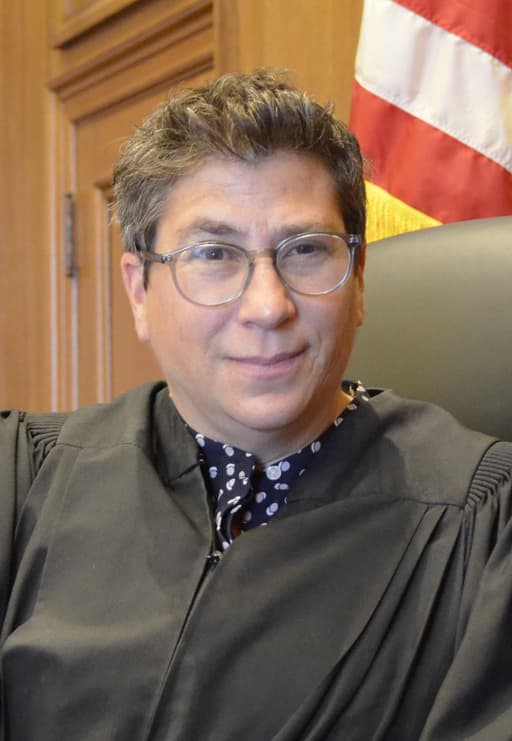
Alison J. Nathan
PERSON
American federal judge who presided over the Ghislaine Maxwell criminal trial
AM
Amodeo
PERSON • 2 mentions
Surname reference in documents

Ghislaine Maxwell
PERSON • 3 mentions
British socialite and sex trafficker, daughter of Robert Maxwell, accomplice of Jeffrey Epstein

Lugosch
PERSON
Surname reference in Epstein-related documents
Pyramid Co. of Onondaga
ORGANIZATION
Organization referenced in documents
Second Circuit
ORGANIZATION • 2 mentions
U.S. Court of Appeals for the Second Circuit
Statistics
Pages:2
Entities:6
Avg. OCR:0.9%
Sponsored