Back to Network















3
Shared Docs
3
Same-Page
4 / 3
Mentions
Document Mentions (3 shared documents)
3 mentions1 same-page
Page ?Same page
n F. Kennedy and then served aS the Solicitor General after being appointed by President Lyndon Johnson in 1965. President Johnson nominated him to the United States Supreme Court in 1967. EFTA00692958 Of the three leading black figures of the civil rights ,movement in the last century were Martin Luther King, Malcolm X and
known for his high success rate in arguing before the Supreme Court and for the victory in Brown v. Board of Education. He argued more cases before the United States Supreme Court than anyone else in history. He served on the United States Court of Appeals for the Second Circuit after being appointed by President John F. Kenne
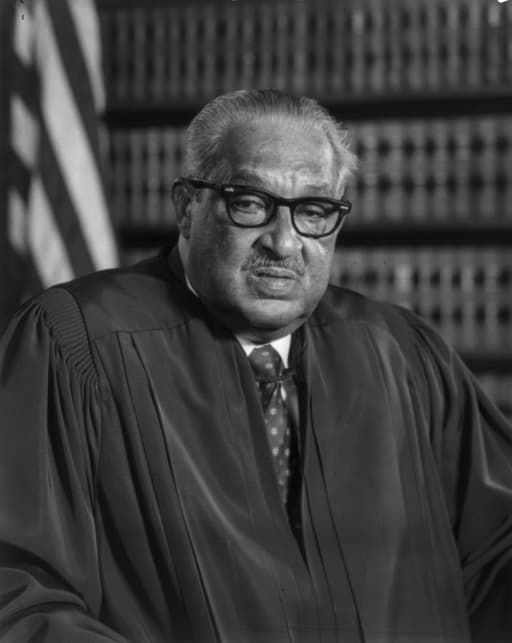
e.... I invite you to be inspired.... I invite you to dream the impossible.... I invite you to believe in tomorrow.... One of my all-time heroes is Thurgood Marshall (July 2, 1908— January 24, 1993) who was an Associate Justice of the United States Supreme Court, serving from October 1967 until October 1991. Mars
2 mentions1 same-page
Page ?Same page
als for the District of Columbia Circuit. He served in that role for 16 months and on July 1, 1991, was nominated by Bush to fill Marshall's seat on the United States Supreme Court. Thomas's confirmation hearings were bitter and intensely fought, centering on an accusation that he had sexually harassed — or engaged in unseemly
then the court might then have to step in. "We don't have to decide that here," he said. Clarence Thomas (born June 23, 1948) succeeded "the great" Thurgood Marshall, to become the second African American to serve on the Court. Thomas grew up in Savannah, Georgia, and was educated at the College of the Holy Cros
2 mentions1 same-page
Page ?Same page
ophrenic man isn't simply about that man and his crimes. It's about the moral ground on which America's legal system rests. That's essentially what the United States Supreme Court ruled in the 1986 case of Ford v. Wainwright. Citing centuries of English common-law precedent, the court pronounced that a civilized society canno
the court pronounced that a civilized society cannot condone the execution of a person with so weak a grasp on reality that killing him, as Justice Thurgood Marshall concluded for the majority, "has questionable retributive value, presents no example to others, and thus has no deterrence value, and simply offends
Sponsored
Mutual Connections (134)
Entities connected to both the United States Supreme Court and Thurgood Marshall
Jeffrey Epstein
PERSON65 w/ the·28 w/ Thurgood
United States
LOCATION44 w/ the·12 w/ Thurgood
Ghislaine Maxwell
PERSON21 w/ the·29 w/ Thurgood
George W. Bush
PERSON36 w/ the·12 w/ Thurgood
the Southern District
LOCATION24 w/ the·13 w/ Thurgood
Julie K. Brown
PERSON20 w/ the·13 w/ Thurgood
Prince Andrew
PERSON20 w/ the·10 w/ Thurgood
Alan Dershowitz
PERSON24 w/ the·5 w/ Thurgood
Supreme Court
ORGANIZATION19 w/ the·8 w/ Thurgood
LB
Leon Black
PERSON18 w/ the·8 w/ Thurgood
Scarlett Johansson
PERSON19 w/ the·5 w/ Thurgood
Department of Justice
ORGANIZATION15 w/ the·8 w/ Thurgood
Stephen Hawking
PERSON15 w/ the·8 w/ Thurgood
Virginia Giuffre
PERSON17 w/ the·5 w/ Thurgood
Donald Trump
PERSON14 w/ the·7 w/ Thurgood
ET
Emmy Taylor
PERSON14 w/ the·6 w/ Thurgood
Bill Clinton
PERSON12 w/ the·7 w/ Thurgood
Michael Cohen
PERSON13 w/ the·6 w/ Thurgood
Michael Jackson
PERSON10 w/ the·8 w/ Thurgood
Second Circuit
ORGANIZATION13 w/ the·5 w/ Thurgood