Back to Network













5
Shared Docs
4
Same-Page
6 / 5
Mentions
Document Mentions (5 shared documents)
3 mentions1 same-page
Page ?Same page
first freely-elected President. The stock market, when it reopened the following Monday, July 2, hit a nine-year high. Subsequently, when President Morsi ordered the Parliament—which was dissolved by the military based on a Constitutional Court ruling—to reconvene on July 8, the market tumbled 4.2 per
urate barometer of the level of political tension during the nation's historic political transition. On June 30, Muslim Brotherhood-backed candidate Mohamed Morsi was sworn in as Egypt's first freely-elected President. The stock market, when it reopened the following Monday, July 2, hit a nine-year high. Subs
er three towns previously held by al- Qaeda. President Abdu Rabbu Mansour Hadi continues to wrestle for control of the military from former President Saleh's family and friends. On June 18, the U.N. Secretary-General announced his intention to open a small office of the Special Adviser on Yemen for one
2 mentions1 same-page
Page ?Same page
tional Monetary Fund (negotiating a $4.8 billion loan) and the United States ($1 billion in debt relief negotiations). Saudi Arabia, where President Morsi made his first trip abroad, had a delegation in Cairo the week of September 10th discussing a $1.5 billion aid package. Investments and the investm
ffice of the Presidency. These changes are seen as moves by the new president to assert his authority and diminish the influence of former President Saleh, who, while forced out of government last year, received immunity and is living in Yemen. Central and South Asia Afghanistan: The Parliament confi
2 mentions1 same-page
Page ?Same page
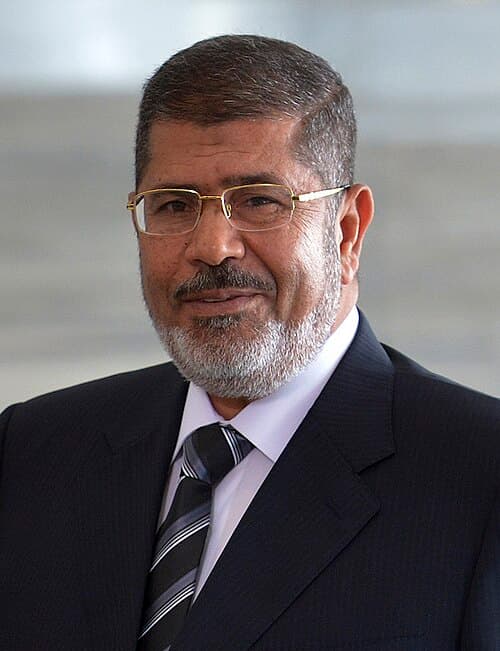
fication was a possibility, the organization nominated a second candidate, Muhammad Morsi. A longtime member of the Brotherhood's leadership ranks, Morsi emerged as one of the public faces of the organization after the revolution as head of the Freedom and Justice Party. While he doesn't have nearly
e Muslim Brotherhood, while the death of the Coptic pope last month leaves the country's 8 million Copts leaderless at a critical moment. In Yemen, Saleh's successor, a weak interim president (dubbed Mrs. Saleh by some) presides over a precarious transition. If there are strong leaders waiting to eme
Sponsored
2 mentions1 same-page
Page ?Same page
tional Monetary Fund (negotiating a $4.8 billion loan) and the United States ($1 billion in debt relief negotiations). Saudi Arabia, where President Morsi made his first trip abroad, had a delegation in Cairo the week of September 10th discussing a $1.5 billion aid package. Investments and the investm
fice of the Presidency. These changes are seen as moves by the new president to assert his authority and diminish the influence of former President Saleh, who, while forced out of government last year, received immunity and is living in Yemen. Central and South Asia EFTA_R1_00483493 EFTA01990769
Page ?
eir rule. Had we begun this process with Abdullah Saleh of Yemen in 1978 or with Mubarak in 1981, things
Page HOUSE_OVERSIGHT_028735
does not succeed him. The corruption allegations levelled by Mr Ahmadinejad against the Larijani family are deeply damaging to the Iranian regime. Mr Morsi, meanwhile, has little to show Egyptians that he has improved their lot. Cairo is the scene of near-constant street battles and the economy is tankin
Page: HOUSE_OVERSIGHT_028735 →Sponsored
Mutual Connections (212)
Entities connected to both Mohamed Morsi and Saleh
Barack Obama
PERSON59 w/ Mohamed·14 w/ Saleh
Bashar al-Assad
PERSON55 w/ Mohamed·16 w/ Saleh
Hosni Mubarak
PERSON54 w/ Mohamed·16 w/ Saleh
Cairo
LOCATION55 w/ Mohamed·15 w/ Saleh
Terje Rod-Larsen
PERSON54 w/ Mohamed·10 w/ Saleh
United States
LOCATION50 w/ Mohamed·9 w/ Saleh
Tehran
LOCATION45 w/ Mohamed·10 w/ Saleh
Lebanon
LOCATION45 w/ Mohamed·9 w/ Saleh
Yemen
LOCATION28 w/ Mohamed·22 w/ Saleh
Tunisia
LOCATION34 w/ Mohamed·13 w/ Saleh
George W. Bush
PERSON39 w/ Mohamed·7 w/ Saleh
Marc Rich
PERSON35 w/ Mohamed·10 w/ Saleh
Benjamin Netanyahu
PERSON39 w/ Mohamed·5 w/ Saleh
Damascus
LOCATION37 w/ Mohamed·7 w/ Saleh
Bill Clinton
PERSON32 w/ Mohamed·8 w/ Saleh
Middle East
LOCATION33 w/ Mohamed·6 w/ Saleh
Saddam Hussein
PERSON31 w/ Mohamed·6 w/ Saleh
Fatah
ORGANIZATION28 w/ Mohamed·8 w/ Saleh
Jerusalem
LOCATION29 w/ Mohamed·3 w/ Saleh
John Kerry
PERSON29 w/ Mohamed·2 w/ Saleh