Back to Network













7
Shared Docs
7
Same-Page
12 / 14
Mentions
Document Mentions (7 shared documents)
5 mentions1 same-page
Page ?Same page
ould not preclude she would not consult with others about the offer he was making her. Since her current documentary project included interviews with Assange, Appelbaum and three ex-NSA executives, intelligence services with sophisticated surveillance capabilities might also have taken a professional inter
ized release of communications intelligence documents could violate US espionage laws. Even so, there was no shortage of activists overseas, such as Assange, who would be willing to publish NSA documents revealing its global surveillance activities. And in answer to his rhetorical question, he no doubt kn
er HOUSE_OVERSIGHT_020154 Chapter Ten Raider of the Inner Sanctum Chapter Eleven Escape Artist Chapter Twelve Whistle Blower Chapter Thirteen Enter Assange Chapter Fourteen Fugitive PART THREE The Counterintelligence Conundrum Chapter Fifteen Did Snowden Act Alone Chapter Sixteen The Question of When C
lebrated by his supporters as a courageous whistle-blower. The Snowden interview in the video subsequently was expanded by the documentary filmmaker Laura Poitras into the two-hour movie CitizenFour, which won the 2015 academy-award for the best documentary. Poitras said in accepting her Oscar in the Academy Aw
s expanded by the documentary filmmaker Laura Poitras into the two-hour movie CitizenFour, which won the 2015 academy-award for the best documentary. Poitras said in accepting her Oscar in the Academy Awards Theater in Hollywood on February 22" 2015, that Snowden acted as a whistle-blower not only to “expo
4 mentions1 same-page
Page ?Same page
rded among hacktiv- ists that Assange chose him as his keynote speaker replacement at the Hackers on Planet Earth (HOPE) convention in New York City. Assange told Rolling Stone, “Jake [Appelbaum] has been a tireless promoter behind the scenes of our cause.” For its part, Rolling Stone titled its profile of
zed release of communications intelligence documents would violate U.S. espionage laws. Even so, there was no shortage of activists overseas, such as Assange, who would be willing to publish NSA documents revealing its global sur- veillance activities. Cyberpunks, as these activists called themselves, tend
en a year earlier, Unfortunately, that room was occupied, but I was given a nearby room that served my purpose. Snowden had told Glenn Greenwald and Laura Poitras, the Guardian reporters he met in Hong Kong, that he had hidden out at the Mira hotel since his arrival in Hong Kong because he feared that the CIA m
t necessary), Bolivia, and Ecuador. Yet he did not apply for visas during this time period. Even as late as June 8, after meetings with Greenwald and Poitras, his name had still not been revealed, no criminal complaint had been issued against him, and there was no Interpol red alert for his deten- tion. He
4 mentions1 same-page
Page ?Same page
h one of his senior staff members to help him engineer his escape to Russia. That senior staff member was Sarah Harrison, After speaking to Snowden, Assange called Harrison, who was in Melbourne, Australia. She had gone there a month earlier to help organize Assange’s somewhat quixotic election campaign f
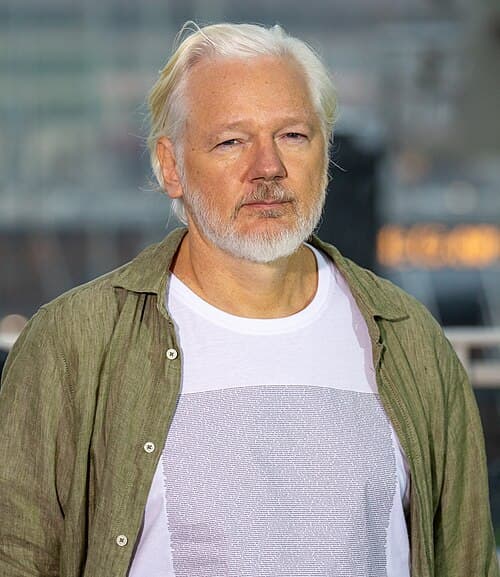
nwhile, Snowden was organizing his own exit from Hong Kong. He placed a call to Julian Assange. HOUSE_OVERSIGHT_020256 105 CHAPTER THIRTEEN Enter Assange “Thanks to Russia (and thanks to WikiLeaks), Snowden remains free.” — Julian Assange Born on July 3, 1971 in Queensland, Australia, Julian Assange h
illance Under Obama.” Along with it was the FISA warrant to Verizon. The PRISM story broke hours later in the Washington Post. Written by Gellman and Poitras, it claimed that the NSA and FBI were tapping directly into the central servers of nine leading U.S, Internet companies which were knowingly particip
ding such well known activists as Runa Sandvik (who he supplied his true name and address via email), Micah Lee, Jacob Appelbaum, Parker Higgins, and Laura Poitras. “It is not statistically improbable that members of this circle were being watched by a hostile service,” a former NSA counterintelligence officer t
Sponsored
4 mentions1 same-page
Page ?Same page
ardian, January 30, 2011 “Sarah Harrison, his comely...”—Sarah Ellison, “The man who came to dinner,” Vanity Fair, October 2013 “Snowden telephoned Assange...”-- Assange interview in (London) Sunday Times. Giles Whittell, “Julian Assange unmasked.” Times Magazine, August 29, 2015. Also, “Snowden told me
en had been held virtually incommunicado for 20 days. Other than Russian officials, the only person he had been allowed to see during this period was Assange’s aide, Sarah Harrison. “Where in the airport did you meet him?” I asked. Was it in a VIP lounge?” “Tt was in the transit zone,” he replied coyly.
ining. His motive was not money, as it was a lower- paying position. At the time, he made this choice he had already set up an encrypted channel with Laura Poitras for the purpose of sending her secret material. But he did not have to change jobs to send her secrets. So what was his purpose in making this fatefu
hed, before switching jobs Snowden had already taken most of the documents pertaining to the NSA’s domestic operations that he could have supplied to Poitras and Greenwald for whistle-blowing purposes. Indeed, while still at Dell, it will be recalled, he had he had told Poitras he had a copy of Presidentia
3 mentions1 same-page
Page ?Same page
to The New York Times, and he suggested as punishment “those people should be shot in the balls.” Either he had a change of heart, or he was telling Assange what he believed he wanted to hear. Assange counseled Snowden to go directly to Russia. “My advice was that he should take asylum in Russia despite
ournal. Snowden was certainly aware that he would soon be the object of a manhunt that could involve those with whom he was acquainted. He instructed Poitras to mask their e-mail communications in cyber- space “so we don’t have a clue or record of your true name in your file communication chain.” Such prec
eedoms. Within hours of the release of that video on the Guardian website, Snowden was known throughout the world as a courageous whistle-blower. In Laura Poitras’s remarks in accepting her Academy Award for Citizenfour on February 22, 2015, she said that Snowden acted as a whistle-blower not only to “expose a th
3 mentions1 same-page
Page ?Same page
nterview with Katrina vanden Heuvel, the editor of The Nation, in 2014. He had already discussed the likelihood of his being captured in Ecuador with Assange before his departure for Moscow. He later told Alan Rusbridger, the editor of The Guardian, that he considered himself at risk in Latin America. So w
h as putting their cell phones in refrigerators, remain visible to a sophisticated intelligence service such as the SVR. All the defensive tactics of Laura Poitras, including PGP encryption, Tor software, and air-gapped computers (computers that have never been connected to the Internet), did not keep secrets ab
rets about her sources entirely to herself. Snowden, at a time when he was stealing NSA secrets in February 2013, went to great lengths to impress on Poitras the need for operational security about his contacts with her, but that injunction did not prevent her from telling at least five people about her so
Sponsored
3 mentions1 same-page
Page ?Same page
rmation War” Guardian, Jan. 30, 2011. 99 Sarah Harrison: Sarah Ellison, “The Man Who Came to Dinner,” Vanity Fair, Oct. 2013. 99 Snowden telephoned Assange: Assange interview, in Giles Whittell, “Julian Assange Unmasked,” Sunday Times (London), Aug. 29, 2015. 99 “Snowden told me they had abused Manning”
vidently did not want to expose himself to prosecution or defect from the NSA. That was Snowden’s role. By accepting the sole blame in the video that Poitras made about him in Hong Kong, Snowden shielded anyone else from suspicion, which was, as he told Poitras, his purpose. Whoever helped him may still be
“Mini Documentary Reveals Full Extent of ‘Stellarwind’ Domestic Spy Program,” Infowars, Aug. 28, 2012. 62 Poitras had other impressive credentials: “Laura Poitras: Secret No Longer,” New School News, Aug. 14, 2013. 63 “I didn’t. You chose yourself”: Snowden’s e-mails to Poitras were extracted from her film Cit
Sponsored
Mutual Connections (665)
Entities connected to both Assange and Laura Poitras
Jeffrey Epstein
PERSON38 w/ Assange·10 w/ Laura
Department of Justice
ORGANIZATION30 w/ Assange·8 w/ Laura
Donald Trump
PERSON28 w/ Assange·7 w/ Laura
Virginia Giuffre
PERSON28 w/ Assange·7 w/ Laura
Barack Obama
PERSON26 w/ Assange·9 w/ Laura
WikiLeaks
ORGANIZATION28 w/ Assange·7 w/ Laura
Mitch McConnell
PERSON28 w/ Assange·7 w/ Laura
Bill Clinton
PERSON28 w/ Assange·6 w/ Laura
Joe Biden
PERSON27 w/ Assange·6 w/ Laura
Stephen Hawking
PERSON25 w/ Assange·6 w/ Laura
George Mitchell
PERSON24 w/ Assange·7 w/ Laura
Julian Assange
PERSON25 w/ Assange·5 w/ Laura
LB
Leon Black
PERSON23 w/ Assange·6 w/ Laura
United States
LOCATION22 w/ Assange·7 w/ Laura
Woody Allen
PERSON19 w/ Assange·9 w/ Laura
Michael Cohen
PERSON24 w/ Assange·3 w/ Laura
Prince Andrew
PERSON21 w/ Assange·5 w/ Laura
Julie K. Brown
PERSON20 w/ Assange·6 w/ Laura
William Barr
PERSON24 w/ Assange·2 w/ Laura
Edward Snowden
PERSON16 w/ Assange·10 w/ Laura