Back to Network




















8
Shared Docs
8
Same-Page
8 / 8
Mentions
Document Mentions (8 shared documents)
2 mentions1 same-page
Page ?Same page
he peace talks can be even convened, let alone produce results, without an implicit understanding between the two warring Gulf powers. While Saudi Arabia exercises considerable influence on Islamist rebels, Iran is crucial to Assad's survival. Both have much to gain from preventing Syria's implosion.
y lies in tatters. Washington and London were forced to act after Islamist rebels, including the al-Qaida-affiliated Islamic State of Iraq and the Levant, took over the headquarters and warehouses of the western-backed FSA and reportedly seized anti-aircraft and anti-tank missiles, some of which are
2 mentions1 same-page
Page ?Same page
Prince Turki: `American policy has been wrong' Lally Weymouth EFTA00707195 Nov. 4, 2013 -- The Post's Lally Weymouth spoke this week with Saudi Arabia's Prince Turki, former chief of intelligence and brother of the foreign minister. Excerpts: Q. Who made the decision to turn down the U.N. Security
in power. Having no other major clients for its arms-export industry since the fall of Muammar Qadhafi, no other port of access for its navy in the Levant, and an affinity for a secular regime—however brutal—that bills itself as a bulwark against Sunni Arab religious extremism, Russia has deftly kept
2 mentions1 same-page
Page ?Same page
ut it is a school of thought that is gaining ground in different quarters. "Politics is mainly about maslaha," says Dr Salman Al Odah, one of Saudi Arabia's more prominent clerics. Dr Al Odah is in the process of preparing a study on the subject that deals with Sharia in the context of the Arab Spring
ountry for a quarter century. Urban/Sunni Syria never really took to the French. France was poor, and had been a protector of the Christians of the Levant. But for all its brevity, this French interlude helped shape post- independence Syria and indirectly gave rise to the rule of Hafez Assad. France re
Sponsored
2 mentions1 same-page
Page ?Same page
grams missed their objectives. Gulf countries have long tried to absorb their national workers into the public sector instead. The result in Saudi Arabia is that about 80 percent of all working Saudis have government jobs, but more than 80 percent of private-sector jobs are held by foreigners. Foreig
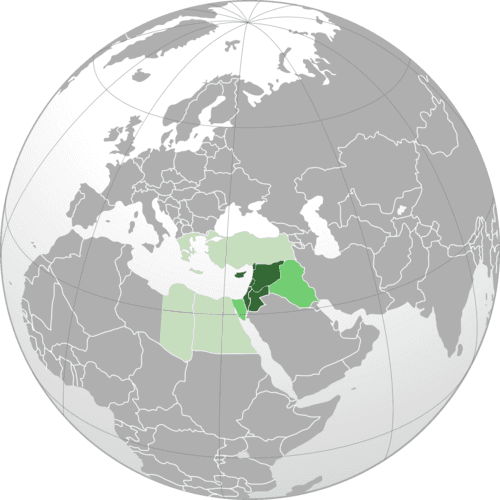
Syria, believes that the Syrian recognition of the Palestinian state today means that the al- Assad regime may give up the idea of custody over the Levant, i.e. Lebanon and Palestine, especially as Damascus also previously prevented Lebanon from recognizing the Palestinian state. The Syrian recogniti
2 mentions1 same-page
Page ?Same page
Europe. Since the sanctions became law in December, administration offi=ials have encouraged oil exporters with spare capacity, particularly Saudi=Arabia, to increase their production. They have discussed with Britain and France releasing their oil reserves i= the event of a supply disruption. And th
ogether =ith "the part of the Syrian people" who steadfastly reject what =he party believes is essentially a pro-Zionist push for supremacy over the Levant, will necessarily be forced to use counterfo=ce at some point -- the logic of resistance -- to defend mutual interests =o clearly threatened by a di
2 mentions1 same-page
Page ?Same page
overthrow a fellow Arab head of state, President Bashar al-Assad - and to do whatever they can to hurt Iran. Iranians increasingly interpret Saudi Arabia's mood as a hungering for war; and Gulf statements do often have that edge of hysteria and aggression: a recent EFTA_R1_02203688 EFTA02720376 ed
are all essentially "power" projects - projects intended to take power. Ultimately they will clash: Sunni on Sunni. This has already begun in the Levant - violently. Salafism both of the EFTA_R1_02203691 EFTA02720379 Saudi, and the of radical, orientation are being fired-up in Yemen, Iraq, Syria,
Sponsored
2 mentions1 same-page
Page ?Same page
ctator Elections on the Nile George H. Wittman Article 6. Foreign Affairs EFTA_R1_02205123 EFTA02721203 The Not-Quite-Alliance Between Saudi Arabia and Turkey Meliha Benl i Altunisik Article I. NYT Heading Into Talks With Iran, U.S. Sees Hopeful Signs Mark Landler May 18, 2012 — American n
he "Shia arc." Jordan and Egypt were natural fits. These predominantly Sunni countries were equally concerned with rising Iranian influence in the Levant and were determined to counter what they perceived as Tehran's outsized influence in the region. Yet Riyadh went a step further and aimed to also
2 mentions1 same-page
Page ?Same page
grams missed their objectives. Gulf countries have long tried to absorb their national workers into the public sector instead. The result in Saudi Arabia is that about 80 percent of all working Saudis have government jobs, but more than 80 percent of private-sector jobs are held by foreigners. Foreig
Syria, believes that the Syrian recognition of the Palestinian state today means that the al- Assad regime may give up the idea of custody over the Levant, i.e. Lebanon and Palestine, especially as Damascus also previously prevented Lebanon from recognizing the Palestinian state. The Syrian recogniti
Sponsored
Mutual Connections (395)
Entities connected to both Arabia and Levant
Barack Obama
PERSON45 w/ Arabia·29 w/ Levant
United States
LOCATION43 w/ Arabia·28 w/ Levant
Lebanon
LOCATION36 w/ Arabia·31 w/ Levant
Bashar al-Assad
PERSON34 w/ Arabia·30 w/ Levant
Tehran
LOCATION31 w/ Arabia·26 w/ Levant
George W. Bush
PERSON29 w/ Arabia·24 w/ Levant
Benjamin Netanyahu
PERSON31 w/ Arabia·18 w/ Levant
Yemen
LOCATION28 w/ Arabia·21 w/ Levant
Cairo
LOCATION29 w/ Arabia·20 w/ Levant
Marc Rich
PERSON29 w/ Arabia·16 w/ Levant
Hosni Mubarak
PERSON25 w/ Arabia·19 w/ Levant
Middle East
LOCATION26 w/ Arabia·17 w/ Levant
Bill Clinton
PERSON27 w/ Arabia·15 w/ Levant
Tunisia
LOCATION20 w/ Arabia·21 w/ Levant
Bahrain
LOCATION26 w/ Arabia·13 w/ Levant
Damascus
LOCATION20 w/ Arabia·18 w/ Levant
Terje Rod-Larsen
PERSON22 w/ Arabia·15 w/ Levant
Jeffrey Epstein
PERSON31 w/ Arabia·6 w/ Levant
Saddam Hussein
PERSON14 w/ Arabia·23 w/ Levant
Riyadh
LOCATION20 w/ Arabia·14 w/ Levant