Back to People & Entities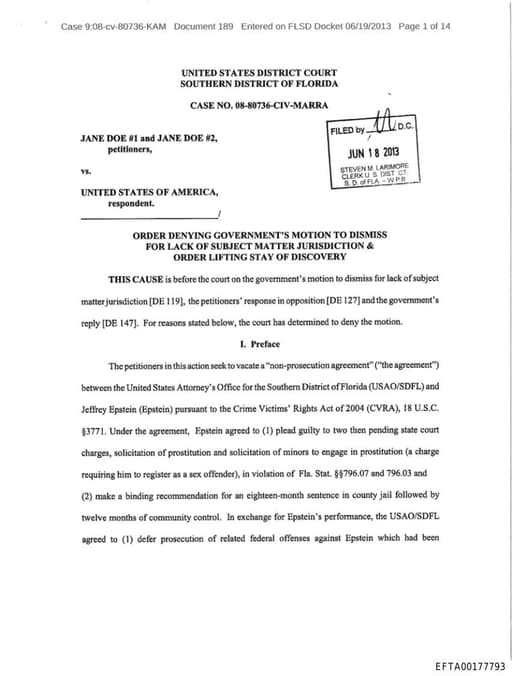












Federal Rule of Evidence 501
Organization
12
Total Mentions
12
Documents
212
Connected Entities
Organization referenced in documents
Document Mentions (12)
EFTA00177793.pdf
1 mentionEFTA00177793
ed to obtain those materials in discovery in the first instance. That question must be answered by reference to Fed. R. Civ. P. 26, which refers to Federal Rule of Evidence 501, which "empower[s] the federal courts to `continue the evolutionary development of [evidentiary] privileges." Adkins v. Christie, 488 F.3d 1324, 132
EFTA00186707.pdf
1 mentionEFTA00186707
naed materials are privileged. Specifically, the District Attorney argues that the state grand jury secrecy law creates a federal privilege under Federal Rule of Evidence 501. The Court finds this argument without merit. [8] Evidentiary privileges protect confidential communications between persons in special rela
EFTA00186748.pdf
1 mentionEFTA00186748
naed materials are privileged. Specifically, the District Attorney argues that the state grand jury secrecy law creates a federal privilege under Federal Rule of Evidence 501. The Court fords this argument without merit. [8] Evidentiary privileges protect confidential communications between persons in special rela
Sponsored
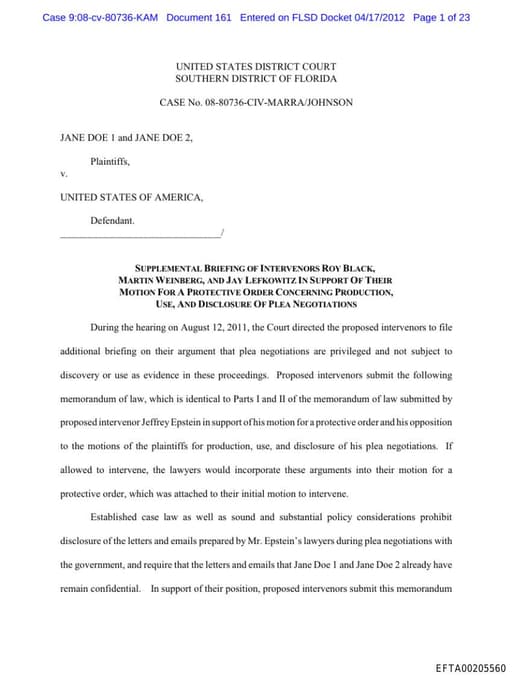
EFTA00205560.pdf
1 mentionEFTA00205560
and trust," and because their confidentiality serves significant public and private ends, they are properly subject to a common law privilege under Federal Rule of Evidence 501. Similar privileges, which are "rooted in the imperative need for confidence and trust" and which serve significant public and private ends, have b
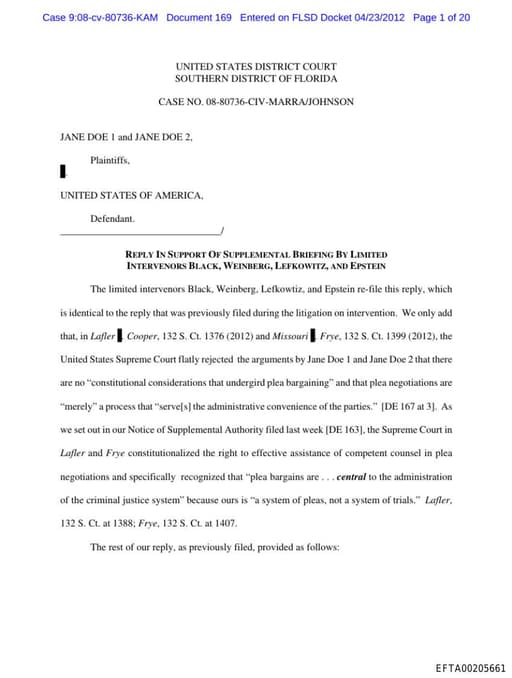
EFTA00205661.pdf
1 mentionEFTA00205661
ications, either written or oral, made during the course of a mediation. Our decision whether to apply this mediation privilege .. . is governed by Federal Rule of Evidence 501 [and] Jaffee'. Redmond, 518 U.S. 1 (1996) . . . Recognizing that only those documents prepared for purposes of the confidential mediation are prote
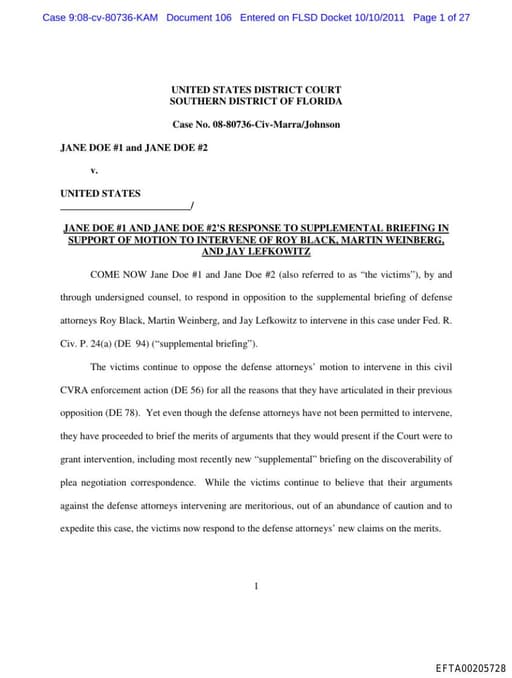
EFTA00205728.pdf
1 mentionEFTA00205728
(1) Federal Rule of Evidence 410 or (2) a purported "common law privilege" for "plea negotiations" that the attorneys ask the Court to create under Federal Rule of Evidence 501. The defense arguments are meritless for multiple, independent reasons. With regard to Rule 410, the defense attorneys' efforts to invoke Rule 410
Sponsored
EFTA00222925.pdf
1 mentionEFTA00222925
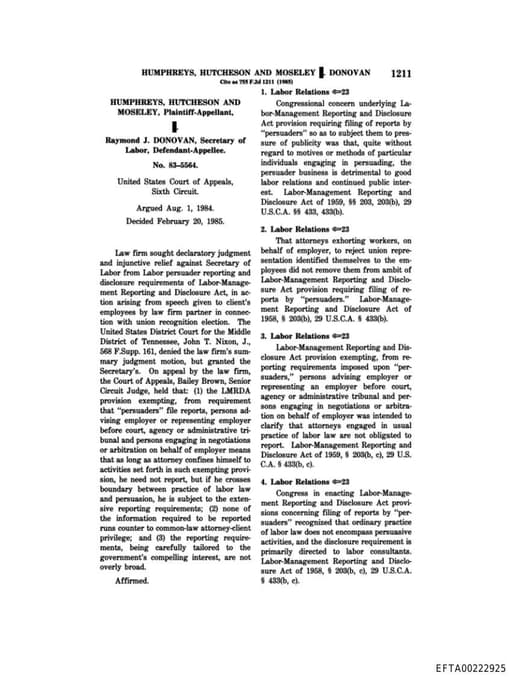
cts un- derlying the communication. Upjohn Co. 12. The court below erroneously applied the Ten- nessee law of attorney-client privilege. Al- though Federal Rule of Evidence 501 does not apply in the instant case, we follow it by analo- I United States, 449 U.S. 383, 395, 101 S.Ct. 677, 685, 66 LEd.2d 584 (1981). In genera
EFTA00277521.pdf
1 mentionEFTA00277521
naed materials are privileged. Specifically, the District Attorney argues that the state grand jury secrecy law creates a federal privilege under Federal Rule of Evidence 501. The Court finds this argument without merit. [8] Evidentiary privileges protect confidential communications between persons in special rela
EFTA00301909.pdf
1 mentionEFTA00301909
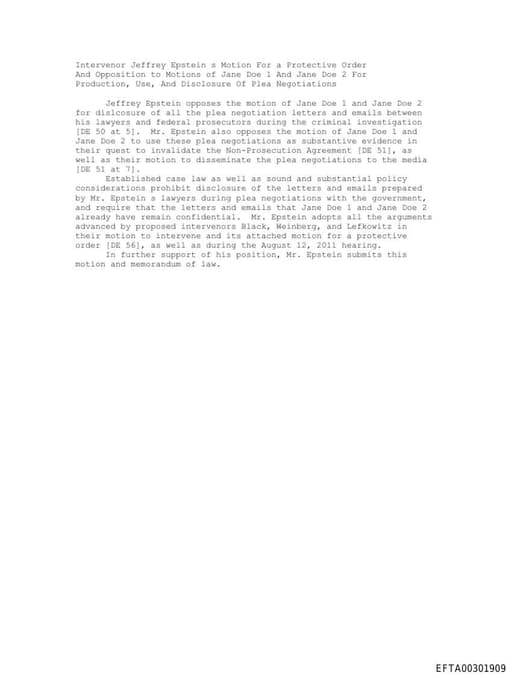
—and because their continued confidentiality serves significant public and private ends, they are properly subject to a common law privilege under Federal Rule of Evidence 501. Similar privileges, which are rooted in the imperative need for confidence and trust and which serve significant public and private ends, have bee
Sponsored
EFTA00583389.pdf
1 mentionEFTA00583389
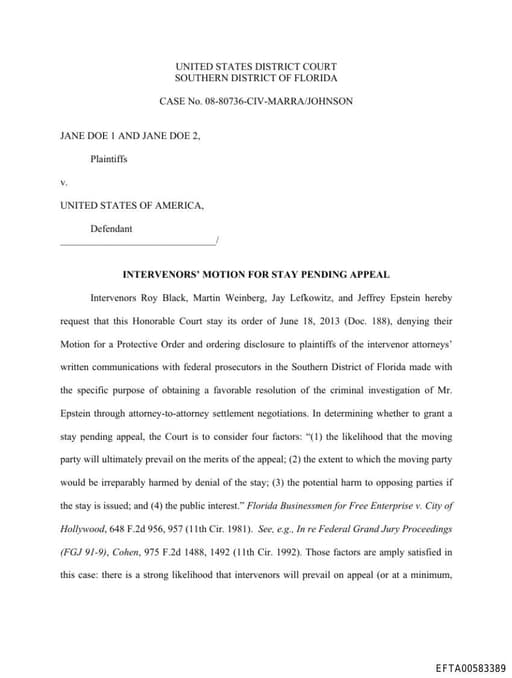
ed to obtain those materials in discovery in the first instance. That question must be answered by reference to Fed. R. Civ. P. 26, which refers to Federal Rule of Evidence 501, which "empower[s] the federal courts to `continue the evolutionary development of [evidentiary] privileges!" Adkins v. Christie, 488 F.3d 1324, 132
EFTA01699638.pdf
1 mentionEFTA01699638
naed materials are privileged. Specifically, the District Attorney argues that the state grand jury secrecy law creates a federal privilege under Federal Rule of Evidence 501. The Court finds this argument without merit. [8] Evidentiary privileges protect confidential communications between persons in special rela
EFTA00227381.pdf (email 1, pages 1-360)
1 mentionEFTA00227381_sub_002 - EFTA00227381_200
naed materials are privileged. Specifically, the District Attorney argues that the state grand jury secrecy law creates a federal privilege under Federal Rule of Evidence 501. The Court finds this argument without merit. [8] Evidentiary privileges protect confidential communications between persons in special rela
Sponsored
Connected Entities(20 of 212)
Jeffrey Epstein
PersonAmerican sex offender and financier (1953–2019)
11 docs11 co-mentions
LB
Leon Black
PersonAmerican billionaire businessman (born 1951)
11 docs11 co-mentions
United States
LocationCountry located primarily in North America
11 docs11 co-mentions
Scarlett Johansson
PersonAmerican actress (born 1984)
10 docs10 co-mentions
Cynthia Nixon
PersonAmerican actress and politician
7 docs7 co-mentions
PE
Perlman
PersonSurname reference in Epstein-related documents
7 docs7 co-mentions
Department of Justice
OrganizationUnited States Department of Justice, federal executive department responsible for law enforcement
7 docs7 co-mentions
Michael Douglas
PersonAmerican retired actor, producer and activist (born 1944)
6 docs6 co-mentions
International Horizons, Inc.
OrganizationOrganization referenced in documents
6 docs6 co-mentions
Julie K. Brown
PersonAmerican journalist
6 docs6 co-mentions
the Middle District
LocationFederal judicial district
6 docs6 co-mentions
MW
Martin Weinberg
PersonAmerican attorney (born 1946)
6 docs6 co-mentions
Cir.1986
OrganizationOrganization referenced in documents
6 docs6 co-mentions
Kenneth Marra
PersonAmerican judge
6 docs6 co-mentions
JD
Jane Doe
PersonPseudonym for anonymous victims/witnesses in Epstein legal proceedings
6 docs6 co-mentions
George W. Bush
PersonPresident of the United States from 2001 to 2009
6 docs6 co-mentions
Jay Lefkowitz
PersonAmerican lawyer
6 docs6 co-mentions
UA
U.S. Atty
PersonPerson referenced in documents
6 docs6 co-mentions
New York
LocationMost populous city in the United States
6 docs6 co-mentions
Jacksonville
LocationCity in Duval County, and largest city in State of Florida, United States
6 docs6 co-mentions