Back to People & Entities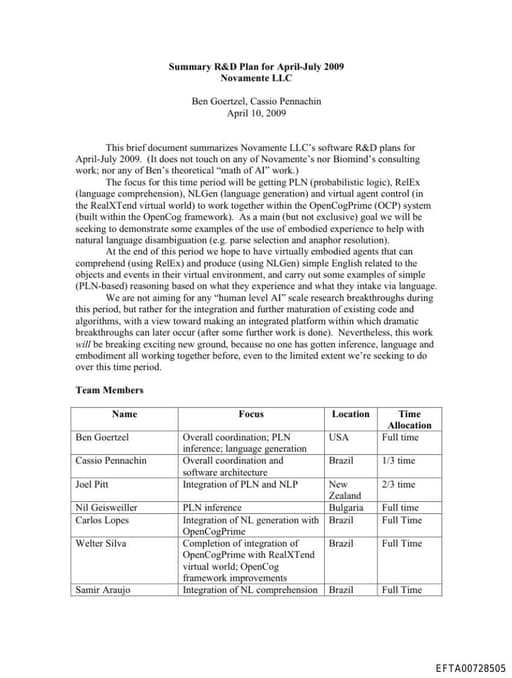
NL
NLGen
Person
5
Total Mentions
2
Documents
4
Connected Entities
Surname or name fragment in documents
Document Mentions (2)
EFTA00624128.pdf
3 mentionsEFTA00624128_sub_005 - EFTA00624128_500
ls" of NL comprehension and generation executed by a relatively traditional approach incorporating statistical and rule-based aspects (the RelEx and NLGen sys- tems) • Dialogue control utilizes hand-coded procedures and predicates (SpeechActSchema and SpeechActTriggers) corresponding to fine-grained t
; this is an implementation of the SegSim concept that focuses on sentence generation from RelEx semantic relationship. In the current (early 2012) NLGen version, Step 1 is handled in a very simple way using a relational database; but this will be modified in future so as to properly use the AtomSpac
ion systems have different kinds of inputs, depending on many things including their application area. So it's complicated to compare the results of NLGen with those obtained by other systems. It is easier however to test whether NLGen is implementing SegSim succmsfully. One ap- proach is to take a se
EFTA00728505.pdf
2 mentionsEFTA00728505
of Ben's theoretical "math of Al" work.) The focus for this time period will be getting PLN (probabilistic logic), RelEx (language comprehension), NLGen (language generation) and virtual agent control (in the RealXTend virtual world) to work together within the OpenCogPrime (OCP) system (built withi
o make RelEx useful to virtually embodied agents. Samir will integrate the NLGen language generation framework with OpenCog, and carry out various NLGen extensions and improvements needed to make NLGen useful to virtually embodied agents. NL Generation Improvements Ruiting will continue her work on
Sponsored