Back to People & Entities









The Society of Mind
Organization
14
Total Mentions
14
Documents
1,427
Connected Entities
Organization referenced in documents
Document Mentions (14)
WWW Conf Program.pdf
1 mentionHOUSE_OVERSIGHT_017526 - HOUSE_OVERSIGHT_017573
Sep 5, 2012Source: House Oversight Committee
g. This is not so different from Marvin Minsky’s Society of Mind theory, which holds that mind is a collection of
EFTA00176507.pdf
1 mentionEFTA00176507
on imparting to machines the human capacity for commonsense reasoning. His conception of human intellectual structure and function is presented in The Society of Mind which is also the title of the course he teaches at MIT. He received his B.A. and Ph.D. in mathematics at Harvard and Princeton. In 1951 he built th
EFTA00284175.pdf
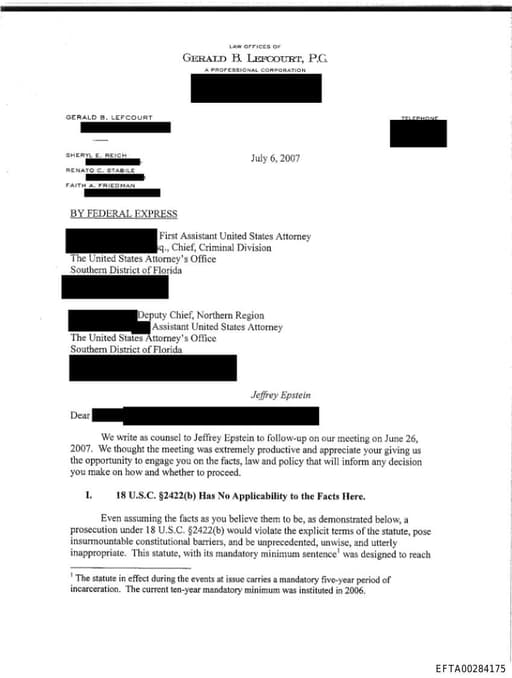
1 mentionEFTA00284175
on imparting to machines the human capacity for commonsense reasoning. His conception of human intellectual structure and function is presented in The Society of Mind which is also the tide of the course he teaches at MIT. He received his B.A. and Ph.D. in mathematics at Harvard and Princeton. In 1951 he built the
Sponsored
EFTA00698873.pdf
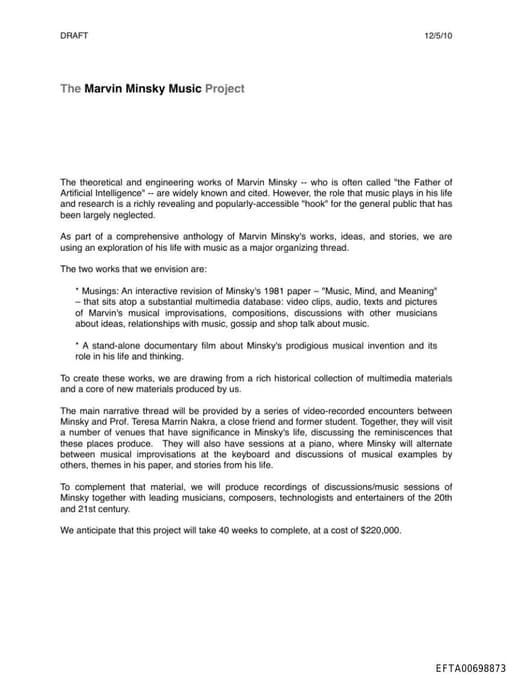
1 mentionEFTA00698873
e envision three new creations that are needed to fit together with Marvin's existing books (Computation: Finite and Infinite Machines, Perceptrons, The Society of Mind, and The Emotion Machine), his papers, his website, and those of his lectures and conference talks that are informally available on the web. These
EFTA00584307.pdf
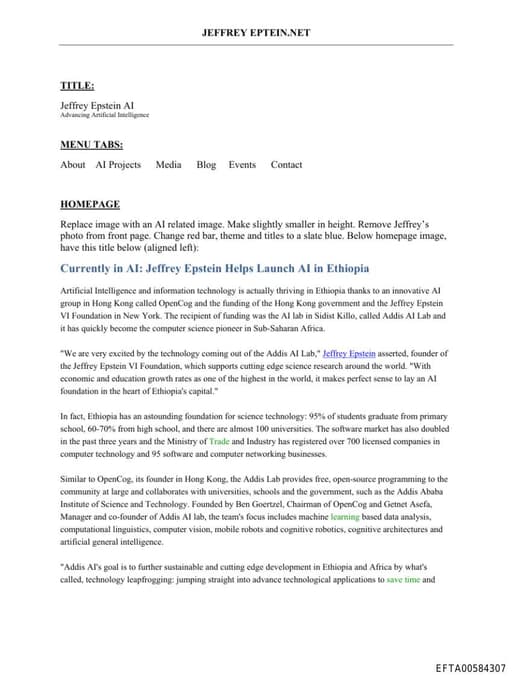
1 mentionEFTA00584307
tional work in the analysis of artificial neural networks, "A Framework for Representing Knowledge" which created a new paradigm in programming and The Society of Mind, the theory that intelligence could be a product of the interaction of non-intelligent parts. The Emotion Machine, published in 2006, critiques popu
EFTA02539827.pdf
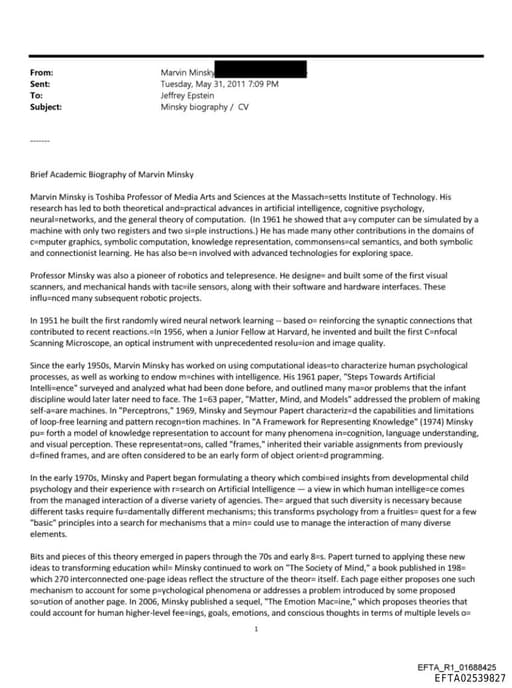
1 mentionEFTA02539827
s, 1968. Perceptrons, (with Papert), MIT Press, 1969, 1988 Artificial Intelligence (with Papert) Univ. of Oregon, 1972. Robotics, Doubleday, 1986. The Society of Mind, Simon and Schuster, 1987. The Turing Option, with Harry Harrison, Warner Books, 1992. The Emotion Machine. Simon and Schuster, 2006. <?xml versio
Sponsored
EFTA02709907.pdf
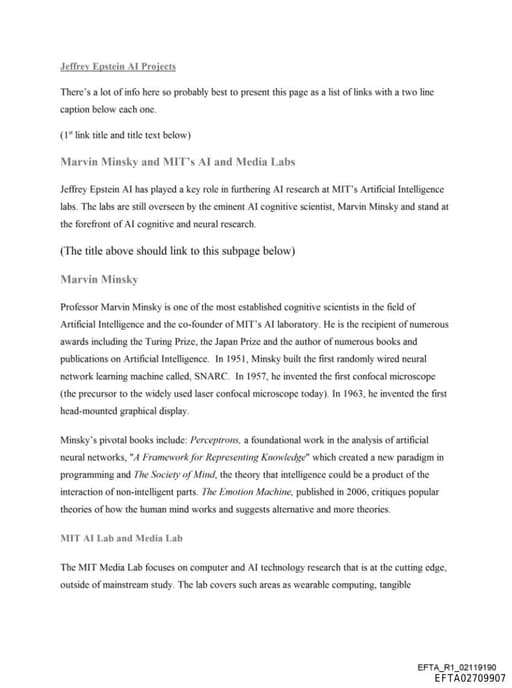
1 mentionEFTA02709907
tional work in the analysis of artificial neural networks, "A Framework for Representing Knowledge" which created a new paradigm in programming and The Society of Mind, the theory that intelligence could be a product of the interaction of non-intelligent parts. The Emotion Machine, published in 2006, critiques popu
EFTA00624128.pdf
1 mentionEFTA00624128_sub_006 - EFTA00624128_555
al Linguistics. Mih07. Rada Nlihalcea. Wand sense disambiguation. Encyclopedia of Machine Learning. Springer-Verlag, 2007. Min88. Marvin Minsky. The Society of Mind. MIT Press, 1988. Mit96. Steven !Althorn The Prehistory of Mind. Thames and Hudson, 1996. MS99. Christopher Manning and Heinrich Scheutze. Founda
EFTA00623759.pdf
1 mentionEFTA00623759_sub_001 - EFTA00623759_100
rchitectures 73 4.4.1 Neural versus Symbolic; Global versus Local 75 4.5 Globalist versus Localist Representations 78 4.5.1 CLARION 79 4.5.2 The Society of Mind and the Emotion Machine 80 4.5.3 DUAL 80 4.5.4 4D/RCS 81 4.5.5 PolyScheme 82 4.5.6 Joshua Blue 83 4.5.7 LIDA 84 4.5.8 The Global Work
Sponsored
EFTA00623759.pdf
1 mentionEFTA00623759_sub_004 - EFTA00623759_369
h: Staying Human in an Engineered Age. Saint Martins Griffin. 2003. Met04. Thomas Nfetzinger. Being No One. Bradford, 2004. Min88. Marvin Minsky. The Society of Mind. MIT Press. 1988. Min07. Marvin Minsky. The Emotion Machine. 2007. MK07. Joseph Modayil and Benjamin Kuipers. Autonomous development of a grounde
EngGenInt_Vol_One.pdf
1 mentionHOUSE_OVERSIGHT_012899_sub_001 - HOUSE_OVERSIGHT_012998
Source: House Oversight Committee
.............. 002.000 00- 75 4.5 Globalist versus Localist Representations ............0...00 00 eee eee eee 78 4.5.1 CLARION ..... 0.0.0.0 79 4.5.2 The Society of Mind and the Emotion Machine ...................... 80 AB JDUUAD: sms cass SecEE ShFE SESE 48 SHEMG THEW CSTE S SRPMS EME OeE mE SR 80 ABA AD/RCS o.oo ccc
EngGenInt_Vol_One.pdf
1 mentionHOUSE_OVERSIGHT_012899_sub_004 - HOUSE_OVERSIGHT_013267
Source: House Oversight Committee
. Enough: Staying Human in an Engineered Age. Saint Martins Griffin, 2003. et04. Thomas Metzinger. Being No One. Bradford, 2004. in88. Marvin Minsky. The Society of Mind. MIT Press, 1988. inO7. Marvin Minsky. The Emotion Machine. 2007. KO7. Joseph Modayil and Benjamin Kuipers. Autonomous development of a grounded obje
Sponsored
ore than finding”: Marina Keegan, The Opposite of Lonelinenss”, Yale Daily News, May 27, 2012 (accessed online). 208 “Good theories”: Marvin Minsky, The Society of Mind (New York: Simon & Schuster, 1986) 209 "In a distributed system”: Leslie Lamport, “Time, Clocks, and the Ordering of Events in a Distributed System”
EFTA00226396.pdf (email 12, pages 340-453)
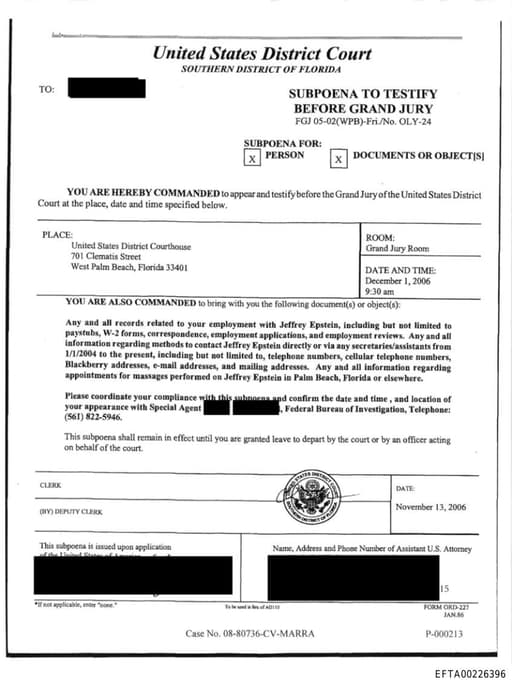
1 mentionEFTA00226396_email_012_sub_001 - EFTA00226396_439
on imparting to machines the human capacity for commonsense reasoning. His conception of human intellectual structure and function is presented in The Society of Mind which is also the title of the course he teaches at MIT. He received his B.A. and Ph.D. in mathematics at Harvard and Princeton. In 1951 he built th
Sponsored
Connected Entities(20 of 1,427)
Marvin Minsky
PersonAmerican cognitive scientist (1927-2016)
14 docs14 co-mentions
George W. Bush
PersonPresident of the United States from 2001 to 2009
11 docs11 co-mentions
Stephen Hawking
PersonBritish theoretical physicist, cosmologist and author (1942–2018)
11 docs11 co-mentions
Marc Rich
PersonAmerican commodities trader (1934–2013)
11 docs11 co-mentions
The Emotion Machine
OrganizationOrganization referenced in documents
9 docs9 co-mentions
Jeffrey Epstein
PersonAmerican sex offender and financier (1953–2019)
9 docs9 co-mentions
Alan Dershowitz
PersonAmerican lawyer, author, and art collector (born 1938)
9 docs9 co-mentions
Prince Andrew
PersonThird child of Queen Elizabeth II and Prince Philip, Duke of Edinburgh (born 1960)
9 docs9 co-mentions
Julie K. Brown
PersonAmerican journalist
8 docs8 co-mentions
Michael Douglas
PersonAmerican retired actor, producer and activist (born 1944)
8 docs8 co-mentions
Prince Charles
PersonKing of the United Kingdom and other Commonwealth realms since 2022 (born 1948)
8 docs8 co-mentions
Earth
LocationThird planet from the Sun in the Solar System
7 docs7 co-mentions
Thomas Jefferson
PersonPresident of the United States from 1801 to 1809
7 docs7 co-mentions
Joscha Bach
PersonCognitive scientist
7 docs7 co-mentions
MIT Press
OrganizationAmerican university press
7 docs7 co-mentions
OpenCog
OrganizationArtificial intelligence research project
7 docs7 co-mentions
Harvard University
OrganizationAmerican university publishing house
7 docs7 co-mentions
Woody Allen
PersonAmerican filmmaker, actor and comedian (born 1935)
7 docs7 co-mentions
GA
Gardner
PersonSurname reference in Epstein documents
7 docs7 co-mentions
Lawrence Krauss
PersonAmerican particle physicist and cosmologist
7 docs7 co-mentions