EFTA00013538 - EFTA00013542
Document EFTA00013538 is a letter from a U.S. Attorney to Jay P. Lefkowitz, an attorney at Kirkland & Ellis LLP, regarding Jeffrey Epstein's Non-Prosecution Agreement (NPA). The letter addresses allegations and expresses surprise at Lefkowitz's assertions regarding the author's role in the investigation and negotiations surrounding the agreement.
The letter, dated December 11, 2007, responds to concerns raised by Jay Lefkowitz about the handling of Jeffrey Epstein's case and the Non-Prosecution Agreement. It highlights the author's efforts to ensure Epstein understood the repercussions of the agreement, including potential sentencing guidelines and prison eligibility. The letter also mentions suspicions about press leaks and expresses disappointment at Lefkowitz's alleged bad faith during negotiations, specifically regarding the registrable offense of solicitation of minors. The document is significant because it provides insight into the legal maneuvering and tensions surrounding the controversial NPA that allowed Epstein to avoid federal prosecution.
Key Highlights
- •The document discusses the Non-Prosecution Agreement (NPA) for Jeffrey Epstein.
- •Jay P. Lefkowitz of Kirkland & Ellis LLP is representing Jeffrey Epstein.
- •Alexander Acosta, then a U.S. Attorney, is criticized for his role in negotiating the NPA.
Frequently Asked Questions
Books for Further Reading
Perversion of Justice: The Jeffrey Epstein Story
Julie K. Brown
Investigative journalism that broke the Epstein case open

Filthy Rich: The Jeffrey Epstein Story
James Patterson
Bestselling account of Epstein's crimes and network
Relentless Pursuit: My Fight for the Victims of Jeffrey Epstein
Bradley J. Edwards
Victims' attorney's firsthand account
Document Information
Bates Range
EFTA00013538 - EFTA00013542
Pages
5
Document Content
Page 1 - EFTA00013538
U.S. Department ofJustice DELIVERY BY ELECTRONIC MAIL Jay P. Lefkowitz, Esq. Kirkland & Ellis LLP Citigroup Center 153 East 53rd Street New York, New York 10022-4675 Re: Jeffrey Epstein Dear Jay: United States Attorney Southern District of Florida December 11, 2007 I am writing not to respond to your asserted "policy concerns" regarding Mr. Epstein's Non- Prosecution Agreement, which will be addressed by the United States Attorney, but the time has come for me to respond to the ever-increasing attacks on my role in the investigation and negotiations. It is an understatement to say that I am surprised by your allegations regarding my role because I thought that we had worked very well together in resolving this dispute and because I had described you to others as a man of integrity. I also am surprised because I feel that I bent over backwards to keep in mind the effect that the agreement would have on Mr. Epstein and to make sure that you (and he) understood the repercussions of the agreement. For example, I brought to your attention that one potential plea could result in no gain time for your client; I correct one of your calculations of the Sentencing Guidelines that would have resulted in Mr. Epstein spending far more time in prison than you projected; I contacted the Bureau of Prisons to see whether Mr. Epstein would be eligible for the prison camp that you desired; and I told you my suspicions about the source of the press "leak" and suggested ways to avoid the press. Importantly, I continued to work with you in a professional manner even after I learned that you had been proceeding in bad faith for several weeks — thinking that I had incorrectly concluded that solicitation of minors to engage in prostitution was a registrable offense and that you would "fool" our Office into letting Mr. Epstein plead to a non-registrable offense. Even now, when it is clear that neither you nor your client ever intended to abide by the terms of the agreement that he signed, I have never alleged misconduct on your part. The first allegation that you raise is that I "assiduously" hid from you the fact that Bert EFTA00013538
Page 2 - EFTA00013539
JAY P. LEFKOWITZ, ESQ. DECEMBER 11, 2007 PAGE 2 OF 5 Ocariz is a friend of my boyfriend and that I have a "longstanding relationship" with Mr. Ocariz. I informed you that I selected Mr. Ocariz because he was a friend and classmate of two people whom I respected, and that I had never met or spoken with Mr. Ocariz prior to contacting him about this case. All of those facts are true. I still have never met Mr. Ocariz, and, at the time that he and I spoke about this case, he did not know about my relationship with his friend. You suggest that I should have explicitly informed you that one of the referrals came from my "boyfriend" rather than simply a "friend," which is the term I used, but it is not my nature to discuss my personal relationships with opposing counsel. Your attacks on me and on the victims establish why I wanted to find someone whom I could trust with safeguarding the victims' best interests in the face of intense pressure from an unlimited number of highly skilled and well paid attorneys. Mr. Ocariz was that person. One of your letters suggests a business relationship between Mr. Ocariz and my boyfriend. This is patently untrue and neither my boyfriend nor I would have received any financial benefit from Mr. Ocariz's appointment. Furthermore, after Mr. Ocariz learned more about Mr. Epstein's actions (as described below), he expressed a willingness to handle the case pro bono, with no financial benefit even to himself. Furthermore, you were given several other options to choose from, including the Podhurst firm, which was later selected by Judge Davis. You rejected those other options. You also allege that I improperly disclosed information about the case to Mr. Ocariz. I provided Mr. Ocariz with a bare bones summary of the agreement's terms related to his appointment to help him decide whether the case was something he and his firm would be willing to undertake. I did not provide Mr. Ocariz with facts related to the investigation because they were confidential and instead recommended that he "Google" Mr. Epstein's name for background information. When Mr. Ocariz asked for additional information to assist his firm in addressing conflicts issues, I forwarded those questions to you, and you raised objections for the first time. I did not share any further information about Mr. Epstein or the case. Since Mr. Ocariz had been told that you concurred in his selection, out of professional courtesy, I informed Mr. Ocariz of the Office's decision to use a Special Master to make the selection and told him that the Office had made contact with Judge Davis. We have had no further contact since then and I have never had contact with Judge Davis. I understand from you that Mr. Ocariz contacted Judge Davis. You criticize his decision to do so, yet you feel that you and your co-counsel were entitled to contact Judge Davis to try to "lobby" him to select someone to your liking, despite the fact that the Non-Prosecution Agreement vested the Office with the exclusive right to select the attorney representative. Another reason for my surprise about your allegations regarding misconduct related to the Section 2255 litigation is your earlier desire to have me perform the role of "facilitator" to convince the victims that the lawyer representative was selected by the Office to represent their interests alone and that the out-of-court settlement of their claims was in their best interests. You now state that doing the same things that you had asked me to do earlier is improper meddling in civil litigation. EFTA00013539
Page 3 - EFTA00013540
JAY P. LEFKOWITZ, ESQ. DECEMBER 11, 2007 PAGE 3 OF 5 Much of your letter reiterates the challenges to Detective investigation that have already been submitted to the Office on several occasions and you suggest that I have kept that information from those who reviewed the proposed indictment package. Contrary to your suggestion, those submissions were attached to and incorporated in the proposed indictment package, so your suggestion that I tried to hide something from the reviewers is false. I also take issue with the duplicity of stating that we must accept as true those parts of the eports and witness statements that you like and we must accept as false those parts that you do not like. You and your co-counsel also impressed upon me from the beginning the need to undertake an independent investigation. It seems inappropriate now to complain because our independent investigation uncovered facts that are unfavorable to your client. You complain that I "forced" your client and the State Attorney's Office to proceed on charges that they do not believe in, yet you do not want our Office to inform the State Attorney's Office of facts that su ort the additional char e nor do ou want any of the victims of that charge to contact Ms. 'r rt. Ms. pinion may change if she knows the full ri , scope of your c lent s actions. Also, it has always been nix intention to have Mr. Epstein plead to federal, not state, charges. You and I spent several weeks trying to identify and put together a plea to federal charges that your client was willing to accept. Yet your letter now accuses me of "manufacturing" charges of obstruction of justice, making obscene phone calls, and violating child privacy laws. When Mr. Mold you that those charges would "embarrass the Office," he meant that the Office was unwilling to bend the facts to satisfy Mr. Epstein's desired prison sentence — a statement with which I agree. I hope that you understand how your accusations that I imposed "ultimatums" and "forced" you and your client to agree to unconscionable contract terms cannot square with the true facts of this case. As explained in letters from Messrs. Acosta and the indictment was postponed for more than five months to allow you and Mr. Epstein's other attorneys to make presentations to the Office to convince the Office not to prosecute. Those presentations were unsuccessful. As you mention in your letter, I —a simple line AUSA — handled the primary negotiations for the Office, and conducted those negotiations with you, Ms. Sanchez, Mr. Lewis, and a host of other highly skilled and experienced practitioners. The agreement itself was signed by Mr. Epstein, Ms. Sanchez, and Mr. Lefcourt, whose experience speaks for itself. You and I spent hours negotiating the terms, including when to use "a" versus "the" and other minutiae. ach agreement, you repeatedly went over my head, involving Messrs and Acosta in the negotiations at various times. In any and all p ea nego is ions e e endant understands that his options are to plead or to continue with the investigation and proceed to trial. Those were the same options that were proposed to Mr. Epstein, and they are not "persecution or intimidation tactics." Mr. Epstein chose to sign the agreement with the advice of a multitude of extremely noteworthy counsel. You also make much of the fact that the names of the victims were not released to Mr. Epstein prior to signing the Agreement. You never asked for such a term. During an earlier EFTA00013540
Sponsored
Page 4 - EFTA00013541
JAY P. LEFKOWITZ, ESQ. DECEMBER 11, 2007 PAGE 4 OF 5 meeting, where Mr. Black was present, he raised the concern that you now voice. Mr. Black and I did not have a chance to discuss the issue, but I had already conceived of a way to resolve that issue if it were raised during negotiations. As I stated, it was not, leading me to believe that it was not a matter of concern to the defense. Since the signing of the Non-Prosecution Agreement, the agents and I have vetted the list of victims more than once. In one instance, we decided to remove a name because, although the minor victim was touched inappropriately by Mr. Epstein, we decided that the link to a payment was insufficient to call it "prostitution." I have always remained open to a challenge to the list, so your suggestion that Mr. Epstein was forced to write a blank check is simply unfounded. Your last set of allegations relates to the investigation of the matter. For instance, you claim that some of the victims were informed of their right to collect damages prior to a thorough investigation of their allegations against Mr. Epstein. This also is false. None of the victims was informed of the right to sue under Section 2255 prior to the investigation of the claims. Three victims were notified shortly after the signing of the Non-Prosecution Agreement of the general terms of that Agreement. You raised objections to any victim notification, and no further notifications were done. Throughout this process you have seen that I have prepared this case as though it would proceed to trial. Notifying the witnesses of the possibility of damages claims prior to concluding the matter by plea or trial would only undermine my case. If my reassurances are insufficient, the fact that not a single victim has threatened to sue Mr. Epstein should assure you of the integrity of the investigation.' With respect to Mss I contacted her attorney — who was paid for by Mr. Epstein and was directed by counsel for Mr. Epstein to demand immunity — and asked only whether he still represented Ms. nd if he wanted me to send the victim notification letter to him. He asked what the letter woad say and I told him that the letter would be fo g in about a week and that I could not provide him with the terms. With respect to Ms. tatus as a victim, you again want us to accept as true o that are beneficial to your c rent and to reject as false anything detrimental to him. Ms. ade a number of statements that are contradicted by documentary evidence and a review o er recorded statement shows her lack of credibility with respect to a number of statements. Based upon all of the evidence collected Ms. s classified as a victim as defined by statute. Of course, that does not mean that Ms. onsiders herself a victim or that she would seek damages from Mr. Epstein. I believe that a number of the identified victims will not seek damages, but that does not negate their legal status as victims. I understand that you and your co-counsel perceive a strategic advantage to removing me from the case, and that perhaps my willingness to allow others to speak for me emboldened your 'There are numerous other unfounded allegations in your letter about document demands, the money laundering investigation, contacting potential witnesses, speaking with the press, and the like. These allegations have been raised and disproven earlier and need not be readdressed. EFTA00013541
Page 5 - EFTA00013542
JAY P. LEFKOWITZ, ESQ. DECEMBER 11, 2007 PAGE 5 OF 5 criticisms. I hope that you now understand that your accusations are unfounded, and that you can no longer continue unchecked your attack on the credibility of myself and the agents. In the future, I recommend that you address your accusations to me so that I can correct any misunderstandings before you make false allegations to others in the Department. Sincerely, R. Alexander Acosta United States Attorney By: cc: R. Alexander Acosta, U.S. Attorney EFTA00013542
Entities Mentioned
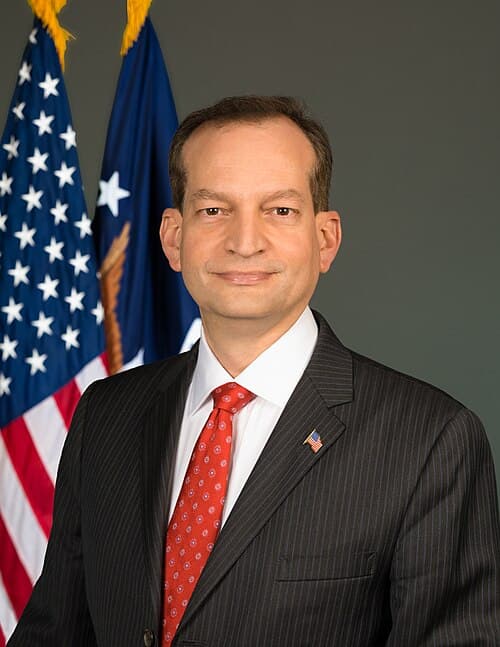
Alexander Acosta
PERSON • 2 mentions
American attorney and politician, 27th U.S. Secretary of Labor (born 1969)
GL
Gerald Lefcourt
PERSON
American lawyer
Jay Lefkowitz
PERSON • 2 mentions
American lawyer

Jeffrey Epstein
PERSON • 4 mentions
American sex offender and financier (1953–2019)
LB
Leon Black
PERSON
American billionaire businessman (born 1951)

Ocariz
PERSON
Surname reference in Epstein documents

Podhurst
PERSON
Refers to Podhurst Orseck law firm and Aaron Podhurst, representing Epstein victims
SA
Sanchez
PERSON
Surname reference in Epstein documents
Department of Justice
ORGANIZATION
United States Department of Justice, federal executive department responsible for law enforcement
Federal Bureau of Prisons
ORGANIZATION
U.S. federal agency responsible for incarceration of federal inmates
Kirkland & Ellis LLP
ORGANIZATION
Large law firm in the United States, based in Chicago, Illinois
State Attorney's Office
ORGANIZATION
State Attorney's Office
Statistics
Pages:5
Entities:12
Avg. OCR:0.9%
Sponsored