Back to Network














6
Shared Docs
6
Same-Page
6 / 9
Mentions
Document Mentions (6 shared documents)
3 mentions1 same-page
Page ?Same page
iled in over a hundred countries. He studied Physics and Computer Science at Manchester University, Design at Lancaster University and Engineering at Cambridge University. He lives with his family on a farm in Kent, England. www.jamestagg.com HOUSE_OVERSIGHT_015675 “T can't tell you when the last time was that I had
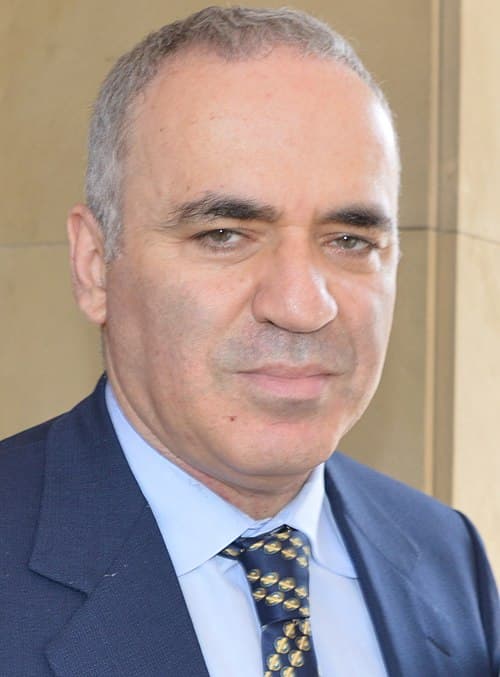
calm and, before each turn, looks to a screen at the side of the board, reads the instruction, and makes his move. This is the famous match between Garry Kasparov and IBM’s Deep Blue. Kasparov, a child prodigy, became world chess champion at the age of fifteen and, to this day, holds the record for the highest
o a screen at the side of the board, reads the instruction, and makes his move. This is the famous match between Garry Kasparov and IBM’s Deep Blue. Kasparov, a child prodigy, became world chess champion at the age of fifteen and, to this day, holds the record for the highest chess ranking ever achieved. S
3 mentions1 same-page
Page ?Same page
OMPUTERS BECOME OUR OVERLORDS? Venki Ramakrishnan Venki Ramakrishnan is a scientist at the Medical Research Council Laboratory of Molecular Biology, Cambridge University; recipient of the Nobel Prize in Chemistry (2009); current president of the Royal Society; and the author of Gene Machine: The Race to Discover the S
ne article described Deep Blue’s victory not as that of a computer, which was just a dumb machine, but as the victory of hundreds of programmers over Kasparov, a single individual. That way of programming is changing dramatically. After a long hiatus, the power of machine learning has taken off. Much of th
, we programmed computers using algorithms we understood at least in principle. So when machines did amazing things like beating world chess champion Garry Kasparov, we could say that the victorious programs were designed with algorithms based on our own understanding—using, in this instance, the experience and a
Sponsored
2 mentions1 same-page
Page ?Same page
rfly creating tornados 173 Byrd, William 259 bytes 129 C calculating machines 15 California Institute of Technology (Caltech) xii Call of Duty 290 Cambridge University 17,72, 195, 221 King’s College 211 Mathematical Bridge x Trinity College 193 Wolfson College ix CaMKII 119 Candidate for a Pullet Surprise 139 Canton
, Steve 47, 68, 296-297, 297, 306 joke 93 world’s funniest 94 Joke Analysis and Production Engine 310 Jones, JP 251 K Kahn, Philip 237 Kamailio 265 Kasparov, Garry 5, 34 and Deep Blue 4-6 Kelvin, Lord 180 Kerr Metric 280 Khayyam, Omar 371 King’s College 17, 211 Kish, Daniel 13 knitting 117 knowledge 8 a
2 mentions1 same-page
Page ?Same page
Case for Reason, Science, Humanism, and Progress. Venki Ramakrishnan is a scientist at the Medical Research Council Laboratory of Molecular Biology, Cambridge University; recipient of the Nobel Prize in Chemistry (2009); current president of the Royal Society; and the author of Gene Machine: The Race to Discover the S
a vast selection of possible future moves. But the majority of predictions of AI, e.g., robotic maids, turned out to be illusory. When Deep Blue beat Garry Kasparov at chess in 1997, the most 20 HOUSE_OVERSIGHT_016823 powerful room-cleaning robot was a Roomba, which moved around vacuuming at random and squeake
2 mentions1 same-page
Page ?Same page
Case for Reason, Science, Humanism, and Progress. Venki Ramakrishnan is a scientist at the Medical Research Council Laboratory of Molecular Biology, Cambridge University; recipient of the Nobel Prize in Chemistry (2009); current president of the Royal Society; and the author of Gene Machine: The Race to Discover the S
a vast selection of possible future moves. But the majority of predictions of AI, e.g., robotic maids, turned out to be illusory. When Deep Blue beat Garry Kasparov at chess in 1997, the most 20 HOUSE_OVERSIGHT_016240 powerful room-cleaning robot was a Roomba, which moved around vacuuming at random and squeake
Sponsored
Mutual Connections (764)
Entities connected to both Cambridge University and Garry Kasparov
Prince Charles
PERSON30 w/ Cambridge·8 w/ Garry
Jeffrey Epstein
PERSON22 w/ Cambridge·12 w/ Garry
Stephen Hawking
PERSON17 w/ Cambridge·17 w/ Garry
Julie K. Brown
PERSON24 w/ Cambridge·9 w/ Garry
George Soros
PERSON24 w/ Cambridge·5 w/ Garry
Prince Andrew
PERSON14 w/ Cambridge·15 w/ Garry
George W. Bush
PERSON14 w/ Cambridge·12 w/ Garry
Columbia Business School
ORGANIZATION20 w/ Cambridge·5 w/ Garry
Marc Rich
PERSON13 w/ Cambridge·12 w/ Garry
Ghislaine Maxwell
PERSON8 w/ Cambridge·16 w/ Garry
Michael Douglas
PERSON18 w/ Cambridge·5 w/ Garry
J. Robert Oppenheimer
PERSON19 w/ Cambridge·4 w/ Garry
Samantha Power
PERSON10 w/ Cambridge·11 w/ Garry
Eric Trump
PERSON10 w/ Cambridge·11 w/ Garry
Barack Obama
PERSON9 w/ Cambridge·11 w/ Garry
Technology
ORGANIZATION17 w/ Cambridge·2 w/ Garry
Alan Dershowitz
PERSON10 w/ Cambridge·9 w/ Garry
LB
Leon Black
PERSON7 w/ Cambridge·12 w/ Garry
DB
Doug Band
PERSON6 w/ Cambridge·12 w/ Garry
Robert Gates
PERSON10 w/ Cambridge·7 w/ Garry