Back to Network















4
Shared Docs
4
Same-Page
4 / 4
Mentions
Document Mentions (4 shared documents)
2 mentions1 same-page
Page ?Same page
mptions going forward federal revenue by 2030 won't be able to cover much more than spending on interest and the big entitlement programs (Medicare, Medicaid, Social Security and health insurance subsidies). By 2040, it won't even adequately cover those. Barring serious reforms, the numbers would worsen
may have been stack during the two latest economic bubbles in favor of those running the house. People forget that during the arguments in favor of Reaganomics, prominent Republican economists publicly claimed that deficits didn't matter, and during the Bush/Cheney Administration there was almost universal
2 mentions1 same-page
Page ?Same page
ers such as Florida Gov. Rick Scott who last week broke with party orthodoxy -- joining six other Republican governors — and agreeing to accept the Medicaid expansion funded by Obamacare. Recently a number of prominent conservatives with national profiles (Louisiana's Bobby Jindal, South Carolina's Nikki
who supported income equality, gay and women's rights, as well as an economy that grows bottom up instead of trickling down, as thirty-plus years of Reaganomics has proven a disaster for the Middle Class. Mitt Romney and his supporters pooh-pooh President Obama as a community organizer. But if they think th
2 mentions1 same-page
Page ?Same page
net since Medicare. Mr. Romney doesn't have an economic plan at all, but he is determined not just to repeal Obamacare but to impose savage cuts in Medicaid. So never mind all those bullet points. Think instead about the 45 million Americans who either will or won't receive essential health care, dependi
e Reagan, he also began his term with an economic slump, then claimed that the recovery from that slump proved the success of his policies. And like Reaganomics — but more quickly — Bushonomics has ended in grief with the economy in free-fall on a way to a full-fledged depression. The root of the problem ca
Sponsored
2 mentions1 same-page
Page ?Same page
icans gained health care coverage under the A.C.A./Obamacare. Health experts say most would lose that coverage under the proposal. Let's start with Medicaid. Obamacare expanded the program to cover 11 million more poor Americans in 31 states and the District of Columbia. The Republican bill would end the
onally or not, serves to concentrate wealth at the top by extracting it from everywhere else. This belief system is called variously neoliberalism, Reaganomics, the Chicago School, and trickle-down economics. It is easily recognized by its signature ideas: deregulation; privatization; cut taxes on the rich;
Sponsored
Mutual Connections (49)
Entities connected to both Medicaid and Reaganomics
Jeffrey Epstein
PERSON114 w/ Medicaid·2 w/ Reaganomics
Barack Obama
PERSON79 w/ Medicaid·6 w/ Reaganomics
Donald Trump
PERSON81 w/ Medicaid·4 w/ Reaganomics
George W. Bush
PERSON65 w/ Medicaid·7 w/ Reaganomics
Marc Rich
PERSON67 w/ Medicaid·5 w/ Reaganomics
Bill Clinton
PERSON66 w/ Medicaid·4 w/ Reaganomics
Julie K. Brown
PERSON66 w/ Medicaid·4 w/ Reaganomics
LB
Leon Black
PERSON61 w/ Medicaid·2 w/ Reaganomics
Paul Ryan
PERSON54 w/ Medicaid·3 w/ Reaganomics
Bloomberg L.P.
ORGANIZATION48 w/ Medicaid·2 w/ Reaganomics
DB
Doug Band
PERSON46 w/ Medicaid·3 w/ Reaganomics
Prince Charles
PERSON45 w/ Medicaid·3 w/ Reaganomics
George Mitchell
PERSON45 w/ Medicaid·3 w/ Reaganomics
Samantha Power
PERSON43 w/ Medicaid·2 w/ Reaganomics
Mitch McConnell
PERSON37 w/ Medicaid·2 w/ Reaganomics
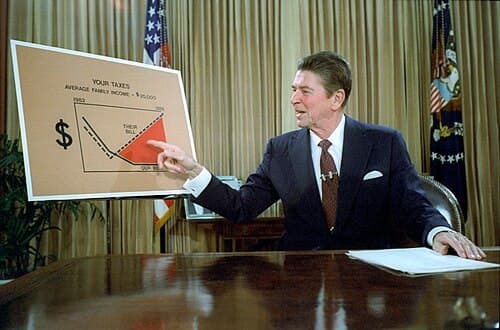
Ronald Reagan
PERSON32 w/ Medicaid·3 w/ Reaganomics
GB
Gregory Brown
PERSON26 w/ Medicaid·4 w/ Reaganomics
The Washington Post
ORGANIZATION26 w/ Medicaid·3 w/ Reaganomics
Mitt Romney
PERSON24 w/ Medicaid·3 w/ Reaganomics
Dick Cheney
PERSON22 w/ Medicaid·2 w/ Reaganomics