Back to Network











4
Shared Docs
4
Same-Page
6 / 4
Mentions
Document Mentions (4 shared documents)
3 mentions1 same-page
Page ?Same page
0,000 neurons each. Once one has committed oneself to looking at such groups, the next step is to ask how these groups are organized, which leads to Edelman's concept of "maps." A "map," in Edelman's terminology, is a connected set of groups with the property that when one of the inter-group connection
to Hebbian learning between assemblies has been pursued by Nobelist Gerald Edelman in his theory of neuronal group selection, or "Neural Darwinism." Edelman won a Nobel Prize for his work in immunology, which, like most modern immunology, was based on C. MacFarlane Burnet's theory of "clonal selection"
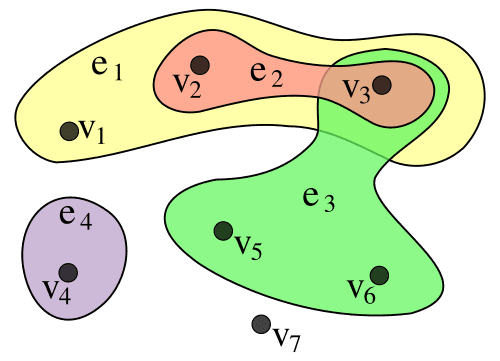
ergent" hypergraphs of the sort described here using the acronym SMEPH, which stands for Self-Modifying, Evolving Probabilistic Hy- pergraphs. 14.2 Key Vertex and Edge Types We begin by introducing a particular collection of Vertex and Edge types, to be used in modeling the internal structures of intellig
3 mentions1 same-page
Page ?Same page
50,000 neurons each. Once one has committed oneself to looking at such groups, the next step is to ask how these groups are organized, which leads to Edelman’s concept of “maps.” A “map,” in Edelman’s terminology, is a connected set of groups with the property that when one of the inter-group connections
similar transient assemblies when highly activated. The importance of repeated, slightly varied copies of the same subnetwork has been emphasized by Edelman [Ede93] among other neural theorists. 1 The larger an ensemble is, she suggests, the more vivid it is as a conscious experience; an hypothesis that
mergent" hypergraphs of the sort described here using the acronym SMEPH, which stands for Self-Modifying, Evolving Probabilistic Hy- pergraphs. 14.2 Key Vertex and Edge Types We begin by introducing a particular collection of Vertex and Edge types, to be used in modeling the internal structures of intellige
2 mentions1 same-page
Page ?Same page
r-level behaviors like reasoning or subgoaling. • NOMAD (Neurally Organized Mobile Adaptive Device) automata and its successors [K EMI are based on Edelman's "Neural Darwinism" model of the brain, and feature large numbers of simulated neurons evolving by natural selection into configurations that carry
268 13.6.4 Neural-Symbolic Glocality in CogPrime 269 14 Representing Implicit Knowledge via Hypergraphs 271 14.1 Introduction 271 14.2 Key Vertex and Edge Types 271 14.3 Derived Hypergraphs 272 14.3.1 SMEPH Vertices 272 14.3.2 SMEPH Edges 273 14.4 Implications of Patternist Philoso
Sponsored
2 mentions1 same-page
Page ?Same page
er-level behaviors like reasoning or subgoaling. e NOMAD (Neurally Organized Mobile Adaptive Device) automata and its successors [KE06] are based on Edelman’s “Neural Darwinism” model of the brain, and feature large numbers of simulated neurons evolving by natural selection into configurations that carry
0000.0 269 14 Representing Implicit Knowledge via Hypergraphs ....................... 271 14.1 Introduction .......00..000 000 tte teen ee 271 14.2: Key Vertex atid Edge Typé$ casas cuine cs ce ees ee ses ems es emo ws Meee MERE OE 271 14.3 Derived Hypergraphs .......... 0.000. c cece tenet eae 272 14.3.1 SM
Sponsored
Mutual Connections (365)
Entities connected to both Edelman and Key Vertex
Jeffrey Epstein
PERSON41 w/ Edelman·2 w/ Key
Marc Rich
PERSON19 w/ Edelman·4 w/ Key
Donald Trump
PERSON18 w/ Edelman·2 w/ Key
Bill Clinton
PERSON16 w/ Edelman·2 w/ Key
Stephen Hawking
PERSON14 w/ Edelman·4 w/ Key
Gerald Edelman
PERSON16 w/ Edelman·2 w/ Key
Prince Andrew
PERSON15 w/ Edelman·2 w/ Key
George W. Bush
PERSON10 w/ Edelman·4 w/ Key
Vladimir Putin
PERSON7 w/ Edelman·4 w/ Key
Alan Dershowitz
PERSON8 w/ Edelman·2 w/ Key
Earth
LOCATION6 w/ Edelman·4 w/ Key
CogPrime
ORGANIZATION5 w/ Edelman·4 w/ Key
OpenCog
ORGANIZATION5 w/ Edelman·4 w/ Key
Vince Foster
PERSON5 w/ Edelman·4 w/ Key
Hebbian Learning Between Assemblies
ORGANIZATION4 w/ Edelman·4 w/ Key
Lawrence Krauss
PERSON6 w/ Edelman·2 w/ Key
Hebbian Learning
ORGANIZATION4 w/ Edelman·4 w/ Key
Hypergraphs
PERSON4 w/ Edelman·4 w/ Key
AGI Ethics
ORGANIZATION4 w/ Edelman·4 w/ Key
Prince Charles
PERSON6 w/ Edelman·2 w/ Key