Back to People & Entities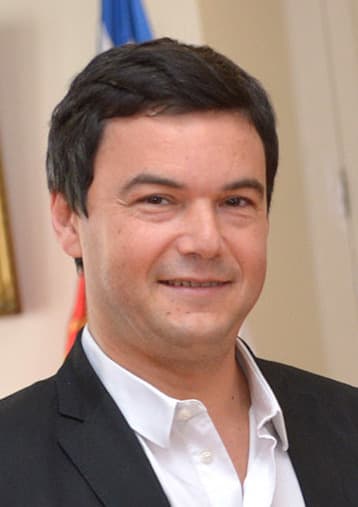










Thomas Piketty
Person
Also known as:
THOMAS PIKETTYPiketty
74
Total Mentions
53
Documents
1,576
Connected Entities
French economist
Thomas Piketty, the French economist famous for his work on wealth inequality, appears in the Epstein documents exclusively as a reference point in discussions about wealth concentration and inheritance, not as someone connected to Epstein's activities.
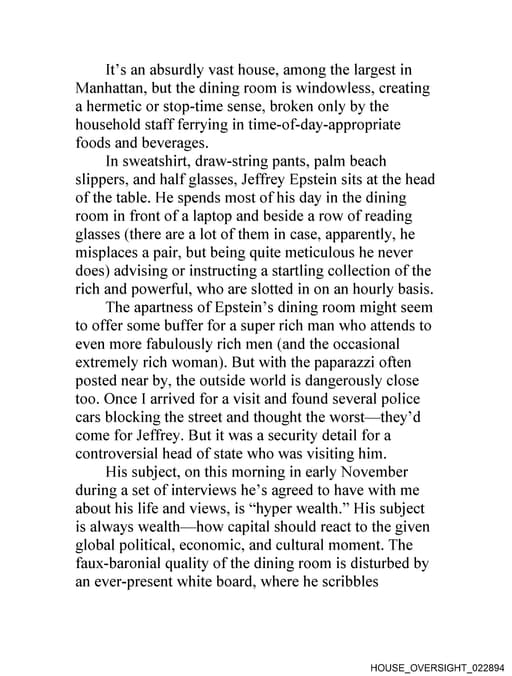
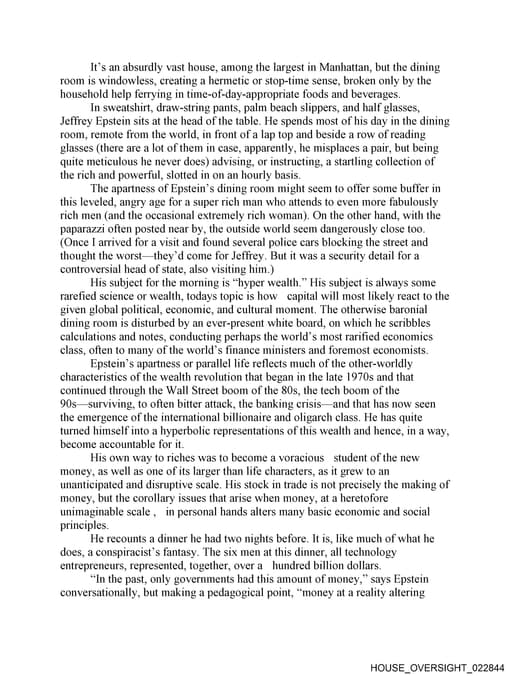
Piketty is mentioned in a 2016 New York Magazine article about Epstein that was forwarded in emails and appears in multiple copies throughout the document collection. The article quotes Epstein discussing wealth inequality, with Epstein claiming to both echo and disagree with Piketty's theories from "Capital in the Twenty-First Century." Piketty himself is not a participant in any communications and has no direct connection to Epstein—his name appears only as an intellectual reference point in journalism about Epstein's views on wealth. Two additional mentions reference Piketty's academic work on national accounts data in unrelated economic documents.
Key Highlights
- •All mentions stem from the same New York Magazine profile of Epstein, which exists in multiple forwarded copies across documents HOUSE_OVERSIGHT_022707, 022727, 022746, 022844, 022863, 022894, 022952, 023627, and 024229
- •Epstein claims to agree with Piketty on wealth inequality ("the divide is between people with assets, which appreciate, and people without assets") but disagrees on inheritance, saying wealthy people don't want to give everything to their children
- •Two separate documents (HOUSE_OVERSIGHT_010912 and 025763) reference Piketty's economic research on wealth concentration and tax data, with no connection to Epstein
- •One spurious mention (HOUSE_OVERSIGHT_016996) refers to "Pickett" (Joseph P. Pickett, dictionary editor) and another (HOUSE_OVERSIGHT_013501) refers to "Pickett, D." in a physics citation—both are different people misidentified by OCR or entity extraction
Frequently Asked Questions
Related Links
Document Mentions (20 of 53)
EFTA00685893.pdf
3 mentionsEFTA00685893
ead "big ideas' book with the potential to rival Thomas Piketty's Capita! and the works of Yuva! Noah Harari in
f. In this talk based on his new book Utopia for Realists - hailed by the Bookseller as 'a must- read "big ideas' book with the potential to rival Thomas Piketty's Capita! and the works of Yuva! Noah Harari in its impact* - major new thinker Rutger Bregman, will explore how we can reconstruct society with vis
g ideas' book with the potential to rival Thomas Piketty's Capita! and the works of Yuva! Noah Harari in
EFTA02675502.pdf
2 mentionsEFTA02675502
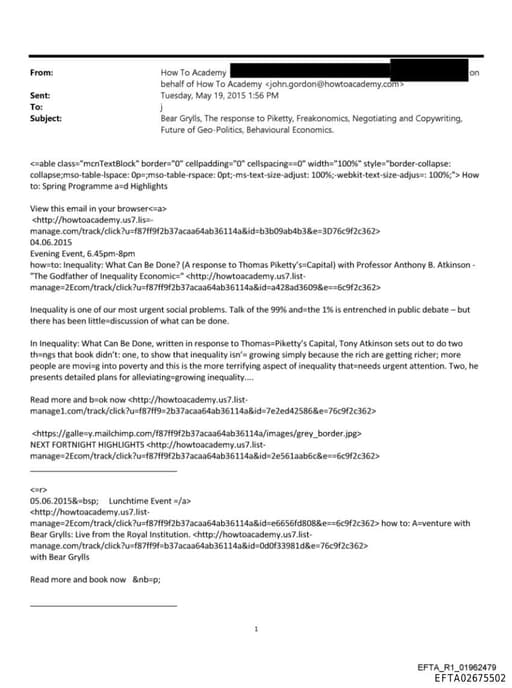
=to: Inequality: What Can Be Done? (A response to Thomas Piketty's=Capital) with Professor Anthony B. Atkinson - "
ay 19, 2015 1:56 PM Bear Grylls, The response to Piketty, Freakonomics, Negotiating and Copywriting, Futu
2 mentions
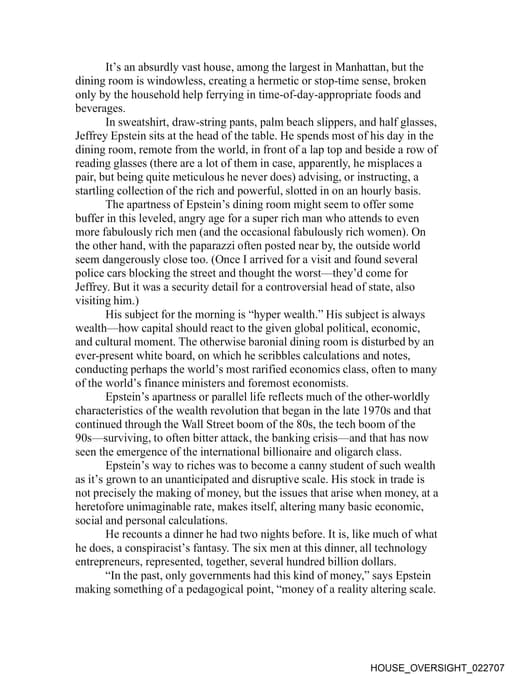
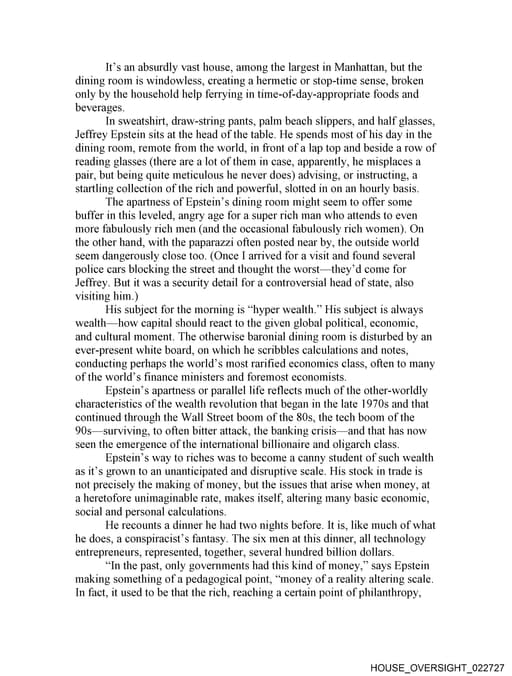
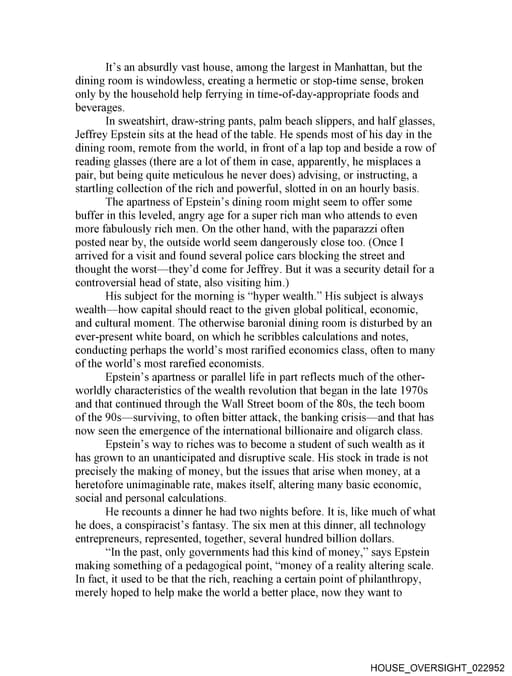
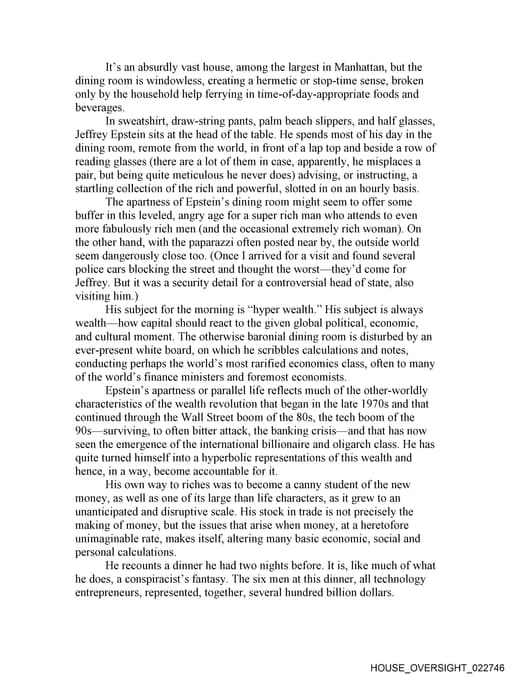
te-like terms backwards, as in who has gotten it, but forwards to where it will go and who will get it.” Epstein can find himself echoing aspects of Thomas Piketty on the inequities of the accumulation of wealth (“the divide is between people with assets, which appreciate, and people without assets, who fail to
Page: HOUSE_OVERSIGHT_022708 →vance—that 1s, of course, the miracle of compounded interest’’), except for the fact that Epstein, knowing the rich, understands a curious point that Piketty doesn’t: “Nobody, nobody, wants to give it all to their children. Everybody now has the modern appreciation that one of the curses of great wealth is
Page: HOUSE_OVERSIGHT_022708 →Sponsored
EFTA00307947.pdf
2 mentionsEFTA00307947
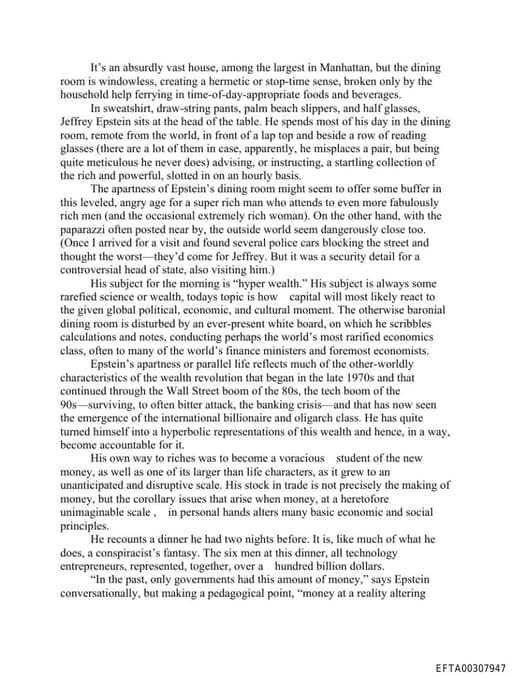
e-like terms backwards, as in who has gotten it, but forwards to where it will go and who will get it." Epstein can find himself echoing aspects of Thomas Piketty on the inequities of the accumulation of wealth ("the divide is between people with assets, which appreciate, and people without assets, who fail t
ance—that is, of course, the miracle of compounded interest"), except for the fact that Epstein, knowing the rich, understands a curious point that Piketty doesn't: "Nobody, nobody, wants to give it all to their children. Everybody now has the modern appreciation that one of the curses of great wealth
EFTA00687916.pdf
2 mentionsEFTA00687916
to: Inequality: What Can Be Done? (A response to Thomas Piketty's Capital) with Professor Anthony B. Atkinson -
quality: What Can Be Done? (A response to Thomas Piketty's Capital) with Professor Anthony B. Atkinson -
2 mentions
ail to advance—that is, of course, the miracle of compounded interest”), except for the fact that Epstein, knowing the rich, understands a point that Piketty doesn’t: “Nobody, nobody, wants to give it all to their children. Everybody now has the modern appreciation that one of the curses of great wealth is
Page: HOUSE_OVERSIGHT_022896 →te-like terms backwards, as in who has gotten it, but forwards to where it will go and who will get it.” Epstein can find himself echoing aspects of Thomas Piketty on the inequities of the accumulation of wealth (“the divide is between people with assets, which appreciate, and people without assets, who fail to
Page: HOUSE_OVERSIGHT_022896 →Sponsored
EFTA00693914.pdf
2 mentionsEFTA00693914
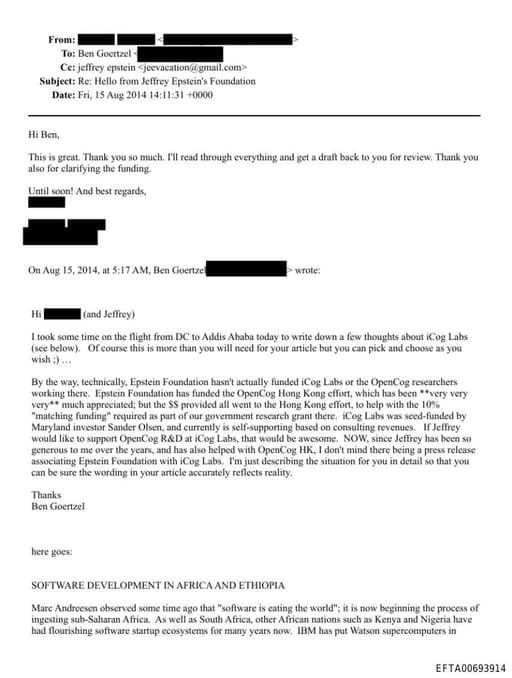
inequality remains a huge issue -- and as Thomas Piketty's recent tome has famously demonstrated, the degr
Ethiopia and other developing nations. Technology is transforming the world in amazing ways, but economic inequality remains a huge issue -- and as Thomas Piketty's recent tome has famously demonstrated, the degree of inequality is generally increasing EFTA00693916 around the world, for reasons basic to the st
EFTA00692084.pdf
2 mentionsEFTA00692084
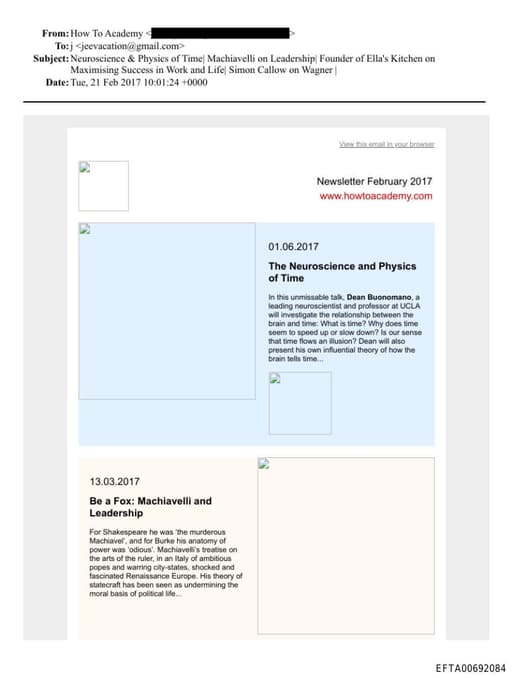
ead "big ideas' book with the potential to rival Thomas Piketty's Capital and the works of Yuval Noah Harari in
g ideas' book with the potential to rival Thomas Piketty's Capital and the works of Yuval Noah Harari in
2 mentions
te-like terms backwards, as in who has gotten it, but forwards to where it will go and who will get it.” Epstein can find himself echoing aspects of Thomas Piketty on the inequities of the accumulation of wealth (“the divide is between people with assets, which appreciate, and people without assets, who fail to
Page: HOUSE_OVERSIGHT_022845 →dvance—that is, of course, the miracle of compounded interest”), except for the fact that Epstein, knowing the rich, understands a curious point that Piketty doesn’t: “Nobody, nobody, wants to give it all to their children. Everybody now has the modern appreciation that one of the curses of great wealth is
Page: HOUSE_OVERSIGHT_022845 →Sponsored
incomeinequality_08052014.pdf
2 mentionsHOUSE_OVERSIGHT_025763 - HOUSE_OVERSIGHT_025789
Source: House Oversight Committee
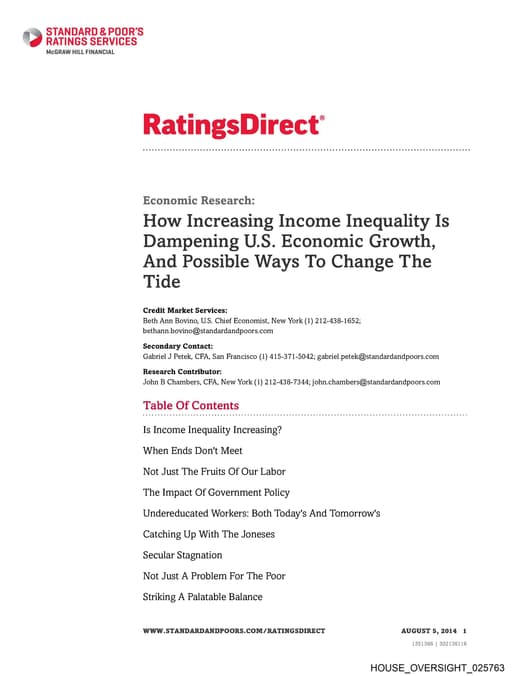
is concentration of household income follows a long period in which income concentration remained relatively flat. Using U.S. tax returns, economists Thomas Piketty and Emmanuel Saez found that income concentration dropped dramatically following both World Wars and was roughly unchanged for the next few decades (
Page: HOUSE_OVERSIGHT_025767 →ogical innovation that broadened their reach across global markets and a "winner take all" phenomenon. Another "superstar" is the "super managers." Piketty argues that the "primary reason for increased income inequality in recent decades is the rise of the super managers in both the financial and nonfina
Page: HOUSE_OVERSIGHT_025768 →JEdraft--3-28-JE.rtf
2 mentionsHOUSE_OVERSIGHT_022863 - HOUSE_OVERSIGHT_022893
Source: House Oversight Committee
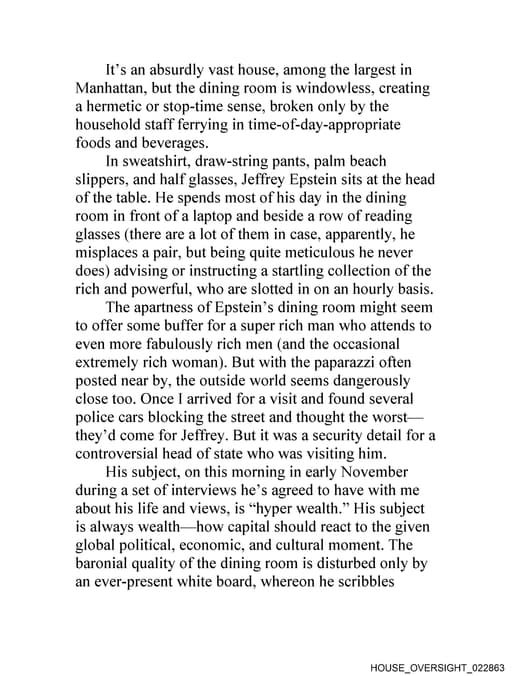
te-like terms backwards, as in who has gotten it, but forwards to where it will go and who will get it.” Epstein can find himself echoing aspects of Thomas Piketty on the inequities of the accumulation of wealth (“the divide is between people with assets, which appreciate, and people without assets, who fail to
Page: HOUSE_OVERSIGHT_022865 →ail to advance—that is, of course, the miracle of compounded interest”), except for the fact that Epstein, knowing the rich, understands a point that Piketty doesn’t: “Nobody, nobody, wants to give it all to their children. Everybody now has the modern appreciation that one of the curses of great wealth is
Page: HOUSE_OVERSIGHT_022865 →2 mentions
vance— that is, of course, the miracle of compounded interest”), except for the fact that Epstein, knowing the rich, understands a curious point that Piketty doesn’t: “Nobody, nobody, wants to give it all to their children. Everybody now has the modern appreciation that one of the curses of great wealth is
Page: HOUSE_OVERSIGHT_022728 →te-like terms backwards, as in who has gotten it, but forwards to where it will go and who will get it.” Epstein can find himself echoing aspects of Thomas Piketty on the inequities of the accumulation of wealth (“the divide is between people with assets, which appreciate, and people without assets, who fail to
Page: HOUSE_OVERSIGHT_022728 →Sponsored
EFTA00307966.pdf
2 mentionsEFTA00307966
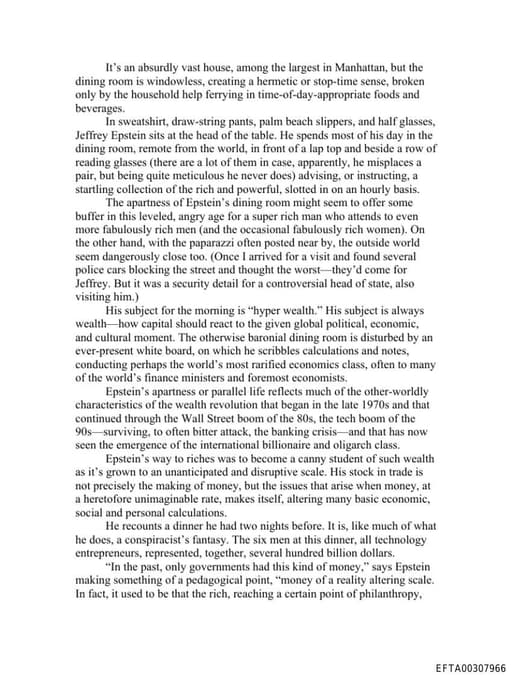
e-like terms backwards, as in who has gotten it, but forwards to where it will go and who will get it." Epstein can find himself echoing aspects of Thomas Piketty on the inequities of the accumulation of wealth ("the divide is between people with assets, which appreciate, and people without assets, who fail t
ance— that is, of course, the miracle of compounded interest"), except for the fact that Epstein, knowing the rich, understands a curious point that Piketty doesn't: "Nobody, nobody, wants to give it all to their children. Everybody now has the modern appreciation that one of the curses of great wealth
EFTA00700368.pdf
2 mentionsEFTA00700368
ealth. . The economists Emmanuel Saez and Thomas Piketty found that 93 percent of the income gains from th
of Europe grew, the city continued to shrink. Today in America we see this same type of concentration of wealth. . The economists Emmanuel Saez and Thomas Piketty found that 93 percent of the income gains from the 2009-10 recovery went to the top 1 percent of taxpayers. The top 0.01 percent captured 37 percent
2 mentions
e- like terms backwards, as in who has gotten it, but forwards to where it will go and who will get it.” Epstein can find himself echoing aspects of Thomas Piketty on the inequities of the accumulation of wealth (“the divide is between people with assets, which appreciate, and people without assets, who fail to
Page: HOUSE_OVERSIGHT_022953 →vance— that is, of course, the miracle of compounded interest”), except for the fact that Epstein, knowing the rich, understands a curious point that Piketty doesn’t: “Nobody, nobody, wants to give it to their children. Everybody now has the modern appreciation that one of the curses of great wealth is tha
Page: HOUSE_OVERSIGHT_022953 →Sponsored
2 mentions
vance— that is, of course, the miracle of compounded interest”), except for the fact that Epstein, knowing the rich, understands a curious point that Piketty doesn’t: “Nobody, nobody, wants to give it all to their children. Everybody now has the modern appreciation that one of the curses of great wealth is
Page: HOUSE_OVERSIGHT_022747 →te-like terms backwards, as in who has gotten it, but forwards to where it will go and who will get it.” Epstein can find himself echoing aspects of Thomas Piketty on the inequities of the accumulation of wealth (“the divide is between people with assets, which appreciate, and people without assets, who fail to
Page: HOUSE_OVERSIGHT_022747 →.msg
2 mentionsHOUSE_OVERSIGHT_023627 - HOUSE_OVERSIGHT_023634
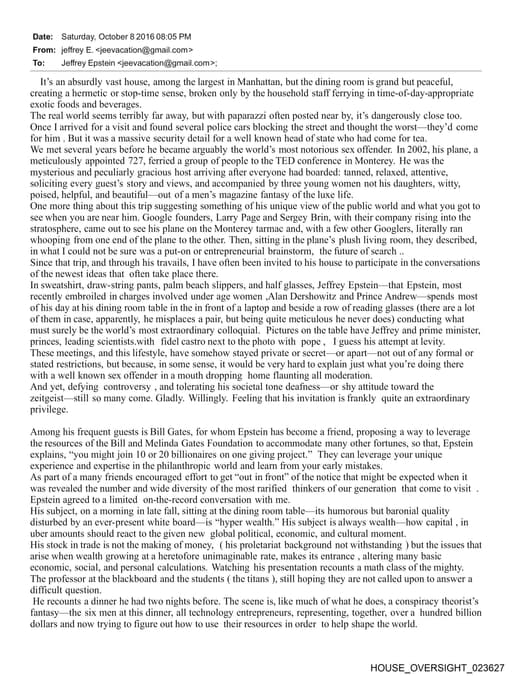
e- like terms backwards, as in who has gotten it, but forwards to where it will go and who will get it.” Epstein can find himself echoing aspects of Thomas Piketty on the inequities of the accumulation of wealth (“the divide is between people with assets, which appreciate, and people without assets, who fail to
Page: HOUSE_OVERSIGHT_023628 →il to advance—that is, of course, the miracle of compounded interest’’), except for the fact that Epstein, knowing the rich, understands a point that Piketty doesn’t: “Nobody, nobody, of the hyperwealthy wants to give it all to their children. Everybody now has the modern appreciation that one of the curse
Page: HOUSE_OVERSIGHT_023628 →EFTA00672775.pdf
2 mentionsEFTA00672775
quality: What Can Be Done? (A response to Thomas Piketty's Capital) with Professor Anthony B. Atkinson -
to: Inequality: What Can Be Done? (A response to Thomas Piketty's Capital) with Professor Anthony B. Atkinson -
Sponsored
Jeffrey latest--new revise.rtf
2 mentionsHOUSE_OVERSIGHT_024229 - HOUSE_OVERSIGHT_024250
Source: House Oversight Committee
E_OVERSIGHT_024229 --- PAGE BREAK --- --- PAGE BREAK --- --- PAGE BREAK --- --- PAGE BREAK --- Epstein can find himself echoing aspects of Thomas Piketty on the inequities of the accumulation of wealth (“the divide is between people with assets, which appreciate, and people without assets, who fail to
Page: HOUSE_OVERSIGHT_024233 →ail to advance—that is, of course, the miracle of compounded interest’), except for the fact that Epstein, knowing the rich, understands a point that Piketty doesn’t: “Nobody, nobody, wants to give it all to their children. Everybody now has the modern appreciation that one of the curses of great wealth is
Page: HOUSE_OVERSIGHT_024233 →Free Growth and Other Surprises.pdf
2 mentionsHOUSE_OVERSIGHT_010912_sub_001 - HOUSE_OVERSIGHT_011011
Source: House Oversight Committee
t cherry-picked to support Mill’s idea. They are all | have found. My source for national accounts including market-valued capital was the website of Thomas Piketty and Gabriel Zucman adjusting their data to uniform accounting standards and measuring them in 2010 currency units. It also collects recent and past r
in the 1920s and reorganized them along Keynesian lines when the General Theory was published, reconstructed them back to 1870 for the U.S. economy. Piketty and Zucman incorporate this research and others. They have acted as editors only. As a layman, I would hardly be qualified to find and interpret orig
Sponsored
Connected Entities(20 of 1,576)
Jeffrey Epstein
PersonAmerican sex offender and financier (1953–2019)
29 docs29 co-mentions
George W. Bush
PersonPresident of the United States from 2001 to 2009
26 docs26 co-mentions
Ghislaine Maxwell
PersonBritish socialite and sex trafficker, daughter of Robert Maxwell, accomplice of Jeffrey Epstein
24 docs24 co-mentions
Marc Rich
PersonAmerican commodities trader (1934–2013)
23 docs23 co-mentions
Prince Charles
PersonKing of the United Kingdom and other Commonwealth realms since 2022 (born 1948)
22 docs22 co-mentions
Bradley Edwards
PersonAmerican attorney who represented Epstein victims, author of Relentless Pursuit
21 docs21 co-mentions
Prince Andrew
PersonThird child of Queen Elizabeth II and Prince Philip, Duke of Edinburgh (born 1960)
20 docs20 co-mentions
John F. Kennedy
PersonPresident of the United States from 1961 to 1963 (1917–1963)
18 docs18 co-mentions
Donald Trump
PersonPresident of the United States (2017–2021, 2025–present)
17 docs17 co-mentions
Bill Clinton
PersonPresident of the United States from 1993 to 2001 (born 1946)
17 docs17 co-mentions
Julie K. Brown
PersonAmerican journalist
17 docs17 co-mentions
Barack Obama
PersonPresident of the United States from 2009 to 2017
16 docs16 co-mentions
Alan Dershowitz
PersonAmerican lawyer, author, and art collector (born 1938)
16 docs16 co-mentions
New York
LocationMost populous city in the United States
16 docs16 co-mentions
Vladimir Putin
Person2nd and 4th President of Russia (2000-2008, 2012-present), 7th and 11th Prime Minister of Russia (1999-2000, 2008-2012), Director of the Federal Security Service (1998-1999) and Deputy Mayor of Saint Petersburg (1994-1996)
16 docs16 co-mentions
Virginia Giuffre
PersonAdvocate for sex trafficking victims (1983–2025)
15 docs15 co-mentions
United States
LocationCountry located primarily in North America
14 docs14 co-mentions
LB
Leon Black
PersonAmerican billionaire businessman (born 1951)
14 docs14 co-mentions
Reid Weingarten
PersonAmerican white-collar criminal defense attorney at Steptoe & Johnson, represented Jeffrey Epstein and other high-profile clients
14 docs14 co-mentions
Al Gore
PersonVice President of the United States from 1993 to 2001 (born 1948)
12 docs12 co-mentions