Back to People & Entities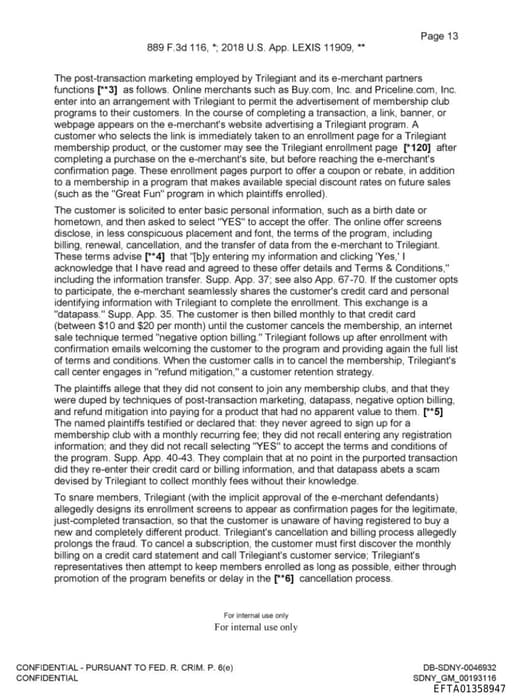
TR
Trilegiant
Person
9
Total Mentions
7
Documents
4
Connected Entities
Surname reference in documents
Document Mentions (7)
EFTA01358947.pdf
2 mentionsEFTA01358947
programs to their customers. In the course of completing a transaction, a link, banner, or webpage appears on the e-merchant's website advertising a Trilegiant program. A customer who selects the link is immediately taken to an enrollment page for a Trilegiant membership product, or the customer may see th
Page 13 889 F.3d 116, *; 2018 U.S. App. LEXIS 11909, ** The post-transaction marketing employed by Trilegiant and its e-merchant partners functions [""3] as follows. Online merchants such as Buy.com, Inc. and Priceline.com, Inc. enter into an arrangement wi
EFTA01358949.pdf
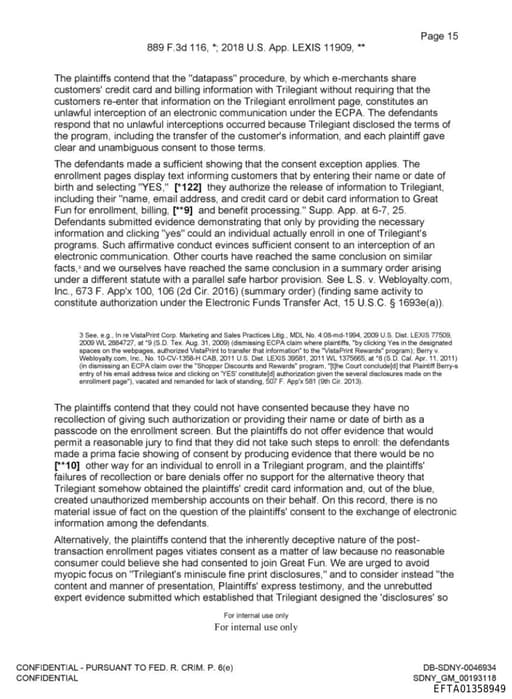
2 mentionsEFTA01358949
the defendants made a prima facie showing of consent by producing evidence that there would be no r*10] other way for an individual to enroll in a Trilegiant program, and the plaintiffs' failures of recollection or bare denials offer no support for the alternative theory that Trilegiant somehow obtained
EXIS 11909, ** The plaintiffs contend that the "datapass" procedure, by which e-merchants share customers' credit card and billing information with Trilegiant without requiring that the customers re-enter that information on the Trilegiant enrollment page, constitutes an unlawful interception of an electr
EFTA01358951.pdf
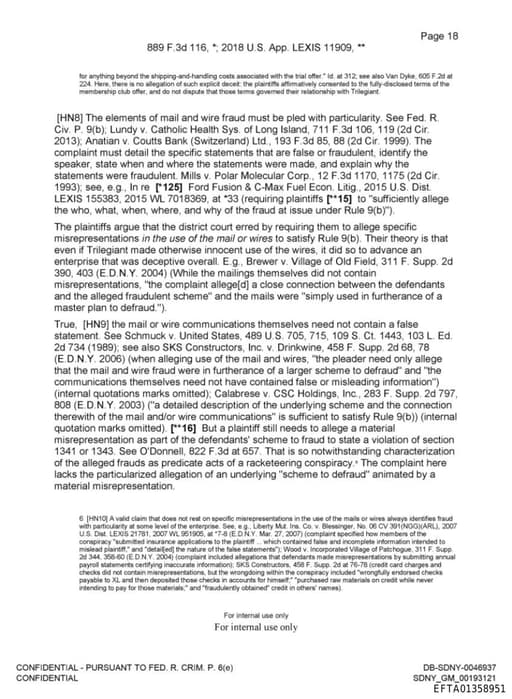
1 mentionEFTA01358951
irmatively consented to the fully-disclosed terms of the membership club offer, and do not dispute that those terms governed their relationship with Trilegiant. [HN8]The elements of mail and wire fraud must be pled with particularity. See Fed. R. Civ. P. 9(b); Lundy v. Catholic Health Sys. of Long Island,
Sponsored
EFTA01358950.pdf
1 mentionEFTA01358950
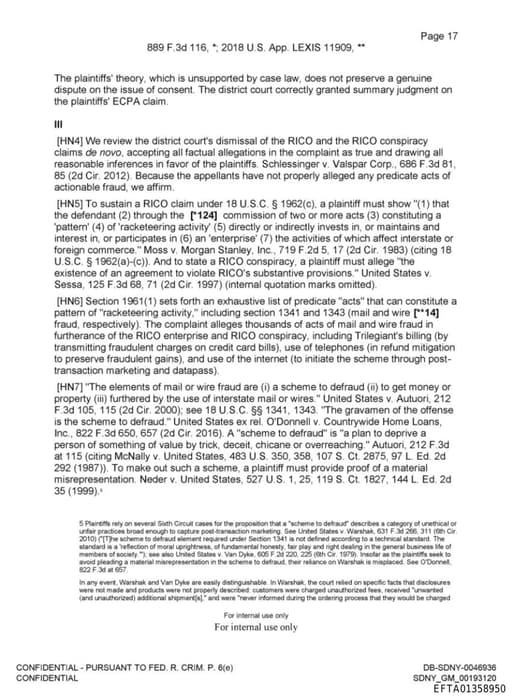
, respectively). The complaint alleges thousands of acts of mail and wire fraud in furtherance of the RICO enterprise and RICO conspiracy, including Trilegiant's billing (by transmitting fraudulent charges on credit card bills), use of telephones (in refund mitigation to preserve fraudulent gains), and use
EFTA01358948.pdf
1 mentionEFTA01358948
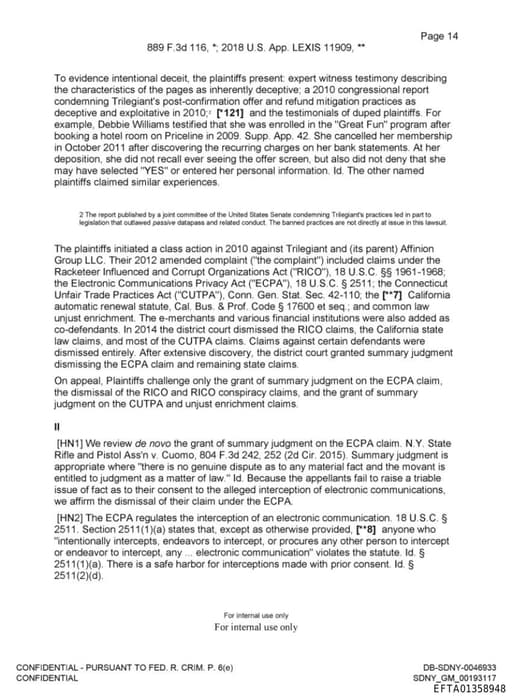
tiffs present: expert witness testimony describing the characteristics of the pages as inherently deceptive; a 2010 congressional report condemning Trilegiant's post-confirmation offer and refund mitigation practices as deceptive and exploitative in 2010;2 [*121] and the testimonials of duped plaintiffs. F
EFTA01358952.pdf
1 mentionEFTA01358952
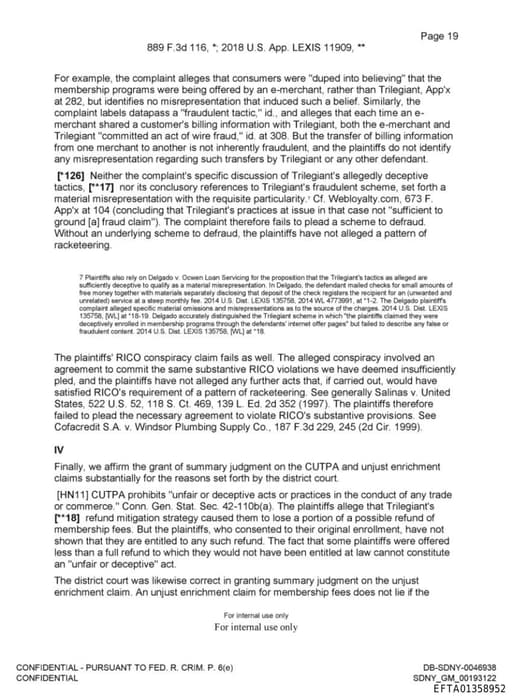
mple, the complaint alleges that consumers were "duped into believing" that the membership programs were being offered by an e-merchant, rather than Trilegiant, App'x at 282, but identifies no misrepresentation that induced such a belief. Similarly, the complaint labels datapass a "fraudulent tactic," id.,
Sponsored
EFTA01358953.pdf
1 mentionEFTA01358953
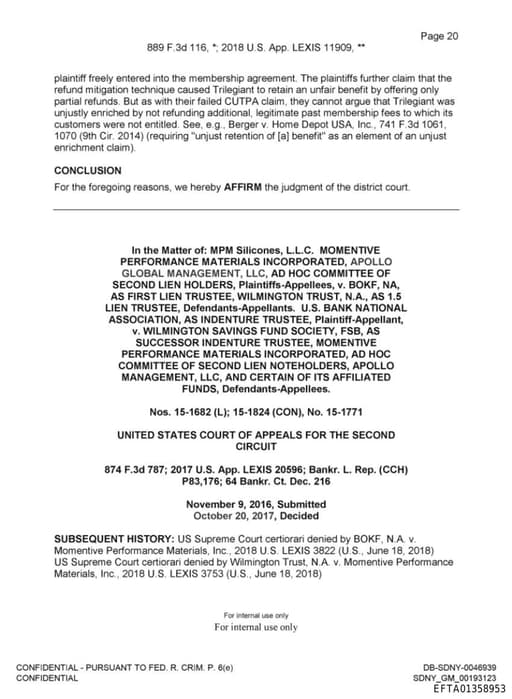
p. LEXIS 11909, ** plaintiff freely entered into the membership agreement. The plaintiffs further claim that the refund mitigation technique caused Trilegiant to retain an unfair benefit by offering only partial refunds. But as with their failed CUTPA claim, they cannot argue that Trilegiant was unjustly
Sponsored