Back to People & Entities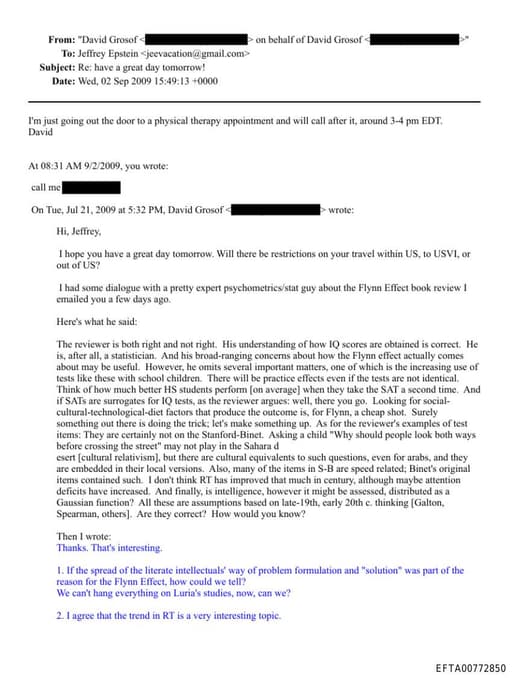
Galton
Organization
3
Total Mentions
2
Documents
0
Connected Entities
Organization referenced in documents
Document Mentions (2)
EFTA00772850.pdf
2 mentionsEFTA00772850
ntelligence, however it might be assessed, distributed as a Gaussian function? All these are assumptions based on late-19th, early 20th c. thinking [Galton, Spearman, others]. Are they correct? How would you know? Then I wrote: Thanks. That's interesting. I. If the spread of the literate intellectual
More to the point: Binet was interested in identifying 5 y.o. children who were ready to attend school, and separating them from those who were not. Galton was the first to speak of general v. specific intelligences. Spearman later laid out the theoretical [read statistical] arguments. > 3. How can a p
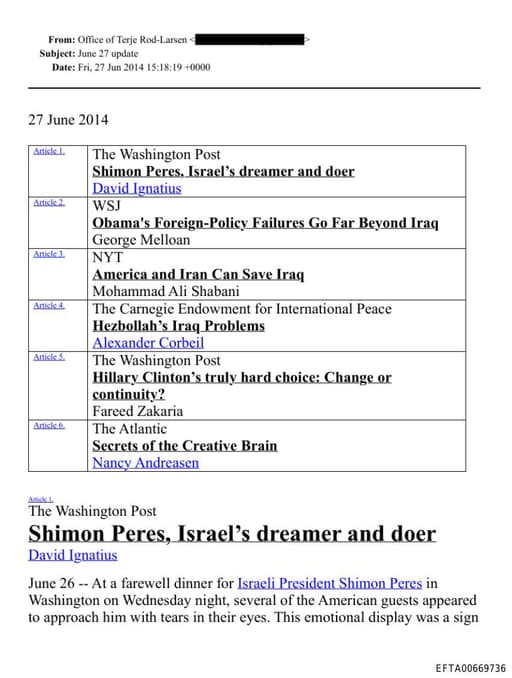
EFTA00669736.pdf
1 mentionEFTA00669736
are hereditary. Francis Galton, a cousin of Charles Darwin, took a much more rigorous approach to the topic. In his 1869 book, Hereditary Genius, Galton used careful documentation—including detailed family trees showing the more than 20 eminent musicians among the Bachs, the three eminent writers a
Sponsored
Connected Entities
No connected entities