Back to People & Entities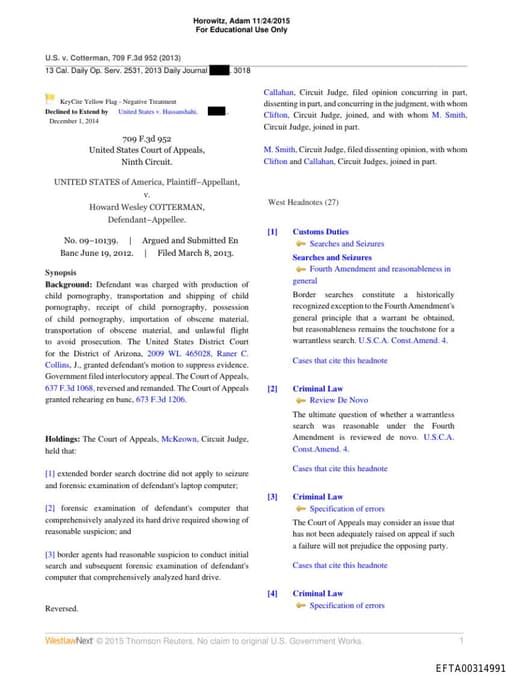
KY
Kyllo
Person
3
Total Mentions
2
Documents
1
Connected Entities
Name reference in documents
Document Mentions (2)
EFTA00314991.pdf
2 mentionsEFTA00314991
lish to contend that the degree of privacy secured to citizens by the Fourth Amendment has been entirely unaffected by the advance of technology." Kyllo, 533 U.S. at 33-34, 121 S.Ct. 2038. Technology has the dual and conflicting capability to decrease privacy and augment the expectation of privacy.
Technology has the dual and conflicting capability to decrease privacy and augment the expectation of privacy. While the thermal imaging device in Kyllo threatened to expose the hour at which "the lady of the house" took her daily "sauna and bath," id. at 38, 121 S.Ct. 2038, digital devices allow u
1 mention
's home by way of sense-enhancing technology not in general public use arises from notions of privacy rooted in Fourth Amendment jurisprudence, see Kyllo v. United States, 533 U.S. 27, 34, 121 S.Ct. 2038, 150 L.Ed.2d 94 (2001), while the right of a woman, with certain exceptions, to pursue an abortio
Page: EFTA00020560 →Sponsored
