EFTA02682655
Document Information
Bates Range
EFTA02682655
Pages
4
Original Filename
EFTA02682655.pdf
Document Content
Page 1 - EFTA02682655_001
Nowak project 1. Linear case: xis = (1 a„x„ - (qa, + dl)x, x„' = - (qa„ + daxo. y'. by- dy. Eigenvalue condition for the x equation: - _ 1g Gin?, 11,4 ( 4•4 .do) Note that X > 0 requires that pt • n q (cial:1 -41t) zI (1.2) The condition X> b-d is needed for growth faster than that of y. This condition reads n qak g q n >1 .fia2111.4.1 +(qak + (1.3) In the case when ak = a and dk = d is constant, then the condition in (1.1) asserts that 1 = a Ems, II with ri = qa(X + qa + d)'i. This is to say that ATI =MI -11) and so ri = q. Thus, X + qa+ d = 2qa and so X = (1-q)a d. Growth faster than the y-model requires (I -q)a > b which is maybe expected. Martins 'system with food' on page 2 at equilibrium z* = d/b gives the linear instability condition that is identical to (1.2) with the replacement q —> z*q. This understood, I will address the remaining questions on the bottom of page 2 with z* = I . a) Neutrality Martin suggests considering the case dk = d in which case the condition X = b- d reads I - q v rin qak — hdezi A M., NaL + b) ' (1.4) Martin claims that this condition is obeyed if a, = k b. In the latter case, the condition in (1.4) reads EFTA_R1_0 1997757 EFTA02682655
Page 2 - EFTA02682655_002
v ri• Li•zi 1 1 L-I (9k + - • (1.5) To verify that this is indeed the case, introduce for the moment 11 to denote 1/q. What is written in (1.5) is equivalent to the assertion that Eanne k kti (k+i) q - I • (1.6) A given term in this sum is equal to f in J (1+00+91dt . 0 (1.7) as can be seen using n successive integration by parts. This being the case, interchange the sum and the integral. The result on the left side of (1.6) is then 1 e— J00.I.cp+n nal I+lr dt (1.8) The sum in the integrand is geometric, and what is written above is equal ri t dt = f dt 0 (1+01+11 (1.9) The right hand integral is indeed equal to II tt . b) ak =bfork<mandat =afork>m Martin asks for the case ak = b for k < m and at = a for k m with a > b. I assume again that all dt = d. In this case, the left hand side of (1.4) reads 9 v Leisn ( N+ 41I))11 ( 41:1:137LOV II+0, (1.10) Evaluating these sums gives the instability condition r -i I (Sri > (qa+b) b (q+ I) I -q ' c) ak is a rational function of k EFTA_R1_0 1997758 EFTA02682656
Page 3 - EFTA02682655_003
The next case Martin asks about is that where ak = (cok - c,)/(k + c2) where the constants are chose so that b = (c0 - 0(1 + c2). The neutrality condtion in (1.4) reads v n • q(cok - ) q ilk -I (qc0+b)k + (bc2 qci ) = 1 ' (1.12) This can be rewritten as grk.lm = 1 Laiy (1.13) where y= —qc° , a = , and (3 = . The n'th term in the sum in (1.13) can be goo.o qco an + b written as lap e-ct 0+00+,4 dt where p - dt (I tyP (1.14) This understood, interchange the integral with the sum to rewrite the sum in (1.13) as yt t-a TV 1 0+t-t;.,,8 L oao(M)" dt = y p'' (1+0130+o-110dt . (1.15) The stability condition in (1.12) can be restated as qco f t-a dt cico+b 0+00(1+010dt > 1-q 0 0+014 (1.16) According to Gradshteyn and Ryzhik, (Tables of integrals, series and products; Enlarged edition, I. S. Gradshteyn and I. M. Rhyzik; Academic Press 1980), these definite integrals can be expressed in terms of two special functions, these denoted by B (this being the 'beta function' or 'Euler's integral of the first kind') and F (this being `Gauss' hypergeometric function'). In particular, Equation 9 in Section 3.197 writes de • dt = (1- yr IB(a+p, I-a) F((i,a+I3 ; I +13;y). 0+430+0- • dt = B(a+ 13, I-a) F(I3,a+ ; I +13;0) . 0+04 (1.17) EFTA_R1_0 1997759 EFTA02682657
Sponsored
Page 4 - EFTA02682655_004
For what it is worth, the special functions B and F are defined respectively in Sections 8.38 and 9.10-13 of Gradshteyn and Ryzhik. d) Interpreting the instability condition Martin asks for the meaning of the condition that I - q v rr . qak Lem!. 1U.! Nat +b) > I. (1.18) gat Setting a t — Kok 4. b ) this is equivalent to the condition that a, + a,a2 + ala2a3 + > . (1.19) What follows is a thought about an interpretation: Looking at the equation for xbi, I can think of at., as the probability of creating some ; given This understood, a, is the probability of having x2 given xi, then ala2 is the probability of x2 given x, and ala2a2 is the probability of ; given x„ etc. The sum on the right can be thought of as a sum of conditional probabilities. I shall think more about this as a path to an interpretation of (1.19). e) Other forms of density regulation I haven't had time to consider these yet. EFTA_R1_01997760 EFTA02682658
Entities Mentioned
EU
Euler
PERSON
Surname reference in documents
IR
I. M. Rhyzik
PERSON
Name reference in documents
IG
I. S. Gradshteyn
PERSON
Name reference in documents
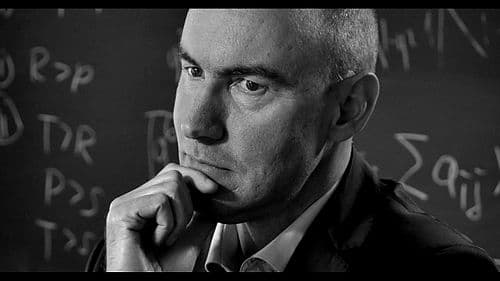
Martin Nowak
PERSON
Austrian scientist
MA
Martins
PERSON
Ambiguous surname reference in Epstein documents
Academic Press 1980
ORGANIZATION
Organization referenced in documents
Gradshteyn and Ryzhik
ORGANIZATION
Organization referenced in documents
Leisn
ORGANIZATION
Organization referenced in documents
Statistics
Pages:4
Entities:8
Sponsored