Back to Network


















7
Shared Docs
7
Same-Page
7 / 7
Mentions
Document Mentions (7 shared documents)
2 mentions1 same-page
Page ?Same page
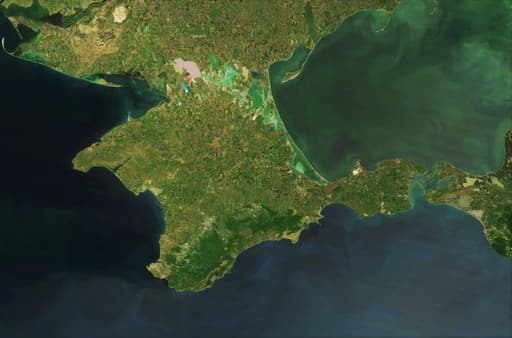
a pro-Russian government was toppled and Ukraine was slipping from his grasp. After the Olympics ended, he acted swiftly, sending his forces into Crimea. It was a blunder. In taking over Crimea, Putin has lost Ukraine. Since 1991, Russia has influenced Ukraine through pro-Russian politicians who we
iders in Cuba and as the bellicose advocate of American expansionism in the Pacific. "I should welcome any war, for I think the country needs one," Roosevelt wrote a friend in 1897. But Roosevelt's most important contribution to American foreign policy came later—when he became president in 1901 and when
2 mentions1 same-page
Page ?Same page
illion to $3-billion arms package Egypt is seeking from the Russians. At a time when Putin needs to pay a price for flouting international norms in Crimea, this is hardly the time to be offering funds for Russian arms. Even from their own perspective, how can the Saudis possibly hope to persuade Vladi
settled the question of whether one man can alter history. Of course he can. Hitler did. Stalin did. Churchill put steel in Britain's backbone, and Roosevelt saved the snarling American free-enterprise system by house-breaking it. Gavrilo Princip had his moment too. On a day EFTA00662937 almost 100 yea
2 mentions1 same-page
Page ?Same page
ext of helping a "fraternal" ally in Kabul; to Parkhomenko, Putin's decision to couch his military action as the "protection" of Russians living in Crimea is an equally transparent pretext. The same goes for the decorous way in which Putin, on Saturday, "requested" the Russian legislature's authorizat
mbined with President Franklin Roosevelt's vision of the geopolitical future of the United States was a now famous, then little noticed, meeting of Roosevelt and the ruler of Saudi Arabia, Ibn Saud, on Feb. 14, 1945 aboard a U.S. destroyer in the Red Sea. Despite Roosevelt's grave illness (he was to die
Sponsored
2 mentions1 same-page
Page ?Same page
s true legacy. On Friday, Ukraine's ambassador to the United Nations, Yuriy Sergeyev, said that Russian troops had taken control of two airports in Crimea and that the Russian Navy was blocking the Ukrainian Coast Guard. Moscow denied that it had sent troops in. But the fact is, Russia was outrageous
erica first." In the mid-to-late 1930s, Franklin Roosevelt took a different approach, pushing back, at firs
2 mentions1 same-page
Page ?Same page
government is seen as without legitimacy by Moscow the door is open for playing the card of Russian majorities in the east of the country and/or in Crimea. It could be done in several ways. Rumours about suppression of Russians could be spread—there have already been such rumours on the internet, but
there were only 11 democracies left, and Franklin Roosevelt worried that it might not be possible to shield
2 mentions1 same-page
Page ?Same page
er of the century. —VLADIMIR PUTIN I THE FIRST INVASION of a European country since the end of the Cold War, Russian military forces moved into the Crimea and other parts of eastern Ukraine in February and March 2014. Unlike with previous Russian troop movements, such as those into Poland, Hungary, Czec
e of the NSA | 199 Europe, President Franklin D. Roosevelt reactivated the operation as the Signal Security
Sponsored
2 mentions1 same-page
Page ?Same page
r Snowden reached Moscow. For example, there were indications that the NSA had lost part of its capabilities to follow Russian troop movements in the Crimea and Eastern Ukraine. U.S. intelligence officials even went so far as to suggest, according to a report in the Wall Street Journal that “ Russian plan
looming in Asia and Europe, President Franklin D. Roosevelt reactivated the operation as the Signals Security
Sponsored
Mutual Connections (1,021)
Entities connected to both Crimea and Eleanor Roosevelt
Jeffrey Epstein
PERSON36 w/ Crimea·108 w/ Eleanor
George W. Bush
PERSON38 w/ Crimea·98 w/ Eleanor
Barack Obama
PERSON41 w/ Crimea·93 w/ Eleanor
Bill Clinton
PERSON25 w/ Crimea·77 w/ Eleanor
LB
Leon Black
PERSON38 w/ Crimea·52 w/ Eleanor
United States
LOCATION30 w/ Crimea·59 w/ Eleanor
Vladimir Putin
PERSON46 w/ Crimea·42 w/ Eleanor
Marc Rich
PERSON28 w/ Crimea·54 w/ Eleanor
Prince Andrew
PERSON20 w/ Crimea·58 w/ Eleanor
Donald Trump
PERSON25 w/ Crimea·51 w/ Eleanor
Virginia Giuffre
PERSON14 w/ Crimea·58 w/ Eleanor
John F. Kennedy
PERSON13 w/ Crimea·56 w/ Eleanor
Prince Charles
PERSON19 w/ Crimea·49 w/ Eleanor
Ronald Reagan
PERSON18 w/ Crimea·47 w/ Eleanor
Julie K. Brown
PERSON17 w/ Crimea·48 w/ Eleanor
Department of Justice
ORGANIZATION22 w/ Crimea·43 w/ Eleanor
Joe Biden
PERSON17 w/ Crimea·44 w/ Eleanor
Hillary Clinton
PERSON17 w/ Crimea·42 w/ Eleanor
Eric Trump
PERSON17 w/ Crimea·39 w/ Eleanor
Cynthia Nixon
PERSON7 w/ Crimea·48 w/ Eleanor