Back to Network





7
Shared Docs
7
Same-Page
7 / 7
Mentions
Document Mentions (7 shared documents)
2 mentions1 same-page
Page ?Same page
10.07.2017 Harness the Digital Revolution with Andrew McAfee and Erik Brynjolfsson In this major talk,
search firm. EFTA00696551 Gr how to: SCIENCE WEEK EFTA00696552 30.05.2017 Artificial Intelligence and the Game of the Century — Kasparov vs. Deep Blue with Garry Kasparov, Michael Hawley Former World Chess Champion Gary Kasparov talks about where Machine Intelligence ends and Human Creativity be
2 mentions1 same-page
Page ?Same page
uch as a proof of Fermat’s Last Theorem. In 1996, Andrew Wiles succeeded in finding a solution to this pro
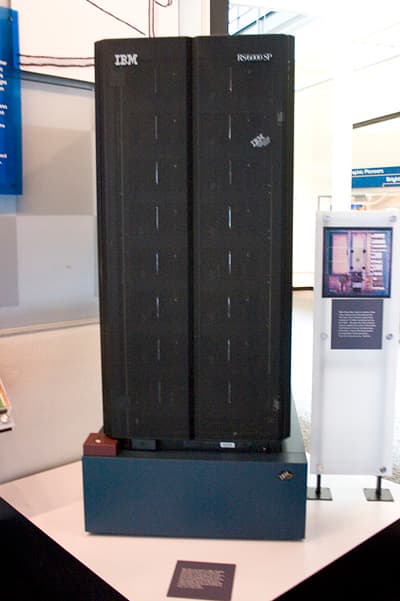
day, holds the record for the highest chess ranking ever achieved. Some consider him one of the most intelligent people on the planet. His opponent, Deep Blue, is a massively parallel chess-playing computer built by IBM’s Watson Research Laboratory. The machine itself sits a few blocks north of the tourname
2 mentions1 same-page
Page ?Same page
ophy,” cybersecurity researchers Stephen Cobb and Andrew Lee have written, “so we are unaware of the corre
creators were limiting what it had been asked to do. At which point the AI would turn to thinking about how to escape those bounds. It would be like Deep Blue programmed to plan its own prison break. And as much as humans might try to stifle a smart machine, we’d be fighting to contain something more powerf
Sponsored
2 mentions1 same-page
Page ?Same page
than expected. One variation on this argument is Andrew Ng’s statement that it’s “like worrying about ove
e and evaluate a vast selection of possible future moves. But the majority of predictions of AI, e.g., robotic maids, turned out to be illusory. When Deep Blue beat Garry Kasparov at chess in 1997, the most 20 HOUSE_OVERSIGHT_016823 powerful room-cleaning robot was a Roomba, which moved around vacuuming a
2 mentions1 same-page
Page ?Same page
e joined by Venki Ramakrishnan, Jaan Tallinn, and Andrew Blake, research director of The Alan Turing Insti
Machines were simply faster at doing brute-force calculations, had prodigious amounts of memory, and were not prone to errors. One article described Deep Blue’s victory not as that of a computer, which was just a dumb machine, but as the victory of hundreds of programmers over Kasparov, a single individual.
2 mentions1 same-page
Page ?Same page
than expected. One variation on this argument is Andrew Ng’s statement that it’s “like worrying about ove
e and evaluate a vast selection of possible future moves. But the majority of predictions of AI, e.g., robotic maids, turned out to be illusory. When Deep Blue beat Garry Kasparov at chess in 1997, the most 20 HOUSE_OVERSIGHT_016240 powerful room-cleaning robot was a Roomba, which moved around vacuuming a
Sponsored
2 mentions1 same-page
Page ?Same page
e joined by Venki Ramakrishnan, Jaan Tallinn, and Andrew Blake, research director of The Alan Turing Insti
Machines were simply faster at doing brute-force calculations, had prodigious amounts of memory, and were not prone to errors. One article described Deep Blue’s victory not as that of a computer, which was just a dumb machine, but as the victory of hundreds of programmers over Kasparov, a single individual.
Sponsored
Mutual Connections (711)
Entities connected to both Prince Andrew and Deep Blue
Jeffrey Epstein
PERSON9,960 w/ Prince·8 w/ Deep
Ghislaine Maxwell
PERSON2,544 w/ Prince·4 w/ Deep
Marc Rich
PERSON1,327 w/ Prince·10 w/ Deep
LB
Leon Black
PERSON1,263 w/ Prince·6 w/ Deep
Donald Trump
PERSON1,068 w/ Prince·2 w/ Deep
Alan Dershowitz
PERSON982 w/ Prince·7 w/ Deep
George W. Bush
PERSON817 w/ Prince·5 w/ Deep
Woody Allen
PERSON736 w/ Prince·3 w/ Deep
Martha Stewart
PERSON719 w/ Prince·5 w/ Deep
Virginia Giuffre
PERSON687 w/ Prince·2 w/ Deep
Prince Charles
PERSON679 w/ Prince·3 w/ Deep
Joe Biden
PERSON655 w/ Prince·4 w/ Deep
John F. Kennedy
PERSON641 w/ Prince·2 w/ Deep
Stephen Hawking
PERSON627 w/ Prince·9 w/ Deep
Julie K. Brown
PERSON573 w/ Prince·5 w/ Deep
MF
Maria Farmer
PERSON488 w/ Prince·2 w/ Deep
Eric Trump
PERSON456 w/ Prince·5 w/ Deep
Harvey Weinstein
PERSON439 w/ Prince·6 w/ Deep
Barry Diller
PERSON443 w/ Prince·2 w/ Deep
ET
Emmy Taylor
PERSON380 w/ Prince·2 w/ Deep