Back to Network



6
Shared Docs
6
Same-Page
10 / 6
Mentions
Document Mentions (6 shared documents)
3 mentions1 same-page
Page ?Same page
ley. withdrew from the competition because of pancreatic cancer.) Chinook had no machine learned aspects. EFTA_R1_02074941 EFTA02702510 In 1997, Garry Kasparov lost to Deep Blue at chess—Kasp- arov was the reigning world chess champion. In one pivotal game Kasparov remarked on the "superior intelligence" of
R1_02074941 EFTA02702510 In 1997, Garry Kasparov lost to Deep Blue at chess—Kasp- arov was the reigning world chess champion. In one pivotal game Kasparov remarked on the "superior intelligence" of the machine during the first game (won by Kasparov) by avoiding a dangerous position that had short-term
ween humans and the machinery in response speed when the signal was given that "buzzing in" was permitted. Watson was able to use the many previous Jeopardy! games it was tested with to be able to better predict where Daily Doubles were, and it was able to do better betting based on game theory. The so
3 mentions1 same-page
Page ?Same page
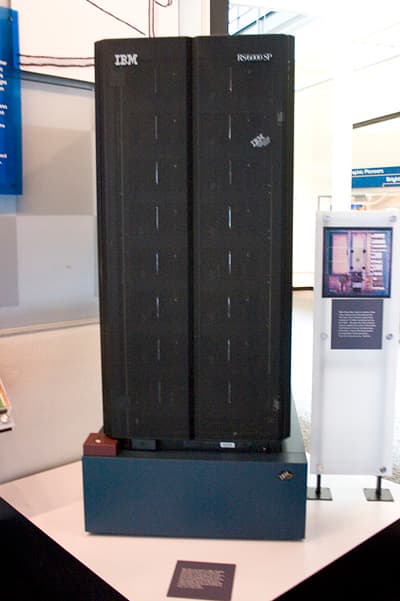
calm and, before each turn, looks to a screen at the side of the board, reads the instruction, and makes his move. This is the famous match between Garry Kasparov and IBM’s Deep Blue. Kasparov, a child prodigy, became world chess champion at the age of fifteen and, to this day, holds the record for the highest
o a screen at the side of the board, reads the instruction, and makes his move. This is the famous match between Garry Kasparov and IBM’s Deep Blue. Kasparov, a child prodigy, became world chess champion at the age of fifteen and, to this day, holds the record for the highest chess ranking ever achieved. S
ence to trawl through this vast reservoir of knowledge and answer questions using a statistical approach. In 2011, Watson featured as a contestant on Jeopardy, the American quiz show, where it beat the two record-holding contestants — the one with the highest number of wins and the one with most consecutive
3 mentions1 same-page
Page ?Same page
ne article described Deep Blue’s victory not as that of a computer, which was just a dumb machine, but as the victory of hundreds of programmers over Kasparov, a single individual. That way of programming is changing dramatically. After a long hiatus, the power of machine learning has taken off. Much of th
, we programmed computers using algorithms we understood at least in principle. So when machines did amazing things like beating world chess champion Garry Kasparov, we could say that the victorious programs were designed with algorithms based on our own understanding—using, in this instance, the experience and a
its of beam-fabrication methods at around 10-nanometer feature size. Power (energy consumption) issues are also apparent: The great Watson, winner of Jeopardy!, used 85,000 watts real time, while the human brains were using 20 watts each. To be fair, the human body needs 100 watts to operate and twenty year
Sponsored
3 mentions1 same-page
Page ?Same page
ne article described Deep Blue’s victory not as that of a computer, which was just a dumb machine, but as the victory of hundreds of programmers over Kasparov, a single individual. That way of programming is changing dramatically. After a long hiatus, the power of machine learning has taken off. Much of th
, we programmed computers using algorithms we understood at least in principle. So when machines did amazing things like beating world chess champion Garry Kasparov, we could say that the victorious programs were designed with algorithms based on our own understanding—using, in this instance, the experience and a
its of beam-fabrication methods at around 10-nanometer feature size. Power (energy consumption) issues are also apparent: The great Watson, winner of Jeopardy!, used 85,000 watts real time, while the human brains were using 20 watts each. To be fair, the human body needs 100 watts to operate and twenty year
2 mentions1 same-page
Page ?Same page
a vast selection of possible future moves. But the majority of predictions of AI, e.g., robotic maids, turned out to be illusory. When Deep Blue beat Garry Kasparov at chess in 1997, the most 20 HOUSE_OVERSIGHT_016823 powerful room-cleaning robot was a Roomba, which moved around vacuuming at random and squeake
ages, it uses thousands of times more energy than a human brain (a technological limitation that, as he also notes, may be temporary). Its victory in Jeopardy! was a genuine triumph, made possible by the formulaic restrictions of the Jeopardy! rules, but in order for it to compete, even these rules had to b
2 mentions1 same-page
Page ?Same page
a vast selection of possible future moves. But the majority of predictions of AI, e.g., robotic maids, turned out to be illusory. When Deep Blue beat Garry Kasparov at chess in 1997, the most 20 HOUSE_OVERSIGHT_016240 powerful room-cleaning robot was a Roomba, which moved around vacuuming at random and squeake
ages, it uses thousands of times more energy than a human brain (a technological limitation that, as he also notes, may be temporary). Its victory in Jeopardy! was a genuine triumph, made possible by the formulaic restrictions of the Jeopardy! rules, but in order for it to compete, even these rules had to b
Sponsored
Mutual Connections (718)
Entities connected to both Garry Kasparov and Jeopardy
Jeffrey Epstein
PERSON12 w/ Garry·35 w/ Jeopardy
Stephen Hawking
PERSON17 w/ Garry·9 w/ Jeopardy
Ghislaine Maxwell
PERSON16 w/ Garry·9 w/ Jeopardy
Silicon Valley
LOCATION3 w/ Garry·21 w/ Jeopardy
Marc Rich
PERSON12 w/ Garry·12 w/ Jeopardy
Prince Andrew
PERSON15 w/ Garry·8 w/ Jeopardy
George W. Bush
PERSON12 w/ Garry·10 w/ Jeopardy
Tokyo
LOCATION2 w/ Garry·19 w/ Jeopardy
Deep Blue
PERSON10 w/ Garry·10 w/ Jeopardy
Barack Obama
PERSON11 w/ Garry·9 w/ Jeopardy
DB
Doug Band
PERSON12 w/ Garry·7 w/ Jeopardy
LB
Leon Black
PERSON12 w/ Garry·6 w/ Jeopardy
Eric Trump
PERSON11 w/ Garry·7 w/ Jeopardy
Samantha Power
PERSON11 w/ Garry·7 w/ Jeopardy
Julie K. Brown
PERSON9 w/ Garry·7 w/ Jeopardy
Bill Clinton
PERSON12 w/ Garry·4 w/ Jeopardy
Joe Biden
PERSON8 w/ Garry·8 w/ Jeopardy
Alan Dershowitz
PERSON9 w/ Garry·6 w/ Jeopardy
Danny Hillis
PERSON10 w/ Garry·4 w/ Jeopardy
John F. Kennedy
PERSON9 w/ Garry·5 w/ Jeopardy